How to do more writing, by someone who has never made any such resolution

Jonathan Lange asked on Google+ for ideas about keeping a “write more” resolution. I took over his comment section, and in the spirit of taking some of my own advice, here’s a synthesis of what I said there. Since not writing as much as I feel I ought is never a problem I’ve had, this advice is in the delightful genre of someone who has never needed the advice simply making some up and giving it to you anyway! Enjoy my half-baked ideas.

Re-use your writing. A lot of people I know spend an enormous amount of time on crafting lengthy, tightly argued emails. These count, and you can make them feel like they count by editing them for a sufficiently general audience and publishing them on your blog. This is one I actually do do: several of my Geek Feminism pieces originated in annoyed private emails I sent to close friends, or in IRC rants.

Accountability and incentives. This is like all of the “how to exercise more” advice: make it public, make it social. Make a public commitment, make a shared commitment with a fellow writer. Have a competition, one-sided or not (“I will write more blog entries than N will this year”?). Deadlines and someone who will be personally disappointed in you can be an excellent motivator (as long as it doesn’t tip you over into an avoidance cycle), and for writing there’s a whole profession which involves, in part, holding people to deadlines and being disappointed if they fail to meet them: so, find an editor.

Unfortunately, in order to get an editor one generally needs to pitch (leaving aside the whole question of finding an agent, especially when it comes to fiction), which means writing, so you will have to be motivated to do some writing before you can partially outsource your motivation to editors and deadlines.

Becoming a freelancer seems like a big effort in order to fulfil a personal goal to “write more”, but part of the attraction is that you can pitch to places that have a ready-made audience, which means that you have outsourced any implicit “write more in places people will read it and find it useful” goal; you don’t need to put an equal or greater amount of work into building an audience for your writing.

Specific goals. This assists with accountability. What does writing more mean? A certain wordcount? A certain number of blog entries? A certain number of pitches sent out? A certain number of pitches converted to published articles? All of these are more artificial but easier to keep accounts of than “write more”.

Spend money. Enrol in a course or similar. This adds deadlines too, typically.

Creative Commons License
How to do more writing, by someone who has never made any such resolution by Mary Gardiner is licensed under a Creative Commons Attribution-ShareAlike 4.0 International License.

Weekend womanscraft: winter warmers

This article originally appeared on Hoyden About Town.

Anyone who has spent Thursday night/Friday in NSW is probably in need of some winter warmers, at least! What’s warming your innards this season? Here are a few recipes of ours, household style (that is, very imprecise measurements).

Cream of mushroom soup

Closeup photo of about ten button mushrooms

Ingredients:
A few handfuls of button mushrooms.
Half an onion.
About 800mL of stock, possibly somewhat more if using a stove top.
About 100mL of cream or sour cream, or some mixture thereof.

NB: I prefer and recommend sour cream but my co-cook despises it, so we tend to make it with cream.

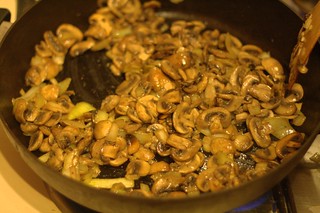
Preparation: Chop up the mushrooms and onions. Fry the mushrooms and onions together. Add the stock and simmer for 5 to 10 minutes. Add the cream and simmer briefly. Pour into a blender and blend until smooth.

Photo of mushrooms and onions in a frying pan

Alternative preparation: Chop up the mushrooms and onions. Place in slow cooker with cream and stock on low for 4 hours. Pour into a blender and blend until smooth.

Optional additions: we don’t cook anything much in our house in winter without thyme and bay leaves. Be sure to remove the bay leaf before blending.

Serving suggestion: grind pepper over the result.

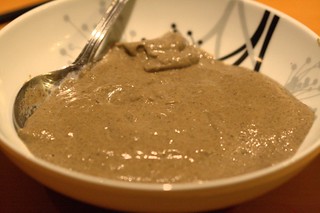
Closeup photo of a bowl of cream of mushroom soup

Slow cooked chicken drumsticks

Ingredients:
An appropriate number of chicken drumsticks.
A 400g tin of diced tomatoes for about every 8 drumsticks.
About 100mL of stock for every drumstick.
A splash of white wine.
As many olives as you think sounds good.
Optional: onion garlic, thyme, bay leaf, etc.

Preparation: roll/dip/immerse the drumsticks in plain flour and briefly brown them in a fry pan (perhaps with onions and garlic). Place them in a slow cooker with all other ingredients and slow cook on high for 4 hours.

Serving suggestion: we serve with couscous.

Red lentil daal

For this we follow a recipe pretty closely, namely Stephanie Alexander’s recipe in The Cook’s Companion. It’s very similar to her published recipe in Fairfax’s Cuisine, except we haven’t been using chilli or mustand seeds.

I’ve also tried this in a slow cooker (don’t pre-soak the lentils, have all the pot ingredients in for 8 hours on low) but it ended up being too smooth for my tastes (I have a very strong aversion to some types of very smooth food, namely well-mashed potatoes, ripe avocados, and a few other things, and this daal went into that range).

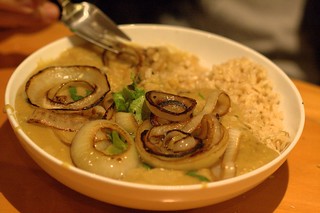
Closeup photo of a bowl full of daal, with fried onions on top and brown rice behind.

Apple crumble

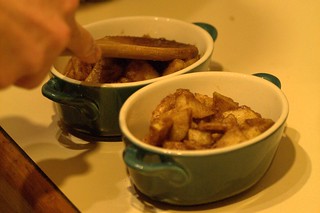
Closeup photograph of cutup apple being placed in cooking vessels.

Another dish where we follow a (simple!) recipe closely, specifically Donna Hay’s recipe for individual portions. We had great luck also, when we had some passionfruit to spare, juicing several of them and mixing the juice with the apple slices for passionfruit crumble.

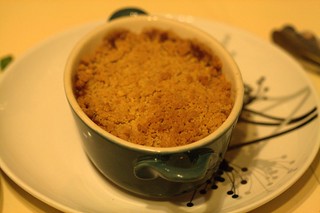
Closeup photo of an individual portion of apple crumble, just after cooking.

A few other warmers you might fancy:

  • Skud’s apple and oat crumble for breakfasts.
  • Tom yum goong can go either way, seasonally, but at this time of year if you make it spicy enough it will warm most of the lower half of your face.
  • Lemon delicious pudding, another great dessert to make in one container or individual portions.

What’s warming you, this winter?

Getting a passport in Australia

See Lindsey Kuper on a expedited US passport, here we have another “life in Australia” comparison piece.

Step 1: obtain passport form. If you are an adult renewing an existing adult passport that has been expired for less than 24 months, you can do this online. Otherwise, obtain form from nearest post office.

Step 2: track down someone — usually just another passport holder — to be your photo referee (ie, to agree that it is you in the picture). Gather relevant documentation, that is, proof of identity and of citizenship. If you were born in Australia on or after 20 August 1986, see below.

Step 3: ring up local post office for passport interview, usually granted within the week. If you need it sooner, call several post offices in turn or go to the Passport Office (in a capital city).

Step 4: attend post office. Have them take your photo, these days, because if they don’t approve it, they can take it again. Have interview, which in fact largely consists of having your documentation and photo checked for validity.

Step 5: pay fee ($233), extra $103 for priority.

Priority passports are printed to be mailed within 2 business days, other applications within 10. They arrive registered post (ie, signature required). If you require one within 2 days, it seems you need to attend a Passport Office in person and hope they can help.

Given that I understand it takes weeks and weeks to get a USA passport if not expedited, 10 days is not too bad.

Born in Australia on or after 20 August 1986? Tricky! This is when Australia stopped granting citizenship by right of birth alone. So you need proof of citizenship, which can include:

  • evidence that you were born in Australia and that one of your parents was either a citizen or permanent resident at the time of your birth
  • evidence that you were born in Australia and that you were still a resident of Australia on your 10th birthday (school records and so on)
  • evidence that you were born in Australia and were not eligible for any other citizenship
  • see also

This diversion has been known to be lengthy. 🙁 It’s also just about impossible to get one as a minor if your guardians don’t agree to you travelling.

Have a small child with you?

Good luck with that, because the photo standards require straight on face shot with open eyes and neutral facial expression. Try getting your pre- or semi-verbal child to do that.

Product review: GoGet carsharing

We’ve been non-car owners again for a few weeks and members of GoGet car sharing for a month or so. These are my initial impressions.

This is against a background of our car being primarily used for occasional errands, and weekend excursions either locally (to the beach etc) or to regional cities. We also used to use our car for our son’s daily childcare run, but since we moved, his new childcare is in walking distance. I wouldn’t recommend GoGet to anyone who has a daily errand, this review is largely comparing it to having an occasional-use personal car.

Good things compared to car ownership:

  1. most areas where there is a car at all, there’s more than one. An out-of-action car does not mean “no car use at all until car repaired”
  2. they take care of on-road costs and insurance. Of course, this is bundled into subscriber fees, but it both flattens them over the year and works out cheaper for our usage. I think in theory they aim for a car for every 10 subscribers or so? We’re on the Frequent member plan, so I guess you could say our on-road costs are $360 a year.
  3. they take care of repairs. Again, bundled in, but flattened and so on.
  4. they take care of having a free parking spot by paying the council for guaranteed spots.
  5. (maybe arguably good) they turn the fleet over far more often than most people I know replace their cars.

Good things compared to car rental:

  1. the cars are just sitting there, in our case quite close by. You just get online, book, and walk up and take one. You only sign away your life in triplicate once. You don’t have to budget in a trip to the car rental place, a wait in a queue, a briefing on the terms and conditions and an inspection of the car.
  2. the insurance is reasonable rather than the typical car rental deal with a $3500+ excess unless you pay them 1/2 the rental cost again. With GoGet, if you can wear a $1500 excess it’s built in to the base pricing, or you can pay about $18 per day to bring it down to $300.
  3. you have to return the car with at least 1/4 of a tank of fuel, which is a lot easier to achieve than the full tank rental companies require.
  4. both the possibility of hourly bookings and the hour saving in pickup time make them way more useful for errands and so on.
  5. close to instantaneous bookings, subject to availability, whereas rental companies often struggle with sub-24-hours-notice requests

Bad things:

  1. Bookings start and finish on the hour. In pathological cases (say you need a car from 1245 to 1315) you pay for two or three hours of use in order to use the car for an hour or so.
  2. They’re for-profit, presumably this could be done cheaper not-for-profit. This is a bad thing-asterisk though: as I know very well, NFPs don’t magically appear out of thin air. Someone would still have to set up an entire car sharing company except with only a salary to motivate them.
  3. GoGet’s big thing is “we pay for fuel”. And they do pay in the sense of providing fuel cards, but they also have a 39c per kilometre usage charge for bookings that aren’t a day long booking. 40c per kilometre adds up fast!
    In theory the day booking rate (24 hours and 150km free for $68) kicks in as soon as your per-hour spend exceeds the day rate, for most cross-metro trips you’re probably going to nearly hit that.
  4. (potentially) GoGet does not accept any member who has a major traffic offence in the last 10 years of driving, and all applications for membership are at the discretion of their insurer. This contributes to the cheaper insurance compared to car rental, but it obviously disadvantages people who do have a traffic record or a history of at-fault accidents.
  5. not an enormous amount of choice wrt make and model, less than many larger rental centres. Really your choice boils down to little-medium-big in whichever make and model are nearby. (For us little == Toyota Yaris, medium == Hyundai i30s and i30 wagons, and big == Hyundai iMax.)
  6. some contention for them. Our experience is that with weekends, we really need to plan our trip the day before to have a good chance of a single car in Glebe being free over the entire block of time we need, and it’s probably worse in suburbs with less cars (Glebe has at least 10, and Pyrmont and Ultimo another 15 or so). Long weekends are worse because people take them away, and the iMaxes get booked really early most weekends.
  7. lack of flexibility with end time. That is, if we want to go somewhere and book a car accordingly but then someone invites us to dinner or whatever, we may not be able to stay because the car needs to be back. We haven’t had to try for last-minute use extensions yet, so we don’t know how often we will find that the car has 3 hours free just after our booking.
  8. if something goes wrong with your booking, they give you a $25 credit on your account, which unless the error is very minor is really not enough. To be fair, they do shift the booking to another car if they can, but on weekends this would be hard, see 6.
  9. fitting children’s car seats is a pain in the neck.
  10. their setup has an annoying feature whereby if it is the very first time that you in particular have used a given car in the fleet, the booking needs to take place about 15 minutes before your slot, so that the car can download your access data. Less important once you’ve used the car nearest to you for the first time.

In the medium term, this is likely to be a sufficiently good replacement for our occasional-use car.

Your friendly guide to talking to me about being tall

Scene setting: I’m 193cm/6’4″ tall. The average height of an Australian woman is about 163cm, so conveniently you can think of me as being a whole ruler taller, or that the average Australian woman’s head is about my shoulder height. This is a weird enough height that I’ve had all kinds of weird conversations about it. Let me get you past the weird.

Rule 1: consider not talking to a tall person about their height. It’s hard to do well. Think of it like this:
Person 1: “your body has a very very unusual feature! very unusual! very unusual!”
Person 2: “whereas your body does not! very normal! very normal!”

It’s a pretty one way conversation, basically. It’s unlikely (statistically) that they can reciprocate in kind by asking you/informing you about your visible weirdnesses, and if they can, it’s likely you don’t want to hear about your weirdnesses. The conversation in reality goes something like this:

Person 1: you are very very tall!
Person 2: um, indeed.
Person 1: [waits patiently for tall person to work harder to pull their turn out of the magical conversation hat]

Or alternatively, the general rule is start conversations where the person you are talking to has some chance of reciprocation.

Rule 2: especially consider not talking to a tall child or teenager about their height! This is because people generally make free with subjecting children and teenagers to every thought that crosses their mind, usually prescriptively at that. I am probably down to a conversation every few months about my height now. When I was a teenager, I had a conversation with a stranger about my height about once a week. That person who by virtue of youth (*cough* and gender) is extra socially obliged to stand there and look polite while they hear your every thought about human height variations? You’re not the only person taking advantage.

Rule 3: I’ve heard the jokes. Useful rule in general for anyone who has what you consider an unusual body, name, accent, hair colour, job, dress, religious belief, ethnic identity, mobility aid, manner of speaking, hobby, and/or other thing.

I have to say, I’m yet to hear what I’d call a good tall joke, but then, I would be biased, wouldn’t I?

Rule 4: I don’t need to know about how unattractive you find it. I won’t belabour this: if you’re the kind of person who tells tall people they are ugly or freaky (in my case, this was almost exclusively done by men to my teenage self, men in late middle age still occasionally do it now), you’re the kind of person who isn’t reading.

Incidentally, the favoured insult for a tall slender woman you’ve just seen on the street and instantly been repelled by is “lanky bitch” or “fucking lanky bitch“. In case it ever comes up in a trivia quiz or something. Who the hell uses the word ‘lanky’?

Rule 5: I don’t want to hear about how jealous you are. This is more complicated and interesting. When I was in my late teens, most of those people stopping me to talk to me about it were middle-aged women* wanting to tell me I was beautiful and special and should stand up straight and be proud and they wished they were me.

It took me ages to work out what was going on, which is that each of these women thought she was the only one and was lighting a torch in the misery of my teen years. Since it happened several times a month, I had no notion that they thought that, and they must have been rather unsettled by my awkward and slightly hostile reaction to their attempt to reach through the fog of human cruelty with a kind thought. Sorry, kind women.

* Um, possibly adult women? I wasn’t good at picking adult’s ages at the time.

Rule 6: unless you are my doctor, I don’t want to discuss my genetic history with you. I’m not sure why everyone wants to know whether my parents are tall (oh what the hell: yes, they are, and if the human race consisted entirely of my father’s relatives, I would be at the tall end of normal, rather than at the “having conversations with strangers and writing blog entries” level). It seems kind of weird to be led through a laundry list of my relatives and asked if they are tall. Are people trying to find out if their own children will/won’t/might be tall?

A special note to doctors on this one: you don’t get out of gaol free! It might help to explain why you’re asking. “There are some diseases and syndromes which have extreme height as a symptom, but if your whole family is tall that’s less likely” is an example of a helpful thing to say. (At my height-for-sex, I suspect you can just about get away with saying “so, Marfan syndrome**, you either have it or have been investigated for it, yeah?”) But since quite a few doctors have done this out of either a desire for chitchat equivalent to the general public or a desire to satisfy some medical curiosity irrelevant to their treatment of me, I don’t like it much from doctors without explanation either. I am all good with doctor chitchat, but not about something where I can’t tell if you think I have a disease or you have a few minutes to shoot the breeze with me.

** Not the only medically interesting cause of tallness, I know.

Rule 7: I will be the judge of whether I can wear heels, thank you. I don’t wear high ones because OUCH and also because there’s absolutely no social advantage to me from being taller, quite the reverse. But I sometimes wear low ones because I like the shoes they are attached to, and every so often a sales assistant refuses to sell them to me. What the hell?

Rule 8: It’s not good news for me that there’s someone taller than you. Actual remark addressed to me on several occasions: “wow, oh my god, you’re taller than me! I feel so good knowing that there’s a woman taller than me out there!” Only about half the time do they go on to realise what that implies from my point of view.

I do see the temptation to start conversations with other tall people about how they are taller than me, but when I do I remember this.

Rule 9: You don’t need to worry about what your kids say. Well, unless it’s “fucking lanky bitch” I guess. But kids specialise in drive-bys: “that lady is very tall!” I don’t mind stating-the-obvious drive-bys, it’s cute.

The champion kid remark to date was while I was pregnant: “Mummy, that lady is very tall and she has a baby in her tummy!” Indeed!

Rule 10: I am all good with reaching stuff on high shelves for you. Maybe this bugs some tall people, certainly people apologise a lot for asking me to do this, but it seems fair enough, really. Why do shelves intended for the general public go so high anyway?

Rule 11: I like to show off. I can touch the ceiling (on tiptoes) in normal height modern rooms. (I use this to change lightbulbs.) I can stand flat-feet on the bottom of a 1.8m depth pool (the usual depth of recreational pools) and it comes up to about my mouth. I almost never get the chance to mention these things to people! Humour me. (OK, you don’t have to, now that you’ve read this.)

Rule 12: If you’ve known me for ages and have secretly always wanted to talk to me about being tall, I usually don’t mind much of this from people I know. I guess the ugly thing would be an exception, but really, it’s strangers bowling up to me and asking about the height of my great-great-grandfather’s sister that comprises 99% of the problem.
Goodness knows why!

Families not claiming thousands in childcare rebate:

“Child Care Minister Kate Ellis says parents often do not know they are eligible for the rebate.”

Or, perhaps they know, and thought they’d applied, and just haven’t gotten around to chasing up yet another damn thing…

Or! I have some suggestions about what might have happened!

Perhaps they went to Centrelink’s site on the childcare rebate and found instructions to apply. Oh wait, no they didn’t. They found information about eligibility and payment rates, but not instructions. It almost sounds like it might happen automatically…

But just in case they went to their online Centrelink account, and it said that their identity has not been sufficiently verified to apply for childcare rebate. And they recall what their current level of identitiy verification involved. Consider this interaction (where “Mary” is a randomly chosen name for a Centrelink childcare benefit* recipient, of course):

Customer service officer: “How many shares do you own in $company?”
Mary: “The correct answer is zero. But I am guessing you want the answer I last gave you in 2001.”
CSO: “Yes, the one in 2001.”
Mary: “Well, I don’t know, because I have not kept records of how many shares I owned in $company in 2001.”
CSO: “OK, I see the problem! That was quite a while ago. All right. If you can just tell me how much rent you pay…”
Mart: “The correct answer is zero. But I am guessing you want the answer I gave you in 2003?”
CSO: “Yes please. If you can!”

That is, I received Youth Allowance as a student from Centrelink, and their entire identification procedure assumes that either I kept details records of my exact financial state at the time, or that it hasn’t changed. (Rents haven’t gone up in eight years, surely?) So, the system is designed to not give a benefit to anyone who ever received a benefit in the past, because interacting with them is just such a pain the second time. Which is not a surprise, since they administer unemployment benefits.

Not that new customers have it easy. A story I heard was someone’s genuine physical address tripping up a rather poorly written “no post office boxes” validator, and who therefore couldn’t meet the requirement of providing a residential address.

* Childcare benefit is not the same as childcare rebate. DUH. And there’s no way that’s confusing people into believing they have received all their entitlements.

Endangered Sunday: grey nurse shark

This article originally appeared on Hoyden About Town.

I’m hoping to blog a little about SCUBA diving here occasionally. I dived on Wed December 29 for the first time in a year and a half (diving is contraindicated in pregnancy and was practically difficult with a young baby to care for and a body rearranging itself too often for a wetsuit fitting).

How did I elect to return to diving? Shark diving!

This is much less adventurous than it sounds, although definitely stressful or impossible for people with a shark phobia. (I’ve also dived with sea snakes—which are, yes, very very venomous, and quite inquisitive and tame so you get very near them, but they’re not aggressive at all—just don’t ever make me touch a slug in the garden because that is my critter limit!)

I’ve been in the water with a lot of sharks: leopard sharks, wobbegongs, Port Jackson sharks, grey and white tipped reef sharks and grey nurse sharks. This isn’t done in cages as you see with great whites, we’re in the ocean together. The trick is the size of the mouth: if a human limb doesn’t fit in there, there’s not much of a problem. Most species of shark are after much smaller prey than humans, the main exceptions are species that hunt seals. It’s also good to know that sharks generally sleep during the day (Port Jackson sharks look like very large cuddly toys, sleeping on the seafloor), and that they find the loud noise of SCUBA rather intimidating, although I have also dived at night when the reef sharks were hunting, but again, their prey is small. (Diving at night, also not as difficult as it sounds, but extremely cool.) I’ve also dived with seals, there’s a fairly simple rule for that, which is that if you notice none of the seals are in the water, you probably ought to follow their example and get out too.

What’s a scary thing I’ve encountered diving? That dreaded apex predator homo sapiens. I was not pleased to find that I’d been diving in murky water below people spearfishing one time. I hope they could see me better than I could see them.

Homo sapiens is of course the big threat to today’s Endangered Sunday species, the grey nurse shark or carcharias taurus. These are big, scary looking sharks (adults are between 2 and 3 metres in length), and if I wanted to impress you with my shark braving skills, I could show you this:

Dentition of a Grey Nurse Shark
Grey Nurse Shark, Dentition of a Grey Nurse Shark (Carcharias taurus). Magic Point, Maroubra, NSW, by Richard Ling, CC BY-NC-SA

Image description: a grey nurse shark is seen from in front and below, its head and fins lit from below, emphasising the teeth visible in its jaws.

Grey nurse sharks are quite timid, docile sharks. There’s a group living in a cave just off Magic Point at the south end of Maroubra at a depth easily accessible to recreational SCUBA divers. It is a very popular site with divers in Sydney. On the 29th there were five sharks in the cave. We didn’t join them: the cave is a protected habitat. It’s not quite up there with Michael McFadyen’s 2008 sighting of 26 sharks, but more than I’ve seen there on the six or so times I’ve dived the site.

The grey nurse shark is listed as critically endangered on the east coast of Australia, with the population estimated at somewhere around 1000 individuals. In 2009 it was reported (the original article is Ahonen et al. (2009)) that there is also low genetic variability on the east coast and that it likely does not interbreed with the west coast sharks .

Grey nurse sharks are ovoviviparous: they give birth to live young (-viviparous), which have grown inside eggs (ovo-) and hatched inside the mother. The two shark pups a female births are the result of adelphophagy: pre-birth cannibalism. Each of the surviving shark pups has consumed its siblings until it was the sole surviving pup in its uterus (of which the mother has two). This process takes up to a year and results in a reproductive rate that means the return from critically endangered levels is going be slow if it happens at all. There is some research into an artificial environment for the sharks to mature to birth size in. These environments have been successfully tested on dwarf wobbegongs.

Here are two more pictures of grey nurse sharks taken at Magic Point. Doug Anderson took these lovely shots of, I think, the sharks in the cave (the angle isn’t quite wide enough to tell on these two):

carcharias taurus, Maroubra, Sydney by Doug Anderson, CC BY-NC

Image description: a large and a small grey nurse shark, close to the bottom of the ocean, side on to the camera. A school of fish is in the foreground.

carcharias taurus, Maroubra, Sydney, by Doug Anderson, CC BY-NC

Image description: four grey nurse sharks are clearly seen side-on between one and three metres above the ocean floor. The outlines of two more sharks are in the background, in dim light, presumably in the cave.

Both Doug Anderson and Richard Ling have shots of the sharks with hooks in their mouths: not happy and A Grey Nurse Shark (Carcharias taurus) with hook and exit wound in the jaw.

So there you have it, big, scary looking but not dangerous: a perfect diver’s day out. May their numbers continue to increase and the number of hooks and wounds seen in their jaws fall.


Ahonen et al. (2009) Nuclear and mitochondrial DNA reveals isolation of imperilled grey nurse shark populations (Carcharias taurus) in Molecular Ecology Volume 18, Issue 21, pages 4409–4421, doi:10.1111/j.1365-294X.2009.04377.x)

Self-guided diving

I went scuba diving yesterday. I normally dive in and around Sydney, which is coolish temperate water (20℃ yesterday, ranges are 16–23℃ over the year) and provision of dive guides for everyone on the boat is fairly standard at least with the shops I dive with. It’s quite common to meet people with 20 to 30 dives experience who have never dived only with a buddy.

Andrew and I were thrown in the deep end with Queensland diving. We learned to dive in Thailand, which many people don’t recommend (because the diving is comparatively easy) but I do recommend (because… the diving is comparatively easy, so you don’t get scared off as much). We then did a single dive in Sydney and then Advanced Open Water and then a liveaboard off Cairns, on which every diver was expected to self-guide.

And ever since then I’ve preferred it. Reasons:

  1. Yesterday, I dived in a group. I got kicked in the face with fins twice, and kneed in the head once. I also think I kneed someone else in the head or back. Divers have a restricted field of vision and are somewhat awkward about turning. Tangles are hard to avoid.
  2. Yesterday, our group was eight people. We were queuing to see anything interesting. If that interesting thing was in motion, the last six people didn’t get to see it.
  3. Queues go double if half the divers have cameras with them. (Some photogs believe they should go last, since they will look for so long. Some believe they should get first look, so as not to have other divers in the shot.)
  4. I try not to get too uptight about purist diver sentiments, in which you must do the hardest reasonably accessible dives and diving style in order to be considered safe or respectable and so on, but I have enjoyed forcing my underwater (landmark based) navigation to improve by not following a site expert around.
  5. Some dive guides (not yesterday’s) are really bad at their job. They won’t turn back when someone’s air is low-ish, they get lost themselves. (Divemasters are often backpackers, not necessarily local experts.) Sometimes their air consumption is worse than mine. There’s nothing less fun than chasing down Speedy the Dive Guide to say you’ve reached the agreed air mark, and to use another 10% of your original air in the chase.
  6. It’s rare that they communicate the details of the dive plan. “We’ll look at the sharks,” is one thing. I dive tables, not computers, and I need to know that there will be a loop back past the boat in time for my timed dive ending (I usually run out of time before air, on air tables). And I hate the practice many dive guides have of reviewing everyone’s air about three quarters of the way into the dive and signalling to people to re-buddy with air matches. My buddy is my spare air, I want to have talked with them before the dive at the very least, and to have the same buddy throughout the dive, not to be paired with Air Matched Random Diver.

Sometimes a guide is unavoidable, for example, in the Similan Islands there are so many boats around, each launching multiple dinghies with outboard motors. And groups aren’t such a nuisance in the tropics, as the vastly improved visibility means that you aren’t all on top of each other. But generally speaking I’m happy diving in pairs.

Ask Auntie Hoyden: get your dog outlines here, and other search engine queries

This article originally appeared on Hoyden About Town.

an on-set photo of Katharine Hepburn, with overlaid text reading "Ask A Hoyden?"auntie hoyden

Why, I enjoyed those posts (1, 2, 3) in which Lauredhel tried to answer search queries as questions too! So much so that I show up in this site’s logs looking for them. So today, I too become Auntie Hoyden.

Frankly, it appears to me that most people stop here on their way to I Can Haz Cheezburger (funny cat pictures, captioned cat pictures, supernatural macros funny, funny pics), but they also appear looking for soylent green simpsons, any medicine for truth speak and, in considerable numbers, anal sex diagram. (Which is a bit odd, Google finds plenty of considerably more helpful sites for me on that term.)

But let’s see what I can do for you all today, although my specialities are more in the computer line than the sexual health and breastfeeding line that is traditional for this.

pluralising names

Lauredhel observed in 2008 that there’s a construction in Australian English (among others) that allows you to use things like “the Marys of the world” to mean “people like one particular Mary” rather than necessary literally multiple people named Mary.

But if you’re simply interested in how to add a suffix to a proper noun in order to indicate multiple things with that name, here’s a style guide’s answer.

dog outline png

[Update 2019: freesvg.org or publicdomainvectors.org are currently more searchable than openclipart.org.]

I like openclipart.org for this sort of thing: it’s public domain clipart, take it, use it and modify it without credit. (Not that I don’t also love various Creative Commons licences that do require credit, but dropping that requirement makes using many pieces a lot easier. I’ve seen people who use CC images from Flickr need to put a credits roll at the end of slide presentations.)

Plus! openclipart.org provides SVG as well as PNG. SVG (Scalable Vector Graphics) is a free image format which allows pictures to be scaled up in size without loss of quality, as well as down in size. This is accomplished by describing an image in terms of lines or curves (hence, vectors) rather than in terms of individual coloured dots. It’s not very useful for photos, but it’s great for clipart (and fonts, which are generally described in vectors and thus can be scaled up).

openclipart.org has hundreds of drawings of dogs. I’m not sure if this person was looking for a silhouette of a dog, which I couldn’t find on a very brief look, or simply a line drawing of a dog, of which there are many. Here’s a cute one.

snuggle otter

Don’t. We love ’em but that doesn’t make them domesticated pets.

mother sprays milk

Does she ever. I breastfeed a ten month old baby. When he was little I had a supply suitable for twins, or perhaps sextuplets, and milk was everywhere. Then things balanced out and we had a nice interlude of not spraying. Then he got a bit more distractible, which resulted on the weekend in him getting a letdown, pulling off and slipping so that he headbutted me in the breast and milk shot out for the best part of a metre.

If anyone else wants to grace the Internet with a milk spray story, feel free.

australia’s prime minister 2010 smiling

On the 25th June 2010, one day after becoming leader of the government and being sworn in as Prime Minister, Julia Gillard smiled in the presence of the US ambassor to Australia, Jeff Bleich. This is important, because it was photographed by embassy staff, and as a work of the US Federal Government, it is thus in the public domain and you can get it from Wikimedia Commons.

anti filter

That’s us!

Can you help out with these?
squirrel give thanks
the worst shoe eveeeer
placenta accreta deathrate
crivens!

Baby and startup? Big deal! Or, perhaps, a big deal?

This article originally appeared on Geek Feminism.

Years back I read Paul Graham’s How to Start a Startup essay, which includes this footnote:

One advantage startups have over established companies is that there are no discrimination laws about starting businesses. For example, I would be reluctant to start a startup with a woman who had small children, or was likely to have them soon. But you’re not allowed to ask prospective employees if they plan to have kids soon.

Which, well, OK, I’m not in the business of forcing Paul Graham to start businesses with people he doesn’t want to start businesses with. But it bugged me for the obvious reasons, not least because, well, you know, men have small children too sometimes. Thank goodness they don’t have to put any work into them. Phew. Lucky escape there, men. Better make sure we keep that labour division in place.

Anyway, in the last few days, Tara Brown wrote this, in response to a few posts by men about having kids and doing a startup.

I am 35 years old, I have an 8 month old child that I breastfeed full-time and I am doing a startup. Big deal. Who isn’t?

Many women start businesses after having a kid, usually because they want to stay home and have an income. This was what I wanted to do after I had Ripley. I decided I wanted to look after him exclusively for his first year and then get a job as a consultant or something where I could continue staying at home with him. My husband and I took off with Ripley to Singapore and France and during that time somehow I ended up a co-founder of Noot.

I have a 9 month old baby (breastfed a fair bit as it happens, although you should have seen him get stuck into ciabatta bread today), and… I’m not doing a startup. I wouldn’t have been a great business partner or core employee for a while after birth, because it made me sick. I wouldn’t be a great partner or employee right now either, in fact, because he brings home illnesses from daycare and so we’re sick and exhausted constantly. (Not that I’m keen to encourage Paul Graham to add to the people he won’t start businesses with, but my husband gets these too, funnily enough.) I did recover our main fileserver when he was 12 days old. Pro tip: if you have any suspicion your hard drive is failing, replace it prior to the birth of your baby. (But then, I had to do the same thing the other week. Pro tip: mobile 9 month olds get in the way of hard drive replacements more than 2 week olds. Wait, that wasn’t a tip. Sorry. Pro tip: don’t have hard drives that fail.) I work various part-time and casual things now to afford the daycare to finish my PhD.

But Tara Brown isn’t telling everyone’s story: she’s telling hers, and she acknowledges that she has some advantages:

Honestly, I never expected to write this blog post because I just figured this is what every other woman that is working and has a baby must do, not something to make a big deal out of. But when I saw that email from Jason Calacanis and Jason Roberts, I just had to speak up so that more women can tell these guys that what they are doing is not extraordinary by any means. I mean come on, Jason Calacanis is rich, his wife stays at home and they have a night nanny. Not exactly a tough situation. What’s tough is single mothers and fathers trying to raise their kids by themselves. Me and the “Jasons” have supportive spouses who are at home for big chunks of time.

So moms dads out there that are doing a startup, tell the world YOUR story. Please! I need to meet more of you for the support and inspiration.

Starting, running and managing businesses, especially small ones, has been women’s work for a long long time, and that means mothers have done it. Mothers have done it a lot. But at the same time, I’m not keen to uncritically contribute to a superwoman culture: get back behind the desk woman! Sickness, disability, parenting and family and education and money demands and life preferences, these all vary a lot more than I would be reluctant to start a startup with a woman who had small children allows for. Sometimes women need to work with small children. Sometimes they need to not. Often it’s in between.

What’s your experience, if you’ve worked as a mother young children? If you’ve been an entrepreneur or business owner, do you think that that was uniformly harder than being an employee, or in some ways easier, or generally easier?