Almost all of the children we first met at age 1, and then at ages 3 and 5, are returning from tonight in Life at 7, with only Loulou not appearing. This time, the two documentaries are Tackling Temperament (now on iView) and Finding Your Tribe (now on iView), screening a week apart.
People with Australian IP addresses can also catch up on the earlier documentaries for a limited time:
Are you watching Life at 7? Please play along in comments, I enjoyed (and was frustrated by) the previous documentaries, and I’m looking forward to seeing the new series.
Today, October 16, is Ada Lovelace Day: write or record a story about a woman in science, technology, mathematics or engineering (STEM) whose achievements you admire. This is a slightly updated version of a profile that has appeared on Geek Feminism and Hoyden About Town. Marita Cheng was named as the Young Australian of the Year winner at the beginning of the year. She’s been involved in volunteering since she was a high school student, and in 2008, early in her undergraduate studies (mechatronic engineering and computer science at the University of Melbourne) she founded Robogals, which is an engineering and computing outreach group, in which women university students run robotics workshops for high school age girls.
Marita, while still in the final year of her undergraduate degree, is also an entrepreneur and has been previously awarded for her work as founder of Robogals, including winning the Anita Borg Change Agent award in 2011. In 2012 she travelled to several countries with the aid of the Nancy Fairfax Churchill Fellowship to study “strategies used to most effectively engage female schoolgirls in science, engineering and technology.”
While I have heard of Robogals, I hadn’t heard of Marita specifically before she became Young Australian of the Year. One of the fascinating things about starting the Ada Initiative is slowly discovering all the other amazing women who work in technology career outreach and related endeavours. But it’s a little embarrassing, judging from her bio, to have not heard Marita Cheng’s name before the beginning of the year!
Today, October 16, is Ada Lovelace Day: write or record a story about a woman in science, technology, mathematics or engineering (STEM) whose achievements you admire.
Else Shepherd is an Australian electrical engineer specialising in communications equipment. She has co-founded multiple Australian engineering companies, including Mosaic Information Technology, a custom modems company, and Microwave & Materials Designs, developing microwave filters for mobile phones. She was appointed as the chairman of Powerlink, the state government-owned corporation maintaining Queensland’s high voltage electricity grid, in 1994, and has been a board member of the National Electricity Market Management Company (now known as the Australian Energy Market Operator).
Shepherd won Engineers Australia’s Peter Nicol Russell Memorial Medal in 2007, their most prestigious award, recognising an engineer with over 20 years of substantial contributions to professional engineering in Australia. As best I can tell, she is the only woman Peter Nicol Russell medallist. She is also a Member of the Order of Australia since 2003, and was the University of Queensland Alumnus of the Year in 2009. She is also a pianist and choral director.
Shepherd has talked about her experience as a woman in electrical engineering with University of Queensland publications. She and one other woman graduated in 1965, the university’s first women graduates in electrical engineering. She was unable to attend Institution of Engineers meetings in the 1960s, because they were held at the local Men’s Club. She continues to promote workplace flexibility, having used part-time work during parts of her career to care for her two children.
This article was written by me and originally published on the Ada Initiative’s website. It is republished here according to the terms of its Creative Commons licence.
The Ada Initiative’s anti-harassment work and other anti-harassment initiatives have resulted in many conferences adopting anti-harassment policies.
The Ada Initiative are not enforcers of individual conferences’ policies: this is the responsibility of conference staff, and conferences do not usually inform us of reports, nor do we expect them to. Harassment within a community is that community’s responsibility. However, in some cases when Ada Initiative staff have attended a conference, we have been asked to advise conference staff on responses. We’ve learned several useful techniques for making sure that the conference follows through quickly on its commitment to anti-harassment. We’ve drawn our experiences together into a wiki page: Responding to harassment reports.
Our first tip is, of course, to have a policy. Harassment incidents at geek conferences — including open technology and culture conferences — are widespread. If harassment is reported at your conference and you do not have a policy, it is difficult to reach consensus among conference staff that harassment is not welcome, let alone that you should respond to it, or about how you should respond. The result is that people who are worried about harassment, or who have experienced it at your event or other events, will not feel or be safe at your event. Your policy should be in place before your conference. The Ada Initiative and Geek Feminism volunteers have prepared substantial resources on how to put a policy in place.
You should also pre-prepare some emergency contacts, for incidents that you can’t handle. Conference volunteers and staff are rarely able to solely respond to and properly help with physical safety threats, illness or people in crisis. We suggest preparing a handout with contacts for emergency services, venue security, local medical and mental health facilities and crisis hotlines for mental illness, sexual assault, and physical violence. Make this info available in your conference materials so that attendees do not have to come to you, but have copies to hand in case they do.
Having a staff member whose key responsibility is to assist attendees in difficulty (rather than routine conference chores) can assist in a fast response, see the Duty officer wiki page.
Unfortunately, having a policy does not mean harassment won’t occur at your event. Once an incident is reported, you need to respond rapidly to reports. As the wiki page discusses in more detail you should:
get a written report where possible, or have the staff member who received it write down what they were told
have a staff member collate these reports in case of multiple incidents of harassment by one person, so that you can respond to the pattern rather than one instance
have a staff member discuss the incident with the alleged harasser
convene a meeting as soon as reasonably practical to decide on a response
decide on a response and communicate it to the complainant and the harasser as soon as possible
provide the harasser with an avenue of appeal if one is available but insist that they abide by any sanctions in the meantime
communicate the incident and response briefly to the community, either attending the conference or reading your blog etc, to allow them to see that the policy is enforced
remind the attendees and community where the policy is found and invite them to review it
This is part of Tansy Rayner Roberts’s Blog Book Week challenge, about favourite childhood reading, how we read these books, and why we remember them.
I haven’t forgotten that I promised to do Ruth Park’s My Sister Sif and I still intend to, but while I’m tracking it down for a re-read, I’ve another Sydney novel in the interim: Melina Marchetta’s Looking For Alibrandi.
Spoilers for Looking For Alibrandi abound!
Warning: self-harm is a plot element in this novel, and it’s discussed in this entry.
Background/plot summary: Looking For Alibrandi is a 1992 young adult book by Australian author Melina Marchetta. Seventeen year old Josephine Alibrandi is in her final year of a expensive private Catholic high school, preparing for the HSC (the Higher School Certificate, which is the statewide final school exams in NSW). She is a scholarship student, the daughter of Christina Alibrandi, a single mother who had a child at sixteen and was exiled from her Italian-Australian family until her father died, in the recent past from the novel’s point of view.
Christina insists that Josie has a relationship with Christina’s mother, Josie’s Nonna Katia, but Christina’s own relationship with Katia is strained due to their long estrangement and Katia’s coolness to her throughout her childhood. At the beginning of the novel Josie is more concerned with school problems in any case: her quartet of outsider friends fight for recognition in their upper class Anglo-dominated school. Josie is school vice-captain to her mortal enemy, perfect blond Ivy, daughter of a wealthy surgeon, as captain.
But Josie’s home life suddenly undergoes another change. Josie’s father, Michael Andretti — son of Christina’s childhood next door neighbours, now a barrister — moves back to Sydney for a year to be welcomed briefly into unknowing Katia’s home as one of the family. Josie confronts him and they agree to have no contact, only to ring him from school frantically to extricate herself from a legal threat by a classmate’s father. After this they have an initially uneasy but gradually warmer relationship. In the meantime, Katia begins telling Josie stories of her immigration to Australia and her married life in rural Queensland in total social isolation, until the arrival of her sister from Sicily. Josie begins to see Katia as more of a person and less of an oppressively tradition-bound stereotypical grandmother.
Events at school also demonstrate to Josie that she’s not as much of a complete outsider as she thought, including a revelation by the principal after some irresponsibility towards younger students on Josie’s part that she was in fact voted school captain at the beginning of the year but that it was awarded to Ivy, who the principal felt was more responsible. While at the beginning of the novel Josie wants nothing more than a relationship with John Barton, her solidly upper-class debating friend, she ends up with Jacob Coote, captain of a nearby public school, as a boyfriend, and has to navigate being middle class to his working class.
It eventually becomes clear to Josie as Katia’s stories of her past continue that Katia’s Anglo-Australian friend Marcus Sandford was in love with her, and eventually Katia slips up and Josie works out her grandmother’s secret: Marcus and Katia were lovers and Marcus was in fact Christina’s biological father, which accounted both for Christina’s father’s loathing of her and of his swift condemnation of her when she became pregnant as a teenager.
Josie very briefly reaches a feeling of peace with herself and her story before her tranquillity is suddenly destroyed again: her friend John Barton commits suicide the night before the HSC exams begin, and she is told this by Ivy, who was even closer to John, crying out the front of the school. In the aftermath of this Jacob Coote breaks up with Josie, not sure what he wants from his future himself in the wake of knowing Josie’s relative class privilege and John’s death in spite of his class privilege. The novel ends with Josie about to find out her university entrance ranking, still relatively at peace with herself, but less sure of her place in the world and her ambitions.
Martin Place by Alpha, CC BY-SA
I think I read Looking For Alibrandi a couple of years after it was published: definitely when I was in high school. I recall it being a book that you had to wait some time for at the school library. (It gets assigned as an English text now, but I never read it in that context.) It has crushes and alcohol and uneasy relationships with friends and a pretty intent focus on high school academic achievement, all of which were pretty familiar to me, even if the rich competitive Sydney folk weren’t so much. (At some point John Barton despairs over his poor ranking in a mathematics competition compared to Sydney Grammar, a reference I understood better when I knew former Maths Olympians from Grammar while at uni!)
Again, it’s very evocative of Sydney: I in fact live now pretty close to where Christina and Josie lived in Sydney. There’s a speech day in Martin Place, truanting at the Sebel and a few other landmarks although it’s not quite as firmly inner west as Saving Francesca and The Piper’s Son (the latter of which is about twentysomethings, and with which I identify even more closely as someone who went to Sydney Uni).
To be honest, as a result of this book I even have a sneaking fascination with Stanmore Maccas, where Josie gets a part-time job briefly, and I felt rather betrayed when the movie version changed it to Oporto!
John Barton’s death was “that bit” in the book, as in “have you got to that bit yet? Oh, you’ll know what I mean when you get to it.” It was my main frame of reference in the aftermath of the actual suicide of someone I knew at school, while of course not fitting exactly.
Again with the fanon style questions: this is the twentieth anniversary of Looking For Alibrandi‘s publication. If we took 1992 as the year Josie was seventeen, she is now thirty-seven. Did she end up doing a law degree like her father, but which she had begun to doubt she was as interested in as she’d thought? Did Christina and Michael reunite, as the novel implies they are considering? Did Josie and Ivy end up with an unexpected friendship, as they are stumbling towards? Did Josie, who would have won Least Likely To Leave Well Enough Alone if Australian schools did yearbooks, attempt to track down Marcus Sandford?
I don’t have as strong a fanon in my head for this as for Playing Beatie Bow but if I had to guess, Josie did Arts/Law and dropped out after the Arts component (quite a lot of people in combined law degrees do this). I have no idea what she’d do instead though. I think there’s too much hurt between Christina and Michael to reunite, although probably Josie and Katia both pushed strongly for it. I don’t know what to make of Josie and Ivy! And I would put money on Josie telling herself that she doesn’t mean anything by nosing around in the S section of the phonebook and so on, and of course meaning something by it, finding out that, as always, people’s lives aren’t as simple as she thought.
This is part of Tansy Rayner Roberts’s Blog Book Week challenge, about favourite childhood reading, how we read these books, and why we remember them.
I’m going to write about two Ruth Park books this week, Playing Beatie Bow and My Sister Sif.
Spoilers for Playing Beatie Bow ahoy!
Background/plot summary: Playing Beatie Bow is a 1980 older children’s book by New Zealand/Australian author Ruth Park. In it, fourteen year old Abigail sees a strange young girl (thin, wearing odd clothes, “furry” shorn head) watching her babysitting charges play, especially when they play “Beatie Bow”, a ghost game. One day she gives chase to the girl and finds herself in Sydney in the same area, only in 1873. She quickly incurs a head injury after being knocked down in the street by Samuel Bow, a war veteran who himself has a brain injury and “takes spells” (flashbacks) as a result. It emerges that the strange girl is his daughter, Beatie, who had found herself several times in the twentieth century watching a game featuring her own ghost.
The Rocks, circa 1900, State Records NSW, CC BY
While both parties hide their knowledge from each other for a while, the Bow and Tallisker (Beatie’s mother’s name) families who share a house in the Rocks know that Abigail is from a different time and will not help her return to the twentieth century. It emerges that some of the women in their family have a psychic Gift as a result of their Orkney heritage, and that every fifth generation it is imperiled, with a prophecy that of the adults in that generation, one is to be barren and one to die, risking there not being another generation. When this happens, the family is visited across time by The Stranger, in this case Abigail, who is destined to save enough of them to continue the Gift. The family has recently had scarlet fever and only a few members of the fifth generation survive: Beatie; her older brother Jonah; and her younger brother, Gilbert, yet to recover his health after the fever; and their cousin Dorcas (“Dovey”). Abigail is initially desperate to return home, but falls in love with Jonah, a sailor, when he has shore leave, and is more conflicted, especially since Jonah is betrothed to Dovey.
Eventually Samuel Bow causes a house fire, from which Abigail saves Dovey and Gilbert. She returns to the twentieth century that same day, under the care of Beatie, still cross with Abigail for pursuing Jonah. Shortly after returning she researches the family history in the newspapers, which suggests that Jonah probably died at sea shortly after she left. She then has a vision which shows that Beatie became a scholar, and that Jonah married Dovey but indeed died young at sea. She tries and fails to warn the family across time. Abigail is overwhelmed with grief that she cannot speak of.
Before long her own parents reunite after years of separation and move with her to Norway. In the final pages of the novel, she returns to Sydney five years later to discover by chance that the Crowns, her former babysitting charges, are descendants of Gilbert Bow through their mother, and (it is heavily implied) Abigail begins a relationship with their uncle Robert Bow after the novel ends. She realises that instead of her role as The Stranger being to save Dovey from the fire for Jonah as the family had believed, it was to save Gilbert.
I think I received Playing Beatie Bow as a gift from a book-loving relative. I wasn’t born when it was written, and probably read it in about 1992 or a bit later, when I was slightly younger than Abigail is for most of the novel. I remember finding the twentieth century portions rather strange for a while: this relative was in the habit of giving me high quality very recent books, and I didn’t realise for a while that the book was more than a decade old and the portrayals of Abigail’s high school experience (secondhand, as she thinks of them with contempt over summer) were using slang and events from the late 1970s! At the time I knew almost nothing about the 1970s, so it sounded rather as if Park had made up a bunch of plausible sounding teenage slang.
The Rocks in 2009, by Richard Taylor, CC BY
Abigail’s teenage alienation was a bit of a foreign country to me at the time. The novel begins with her spending the summer being angry about all sorts of things: her father leaving her mother for another woman, which has alienated Abigail so much she has changed her given name to one that isn’t connected with her father’s affection; her peers at school and their teenage crushes; her mother’s decision to re-partner with her father after his long-lived relationship with another woman. Interestingly, a big part of the novel is Abigail, via falling in love with someone else’s fiancé, coming to a realisation that there’s more going on with love than people falling in love to spite her. The coda at the end in which Abigail has demonstrably grown up emotionally in her nine-odd months in 1873 and then her five years in Norway was also important to me: the Norway part of the arc, being realism, maybe more important than the time-travelling.
It was probably also one of the first encounters I had with a critique of the idea that history is a uniform progression from worse conditions to better conditions (yeah I know, a pretty obvious misconception in hindsight): this critique is put into the mouth of Jonah who is utterly uninterested in the magic that awaits his world in the twentieth century.
Sydney always makes novels memorable for me, too. I didn’t grow up in Sydney, but rather in regional NSW, and as a teenager it tended to signify freedom to me. I was always very excited to have a book with a strong Sydney-centric sense of place: besides Playing Beatie Bow I think only Melina Marchetta’s novels were as evocative for me. (Only Looking For Alibrandi was actually published when I was a child, I was 22 and already lived in Sydney when she published Saving Francesca, and a new mother in my late twenties when The Piper’s Son came out.) Playing Beatie Bow is very thoroughly set in The Rocks around Argyle Street, and grounded in the local geography to the point where I believe it’s possible to identify the set of stairs that led Beatie into the twentieth century and Abigail into 1873.
Fan service insight for other dedicated Beatie Bow readers: there’s very brief speculation by Robert Bow at the end of the novel that his niece Natalie Crown, Abigail’s former babysitting charge and the only other person who could see Beatie watching them play, has the Gift, but otherwise the form the Gift takes in Gilbert’s descendants and what it means to have it with very little cultural connection to the Orkneys and its supernatural origins there, is totally unexplored.
I worked this over several times when I was younger: if I was counting the generations correctly, the fifth generation of Talliskers/Bows/Crowns after Gilbert ought to be Natalie and her brother Vincent, which should make them subject to the “one to be barren, one to die” curse (by the way, the inevitable “cursedness” of being childless is called out in the novel, by Beatie who deeply wants to be, and ends up being, the childfree one). If Abigail and Robert had children, the fifth generation would contain their children also. This last is of course a stretch given that about the first week of Abigail and Robert’s relationship is shown in the novel, but hey, fanon calling.
In addition, in the novel, Granny Tallisker, who had the strongest Gift, spends some time trying and failing to work out why on earth Abigail is their Stranger, since they expected someone with a family relationship. Neither of them at that point knows about the relationship with the Crown children, or for that matter that Gilbert is to live. But if a family relationship is required, Abigail doesn’t have this it unless she goes on to partner with Robert Bow.
In any event, whatever happens to Robert and Abigail, it seems that the Crowns are due a Stranger at some point in their lives. I was always surprised that Park didn’t write a sequel, given this (although as an adult, I can see why it would be difficult to preserve the tone with one novel set in 1873 and the other in the late twentieth century). In my fanon, a somewhat older Beatie ends up being their Stranger, in a reciprocal relationship to that Abigail had with her family.
A few times within the lifetime of this blog, there’s been a major emergency in geekdom: a geek girl has needed a confidence boost.
I hear you cough. Someone just said “geek girl” on Geek Feminism, the home of “ahem, geek women, THANK YOU”?
No really, I mean it, a geek girl. A prepubescent girl has been bullied or heard some gender essentialist crap, and a call to arms goes out. The best known is probably Katie Goldman, the then seven year old whose mother wrote in November 2010 that Katie was being bullied for liking Star Wars, a boy thing:
But a week ago, as we were packing her lunch, Katie said, “My Star Wars water bottle is too small. It doesn’t hold enough water. Can I take a different one?” She searched through the cupboard until she found a pink water bottle and said, “I’ll bring this.”
I was perplexed. “Katie, that water bottle is no bigger than your Star Wars one. I think it is actually smaller.”
“It’s fine, I’ll just take it,” she insisted.
I kept pushing the issue, because it didn’t make sense to me. Suddenly, Katie burst into tears.
She wailed, “The first grade boys are teasing me at lunch because I have a Star Wars water bottle. They say it’s only for boys. Every day they make fun of me for drinking out of it. I want them to stop, so I’ll just bring a pink water bottle.”
Katie’s story went viral including at the official Star Wars blog and a year later CNN reported that at GeekGirlCon when a brigade of Storm Troopers formed an honor guard for Katie, and that there’s an annual Wear Star Wars day as a result.
We had our own smaller burst of geek support on the Geek Feminism blog in May this year, for five year old Maya, who was turning away from her love of cars and robots. 170 comments were left on our blog for Maya, second only to Open Letter to Mark Shuttleworth (200 comments) in our history. In addition, it wasn’t an especially difficult thread to moderate as I recall: a few trolls showed up to tell Maya goodness knows what (sudo make me a sandwich LOL?) but in general people left warm, honest, open stories of their geek life for Maya.
Here’s something I was struck by: when I tweeted about Maya’s post, back in May, I saw replies from men saying that they were crying (with joy, I assume!) about the response to Maya. I have to say I do NOT see a lot of admitted crying about other posts on our blog, no matter how positive or inspirational. (People love the existence of the Wednesday Geek Women posts, but they are consistently our least read and commented on posts.) Or crying about stories that are negative and horrifying either.
It’s going to be hard to stand by a statement that I don’t begrudge Katie and Maya their outpouring of support, but: I don’t begrudge Katie and Maya their outpouring of support. I don’t think they should have less of it.
… but I think geek women and other bullied or oppressed geeks should have more.
Thus I do want to ask why girls? Why do we not have 170 comments on our blog reaching out to women who are frustrated with geekdom? I want to get this out in the open: people love to support geek girls, they are considerably more ambivalent about supporting geek women.
I’ve compared harassment of adults with bullying of children before: they have a lot in common. What they don’t seem to have in common is a universal condemnation from geekdom: bullying children? Totally evil*. Harassing adults? Eh… evil, except you know, he’s such a great guy, and he hasn’t got laid in a while, and (trigger warning for rapist enabling) he does have the best gaming table, so what are you gonna do, huh?
There are a number of reasons, I know, even aside from the (provocative!) title of the blog post. Some of them are more sympathetic than others:
Talking to adults about overcoming difficulties is harder. There can’t always be as much optimism or tales of It Gets Better. For some adults, that’s bullshit. (It’s not always true for children either and telling children this can be a disservice too, but it is more culturally comfortable.)
Adults are often angry when they’ve been mistreated. In this case, feminists are often angry. It’s harder to engage with angry people. They (we) are less appealing. We may not be grateful for your thoughts. Sometimes we pick them apart publicly if we don’t like them enough. And call you mean names.
When a child is bullied by another child, the bad guy is reassuringly definitely not you.
Children don’t talk back, or can’t. If an adult says that It Gets Better, the appropriate role for the child is to smile and look grateful. (This is also true of women when listening to men, but generally somewhat less so.)
Many of us are more familiar with the experience of being a bullied child than being a harassed or oppressed adult, and can be empathetic more easily.
We really really want to believe that things will be basically OK for Katie and Maya, even if they haven’t been for us and people we love.
There’s no easy answer. Many of us are very deeply invested in It Gets Better rhetoric, because the alternative is sure pretty sucky. But at the same time, if you’re doing one thing to stop gendered bullying this year, say, leaving the 170th supportive comment for a five year old girl, while kind, was probably not the single best use of your one thing. Join the fight. Make it better yourself. And, since you aren’t in fact limited to one thing, leave kind or supportive or co-signed righteously angry comments too, while you’re at it, and not only for children.
* At least, in the context of these discussions. I am far from believing that geeks are universally actively working to save children from bullying, nor that they are incapable of perpetrating child abuse.
Anyone who has spent Thursday night/Friday in NSW is probably in need of some winter warmers, at least! What’s warming your innards this season? Here are a few recipes of ours, household style (that is, very imprecise measurements).
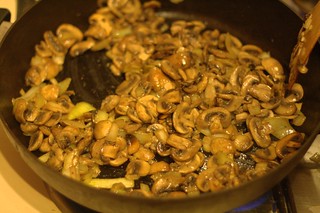
Cream of mushroom soup
Ingredients: A few handfuls of button mushrooms.
Half an onion.
About 800mL of stock, possibly somewhat more if using a stove top.
About 100mL of cream or sour cream, or some mixture thereof.
NB: I prefer and recommend sour cream but my co-cook despises it, so we tend to make it with cream.
Preparation: Chop up the mushrooms and onions. Fry the mushrooms and onions together. Add the stock and simmer for 5 to 10 minutes. Add the cream and simmer briefly. Pour into a blender and blend until smooth.
Alternative preparation: Chop up the mushrooms and onions. Place in slow cooker with cream and stock on low for 4 hours. Pour into a blender and blend until smooth.
Optional additions: we don’t cook anything much in our house in winter without thyme and bay leaves. Be sure to remove the bay leaf before blending.
Serving suggestion: grind pepper over the result.
Slow cooked chicken drumsticks
Ingredients: An appropriate number of chicken drumsticks.
A 400g tin of diced tomatoes for about every 8 drumsticks.
About 100mL of stock for every drumstick.
A splash of white wine.
As many olives as you think sounds good.
Optional: onion garlic, thyme, bay leaf, etc.
Preparation: roll/dip/immerse the drumsticks in plain flour and briefly brown them in a fry pan (perhaps with onions and garlic). Place them in a slow cooker with all other ingredients and slow cook on high for 4 hours.
Serving suggestion: we serve with couscous.
Red lentil daal
For this we follow a recipe pretty closely, namely Stephanie Alexander’s recipe in The Cook’s Companion. It’s very similar to her published recipe in Fairfax’s Cuisine, except we haven’t been using chilli or mustand seeds.
I’ve also tried this in a slow cooker (don’t pre-soak the lentils, have all the pot ingredients in for 8 hours on low) but it ended up being too smooth for my tastes (I have a very strong aversion to some types of very smooth food, namely well-mashed potatoes, ripe avocados, and a few other things, and this daal went into that range).
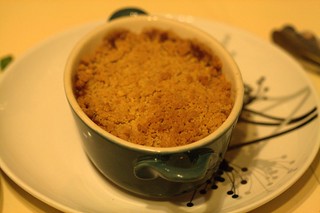
Apple crumble
Another dish where we follow a (simple!) recipe closely, specifically Donna Hay’s recipe for individual portions. We had great luck also, when we had some passionfruit to spare, juicing several of them and mixing the juice with the apple slices for passionfruit crumble.
Any 24-hour period will always begin and end in the same day (or week, or month).
As is usual with these kinds of things, he’s only scratching the surface (even though there’s a lot more than in that excerpt). Andrew and I came up with several more already, on the subject of timezones:
All timezones are a whole number of hours offset from UTC.
All timezones are no more than 12 hours offset from UTC.
Two cities within some sufficiently small distance must be in the same timezone.
Two cities with the same longitude must be in the same timezone.
A city further to the east of another city must have a time ahead of or equal to the more western city.
There will only be one timezone within any political boundary.
Within a sufficiently large political boundary, there will be different timezones.
Timezone designations like ‘EST’ are unambiguous.*
Daylight savings shifts occur on the same day around the globe.
Or at least within a hemisphere.
Or at least within a continent.
Or at least within a nation.
Daylight savings shifts occur on predictable dates announced ‘sufficiently far’ in advance that there can be an exhaustive listing of them accurate for the next couple of decades.
Well, at least the next few years.
OK, surely at least this month?
* Both Australia and the United States call their east coast timezone this in winter, and guess what: it’s never the same time in New York as it is in Sydney, and the daylight savings status is seldom the same either. (If you’ve seen Australians call it ‘AEST’, well, yes, we do. Sometimes.)
Today’s entry is a package for displaying linguistic examples (ie, samples of text which you then want to discuss and analyse). The LaTeX for Linguists Home Page is a good general resource for linguists and computational linguists using LaTeX. I discuss gb4e here because I had to do some messing around to get it to display example numbers the way I want (and the way my supervisor wanted: he likes in-text references to look like “example (4.1)” rather than “example 4.1”), and to get it to work with cleveref, and no one seems to have written that up to my knowledge.
gb4e
gb4e is a linguistic examples package.
usepackage{gb4e}
Input looks like:
begin{exe}
ex This is an example sentencelabel{example}
ex This is another example sentence.
end{exe}

This is a cleveref reference to cref{example}.
This is a normal reference to example (ref{example}).
You can mark sentences with * and ? and so on:
begin{exe}
ex[*] {This is an sentence ungrammatical.}
ex[?] {This is an questionably grammatical sentence.}
end{exe}
You can do sub-examples:
begin{exe}
ex This is an example.
ex
begin{xlist}
ex This is a sub-example.
ex This is another sub-example.
end{xlist}
end{exe}
A few things to do to make gb4e play really nicely. First, some cleveref config. gb4e doesn’t yet automatically tell cleveref how to refer to examples, so you need to tell it that the term is “example”, and second, if you want braces around the number (“example (1.1)” rather than “example 1.1” you need to tell it to use brackets:
% tell cleveref to use the word "example" to refer to examples,
% and to put example numbers in brackets
crefname{xnumi}{example}{examples}
creflabelformat{xnumi}{(#2#1#3)}
crefname{xnumii}{example}{examples}
creflabelformat{xnumii}{(#2#1#3)}
crefname{xnumiii}{example}{examples}
creflabelformat{xnumiii}{(#2#1#3)}
crefname{xnumiv}{example}{examples}
creflabelformat{xnumiv}{(#2#1#3)}
Also, by default, the gb4e numbering does not reset in chapters. That is, your examples will be numbered (1), (2), (3) etc right through a thesis. You probably want more like (1.1), (1.2), (2.1), (2.2), ie chapter.number. Change to this with the following in your preamble:
% Store the old chapter command so that
% our redefinition can still refer to it
letoldchapterchapter
% Redefine the chapter command so that it resets the
% 'exx' counter that gb4e uses on every new chapter.
renewcommand{chapter}{setcounter{exx}{0}oldchapter}

% Redefine how example numbers are shown so that they are
% chapter number dot example number
renewcommand{thexnumi}{thechapter.arabic{xnumi}}
You could also get it to reset in sections by replacing chapter and thechapter with section and thesection in the above.