30 Day book meme, 4: your favourite series ever

Day 4 of the 30 day book meme: your favourite book or series ever.

Let me interrogate the question for a moment. Day 4 is “your favourite book or series ever.” Day 6 is “Favourite book of your favourite series OR your favourite book of all time”. That pretty much compels Day 4 to be about my favourite series ever, doesn’t it? Because if I choose the other door, I have to talk about my “favourite book of my favourite series” on Day 6, which would be strange if I hadn’t talked about the series, no?

In addition, I am actually not a big series reader and the meme has questions that assume that I read essentially all series all the time. My favourite series should be distinct from my comfort book, which should be distinct from my first favourite series which should be distinct from my favourite childhood book. That’s a stretch, frankly.

My favourite series right now, I think, is probably Le Guin’s Earthsea novels. (Not counting the Hainish setting, which doesn’t re-use characters, centuries or planets terribly often, and I don’t think that’s a series as the meme intends it.) Here’s a conversation I had on Geek Feminism.

Stephanie asked:

Okay, please explain to me what I’m missing in the Earthsea series. I read The Wizard of Earthsea on the recommendation of a friend who when he thinks of feminist, he thinks of me and vice/versa so he said I would LOVE them.

Only, I didn’t. If we were to submit the book to the Bechdel Test it would fail miserably. Furthermore all of the women characters are the basic stereotypes of evil witch or virginal damsel.

Does it just get exponentially better as the series goes on or am I missing something?

I answered:

The first three are in fact notoriously male-centric. Decades later Le Guin, with a much more feminist eye, returned to the universe and wrote a fourth novel Tehanu which was a woman’s perspective on the whole thing (although the second novel is also from the point-of-view of a woman, but it’s still About Men). There’s also a fairly large change in tone. The fifth and sixth books (which are a collection of stories and a novel respectively) are more in the tradition of the fourth, although not as exclusively focussed on women’s point-of-view.

With regard to whether to continue, I would suggest that you do so only if you want to follow the story of Ged, because otherwise you will probably find the whole thing pretty annoying. An alternative might be reading the second and then the fourth, fifth and sixth books.

I actually like the first three, especially Tombs of Atuan, better than Stephanie likes A Wizard of Earthsea. But even with Tehanu this wouldn’t have made it into this entry: the fifth book really makes it for me. But I’ll save that for Day 6.

30 Day book meme, 3: the best book you've read in the last 12 months

Day 3 of the 30 day book meme: the best book you’ve read in the last 12 months.

I got into Ursula Le Guin’s writing non-Earthsea writing rather late, but now it’s like always coming home, for me. (Yes, haha, I have not in fact read it. I don’t actually seek them out, because I think her work deserves to be read over many years.) This year’s gem is The Birthday of the World, which is a collection of stories. The thematic draw of this book for me was the stories about various forms of introversion, of relationships unfolding slowly, of societies that have been the same way for a long time and who find meaning in returning and returning again. Thus, my favourite stories in the collection were: Unchosen Love (fear and helplessness in the face of passion) and Solitude (committed adult relationships and all interpersonal manipulation as evil sorcery). I liked Paradises Lost too (and the others!) but for a slightly different reason: I’ve always liked Le Guin’s marriages, indeed they form a really key part of the way I view marriage (as a word for intending life partnership rather than a legal system) and Hsing and Hiroshi have a distinct kind of me: marriage as a secondary part of life’s work.

30 Day book meme, 2: a book you wish more people were reading and talking about

Day 2 of the 30 day book meme – A book or series you wish more people were reading and talking about

This one is rather leading: it seems to think I’m ahead of the curve on books and am going to be introducing a book or series that none of you have ever heard of. I am no one’s book wizard (incidentally, I’ve read a few hundred pages of Infinite Jest and it’s fun).

Still this one is easy compared to Day 20, favourite kiss. Favourite kiss? Yikes.

Anyway, a year or so ago I wished I had more people to talk to about Karen E. Bender and Nina de Gramont (eds) Choice: True Stories of Birth, Contraception, Infertility, Adoption, Single Parenthood, and Abortion. It’s an anthology of women’s stories about reproductive choices.

It’s simply a good (in the reading sense, not the emotional sense) set of real stories if abortion, infertility, pregnancy and birth stories interest you. Since I’ve been reading such since I was a kid, I loved it. I lack a huge number of friends (meatspace or online) who spend much time talking about reproductive choices.

The title doesn’t include childfreedom, but there’s at least one childfree writer, that said, if you’re not interested in parenthood decisions and stories in some way it’s largely not going to be an enormously interesting read.

It may not be a good book to read while pregnant or if you have infertility or pregnancy-related grief: there’s a second trimester abortion for pre-eclampsia (there’s an earlier draft of that one at warning ReadingWritingLiving) for example, a “baby scoop” birthmother’s story, and several other tragedies).

In fact, probably my single major criticism is also inevitable given the book’s scope: many choices are extremely serious, often distressing and conflicted, by the nature of soliciting stories from women willing to write thousands of words about a reproductive choice they made. Given that I tended towards being anxious anyway, it didn’t provide a great basis for pre-pregnancy reading, I should have been reading Pregnancy and Birth: loved it more than lollipops (not, as far as I can see, an actual title on the market).

Also, if you are thinking along these lines about disability politics, abortion and reproductive choice, you will probably find it an incomplete anthology: there’s a mother who chose to abort a fetus that would have been a second hemophiliac son, and a mother who had a
primary CMV infection and a healthy child, but not a lot of questioning of the a healthy child is a better child assumptions.

30 Day book meme, 1: a book series you wish would just freaking end already

Reposted from here

There seem to be a lot of 30 day prompts around at the moment, and I might take on a few of them. The first is the 30 Day book meme, now that I’ve finally found a list of all the prompts. I am not commiting to 30 continuous days.

Day 1 – A book series you wish had gone on longer OR a book series you wish would just freaking end already (or both!)

I’m ready for the ending of Isobelle Carmody’s Obernewtyn Chronicles. There are actually only five books to date (six in the USA, where the fifth book was split in two), and apparently only one more to come (again, two in the USA). But it started in 1987! I started reading it in about 1994 or so. Every book since has been supposed to be the last one. And it’s
ultimately only one large plot arc, and thus very little has actually been wrapped up. Most of the subplots are still unravelling too.

I don’t know why Carmody has taken so long with this one. Perhaps she works slowly, or needs to spend time away from her worlds. But I’ve always thought that the single plot arc, and the first person point-of-view from the same character, is probably a mistake for this series. It’s become a really rich world politically and several of the secondary characters do a lot behind the scenes, but the structure requires the point-of-view character, Elspeth, who is a suspicious, traumatised introvert, to be present in order for the reader to learn anything.

It is nice to see an introvert done well (per Ursula Le Guin’s introduction to Birthday of the World, it isn’t often). Also, Carmody hasn’t made the mistake of making Elspeth’s arc terribly terribly boring in comparison to what is going on in the background (I’m one of the people who feels that JK Rowling managed to write the least interesting parts of events of Harry
Potter and the Deathly Hallows
by virtue of sticking with Harry’s point of view) but to be honest I am starting to get more interested in some of the secondary characters and plots than I am in her and hers. But it seems the Chronicles will conclude with the conclusion of her arc, and I’m ready for that.

Books I haven't finished lately

A sort of an inverse book review, books I have closed, or returned to the library, without finishing them.

Treason’s Harbour by Patrick O’Brien. I probably will finish the Aubrey-Maturin novels at some point, but I don’t think it’s going to be this year, and perhaps not next. I’m not sure exactly why I suddenly went off them, but I think it’s because I don’t like Jack as a character very much. He’d probably be a lovely person to complete your table for dinner (better than Stephen for many dinners), but I don’t want to read twenty novels about him in a short period of time.

Generation text: raising well-adjusted kids in an age of instant everything by Michael Osit. I am in theory deeply interested in problems relating to cyberbullying and so on. In practice I have no patience for the write-ups. As an example, Osit early on compares hypothetical Bobby, fresh-faced teen of the 1960s with surly hypothetical Jake of the late 2000s. Bobby loves his mother’s eggs for breakfast! Jake never leaves his room, because his six speaker sound system is replacing parental affection! Remember your childhood, Osit seems to be asking. Before there was all this stuff?

Well, no, not really, not as you mean it. Bobby is my mother’s age! There are very few people who were teenagers in the 1960s and who are parents of teenagers now. Bobby may well be a grandfather, or at the very least wondering why his 30 year old son won’t leave home despite having so much money to spend on a soundsystem.

I was born in the early 80s. I had an email address before I left high school. I am one of the very last groups of middle-class Australians who did not go through their teens with their own mobile phone. (I got one at nineteen, and my fourteen year old sister had one before the end of that year.) Once at a sleepover my fifteen year old friends and I collectively had terrible cybersex with a random guy (or perhaps another group of teen girls?) on a Yahoo! (or something) chat room. It’s going to be a while before authors of books on parenting teens are aimed at me, I can see that.

My ideal bedroom

From comments elsewhere, I was asked to describe my ideal bedroom:

The west wall would consist mostly of glass, and would look over a generous balcony with a little tea table onto my expansive private beach, and from there into the setting sun.

The bed would be low to the ground, firm, king sized at least and also about two feet longer than is usual so my feet don’t hang over the end. In the ample room between the bed and the window-wall there would be two yoga mats (also about two feet longer than normal).

Behind a discreet sliding panel there is a small but well stocked kitchenette (benches about one foot higher than usual) with tea making facilites and a wee espresso machine. And since this is my ideal bedroom, a SILENT grinder. And a few choices of cereal and many many many fresh fruits.

In a sidecar bed attached to the main bed there is a peacefully sleeping baby, doing nothing but smiling reflexive sleep smiles, and definitely not screaming suddenly in hir sleep, snuffling, suffering from bronchiolitis, rolling around and gasping, or bouncing up and down in order to hear the squeaking it makes.

Behind another discreet sliding panel is an ensuite containing a bath that in some building codes would qualify as an indoor pool. And a double-headed shower. Ideally this bathroom also has a view of the beach.

Some ineffable process would ensure that mints appeared on the pillows every evening, and there would definitely be a cache of sweets somewhere.

Note: this is a very kind ideal bedroom. The whole coffee set up is actually for Andrew’s sake.

Some resources for people who want to be allies

This article originally appeared on Geek Feminism.

This is a 101 post and all of the links here are fairly well known to ‘net feminists, but Noirin being assaulted has caused newcomers to wonder what they can do to help create a safer environment for women and others at risk of assault.

Newcomers: we welcome your help! Here’s some things you could look at.

The Con Anti-Harassment Project: is a grass-roots campaign designed to help make conventions safer for everyone. Our aims are to encourage fandom, geek community and other non-business conventions to establish, articulate and act upon anti-harassment policies, especially sexual harassment policies, and to encourage mutual respect among con-goers, guests and staff. They have a lot of material, see particularly their tips for conferences/conventions who want to create a policy and their FAQ. If you aren’t an organiser, you could make a point of requesting an enforced policy from conferences you attend, and thanking those that have them.

Check out the The Open Source Women Back Each Other Up Project & Gentlemen’s Auxiliary which is more informal: you can share stories of harassment, assault and successful backing each other up, organise meetups at cons you attend, and purchase gear.

Make it not okay, really not okay around you to say the kinds of things people said to and about Noirin. You, presumably, believe* that women can attend conferences and go to bars and have fun and have male friends and consensually touch people and have a romantic/sexual history and have photos of themselves online and be a feminist and have the absolute right to refuse consent to intimate social situations, to touching and to sexual activity. You, presumably, also believe people you personally despise, or aren’t your idea of fun, or who hold opinions you disagree with, or who have hurt you in some fashion, have the absolute right to refuse consent in the same way. You presumably believe that sexualised approaches to people, and sexualised interactions with them are harassment unless they are welcome. If you believe those, and you are around people who don’t, don’t let them believe that they are with allies, if and when you have the power for that to be safe.

Valerie Aurora points out also that if you attend events where harassment and assaults are happening and the event organisers and atmosphere are ignoring or contributing to the problem, stop going if you can. Support spaces that are doing better.

Finally, because I couldn’t find this written up in one place in a bite-sized way, don’t tell people what they have to or should do about abuse or assault or harassment. Abuse, assault and harassment are about withholding power from someone, about denying them self-determination. They need, and have a right to, the power to decide how to respond. It may be appropriate, if you are a witness or a good friend or an event organiser or the person on the spot or otherwise one of the people most likely to be able to help them, to offer them help in getting home, finding a shelter, getting some money, finding a crisis counsellor, going to the police, getting ongoing counselling, speaking out, overcoming fear of the next event, getting the hell out, now or in the future, as seems appropriate at that moment. And then let them decide whether they want to do that or anything else, and whether they want your help. (A reference in forming this thinking was Karen Healey’s Snakes in the grass. tigtog also pointed me at unusualmusic’s linkspam: Why didn’t you call the police? Part One.)

* If you do not believe the things in that paragraph we don’t really need to know why not.

Noirin’s hell of a time

This article originally appeared on Geek Feminism.

Warning: this post discusses sexual assault and links to both a survivor account and to hostile comments.

Noirin Shirley’s post A hell of a time in which she describes her sexual assault at ApacheCon on the 4th November and names her attacker is starting to show up in our Linkspam suggestions and so on.

We’ve seen it.

This post has been widely linked by tech news sites, including (trigger warnings for comments at all of these places) Reddit, Hacker News and Gawker and while some respondents have been sympathetic to or angry for Noirin, there’s a lot of victim blaming in the usual ways: “don’t ruin his life over one mistake”, “don’t go to bars”, “asking for it”.

I think this is hard for us to write about, as several of us (including me) know Noirin either online or in person. We want to acknowledge what happened to her and how she responded (go Noirin!) but the ferociousness of the don’t-speak-out wasn’t-that-bad this-is-how-human-sexuality-works get-over-it this-isn’t-news deserved-it has hit us all hard. It feels like we’ve been working our teaspoons super hard for ages, and someone built another dam and filled it up.

And we are just onlookers.

Noirin: sorry about what happened to you, both the assault and the response.

Surely I don’t really need to say this: comments will be moderated. Leaving anti-speaking-out or compulsory-police-reporting or pro-sexual-assault or I’m-not-necessarily-talking-about-this-situation-but-here’s-a-hypothetical-where-the-alleged-attacker-gets-hurt comment here is a waste of your time.

Update: if you have links to share, please place a warning if that link, or any comments it is allowing, are victim-blaming.

Baby and startup? Big deal! Or, perhaps, a big deal?

This article originally appeared on Geek Feminism.

Years back I read Paul Graham’s How to Start a Startup essay, which includes this footnote:

One advantage startups have over established companies is that there are no discrimination laws about starting businesses. For example, I would be reluctant to start a startup with a woman who had small children, or was likely to have them soon. But you’re not allowed to ask prospective employees if they plan to have kids soon.

Which, well, OK, I’m not in the business of forcing Paul Graham to start businesses with people he doesn’t want to start businesses with. But it bugged me for the obvious reasons, not least because, well, you know, men have small children too sometimes. Thank goodness they don’t have to put any work into them. Phew. Lucky escape there, men. Better make sure we keep that labour division in place.

Anyway, in the last few days, Tara Brown wrote this, in response to a few posts by men about having kids and doing a startup.

I am 35 years old, I have an 8 month old child that I breastfeed full-time and I am doing a startup. Big deal. Who isn’t?

Many women start businesses after having a kid, usually because they want to stay home and have an income. This was what I wanted to do after I had Ripley. I decided I wanted to look after him exclusively for his first year and then get a job as a consultant or something where I could continue staying at home with him. My husband and I took off with Ripley to Singapore and France and during that time somehow I ended up a co-founder of Noot.

I have a 9 month old baby (breastfed a fair bit as it happens, although you should have seen him get stuck into ciabatta bread today), and… I’m not doing a startup. I wouldn’t have been a great business partner or core employee for a while after birth, because it made me sick. I wouldn’t be a great partner or employee right now either, in fact, because he brings home illnesses from daycare and so we’re sick and exhausted constantly. (Not that I’m keen to encourage Paul Graham to add to the people he won’t start businesses with, but my husband gets these too, funnily enough.) I did recover our main fileserver when he was 12 days old. Pro tip: if you have any suspicion your hard drive is failing, replace it prior to the birth of your baby. (But then, I had to do the same thing the other week. Pro tip: mobile 9 month olds get in the way of hard drive replacements more than 2 week olds. Wait, that wasn’t a tip. Sorry. Pro tip: don’t have hard drives that fail.) I work various part-time and casual things now to afford the daycare to finish my PhD.

But Tara Brown isn’t telling everyone’s story: she’s telling hers, and she acknowledges that she has some advantages:

Honestly, I never expected to write this blog post because I just figured this is what every other woman that is working and has a baby must do, not something to make a big deal out of. But when I saw that email from Jason Calacanis and Jason Roberts, I just had to speak up so that more women can tell these guys that what they are doing is not extraordinary by any means. I mean come on, Jason Calacanis is rich, his wife stays at home and they have a night nanny. Not exactly a tough situation. What’s tough is single mothers and fathers trying to raise their kids by themselves. Me and the “Jasons” have supportive spouses who are at home for big chunks of time.

So moms dads out there that are doing a startup, tell the world YOUR story. Please! I need to meet more of you for the support and inspiration.

Starting, running and managing businesses, especially small ones, has been women’s work for a long long time, and that means mothers have done it. Mothers have done it a lot. But at the same time, I’m not keen to uncritically contribute to a superwoman culture: get back behind the desk woman! Sickness, disability, parenting and family and education and money demands and life preferences, these all vary a lot more than I would be reluctant to start a startup with a woman who had small children allows for. Sometimes women need to work with small children. Sometimes they need to not. Often it’s in between.

What’s your experience, if you’ve worked as a mother young children? If you’ve been an entrepreneur or business owner, do you think that that was uniformly harder than being an employee, or in some ways easier, or generally easier?

Halloween: will you be a sexy witch, a sexy bee, or a sexy girl geek?

This article originally appeared on Geek Feminism.
Take Back Halloween! costume resources showed up in the linkspam recommendations.

We love Halloween. We really love Halloween. We think it’s cool that there’s one day a year when people can dress up as anything they want. What we don’t think is cool is that increasingly women are only supposed to dress up as one thing: Sexy _____

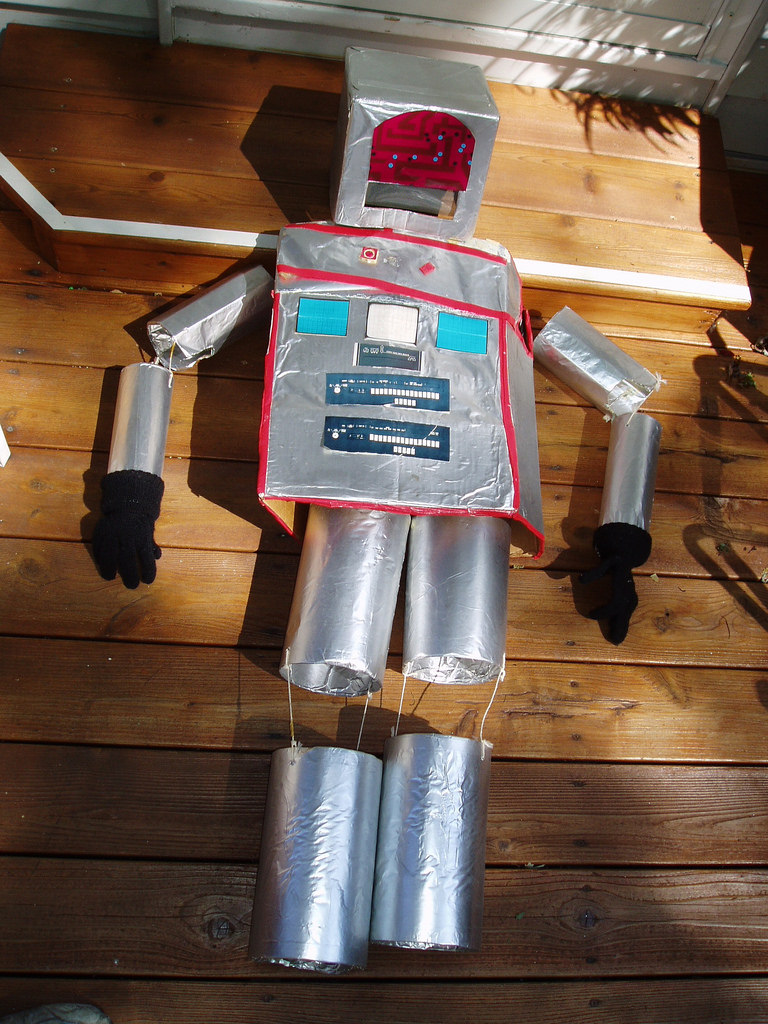
They focus on dressing as queens, goddesses and heroines. But there’s no reason women can’t be robots, right?

Image “Robot costume” by Rob Marquardt, Creative Commons Attribution ShareAlike

And there’s no reason to let men hog the Rubiks Cube:

Man dressed in full body Rubik's Cube costume
Image “solving the cube018” by Fred Benenson, Creative Commons Attribution

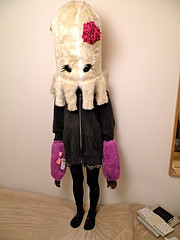
And there’s no reason that a squid monster can’t have a feminine touch!

lady ika costume with squid headdress
Image “lady ika” by Hawken King, Creative Commons Attribution

Here’s your geek feminist costume planning thread. Are you going to any costume parties soon? Have you got any awesome costumes from the past to share, or inspirational links? Are you not sexy or geek sexy or don’t care for Halloween?