
Photo circle shots
I recently ran a “photo circle”, consisting of a small group of people sending prints of their own photographs to each other. It was a fun way to prod myself to take non-kid photos.
My four photos were:

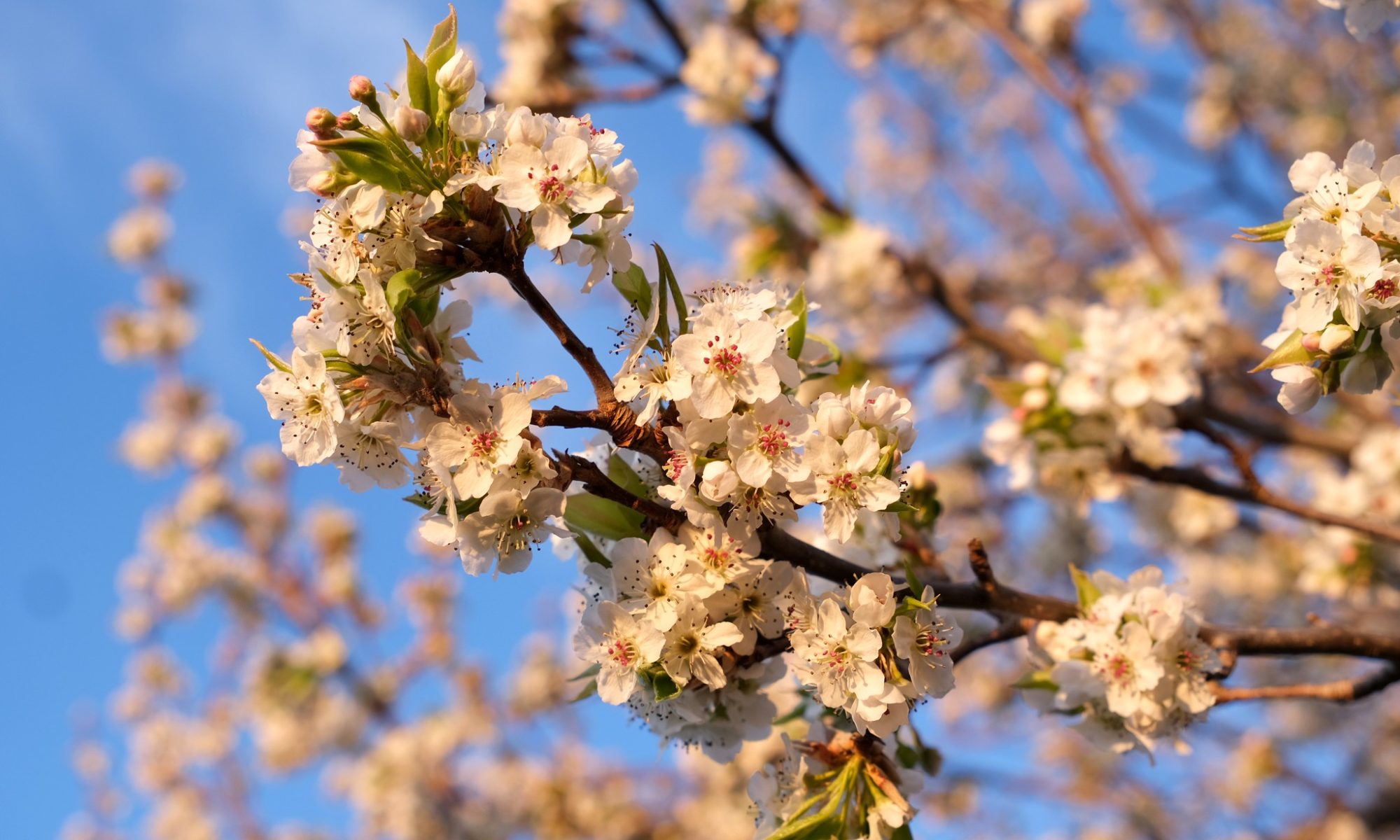
I took Sun in the eucalypts in the late afternoon of Easter Sunday, as the sun was sinking behind the eucalypts at Centennial Park’s children’s bike track. I tried to take one with the sun shining through the trees but didn’t get the lens flare right. I like the contrast between the sunlit tree and the dark tree in this one. It feels springlike, for an autumn scene.
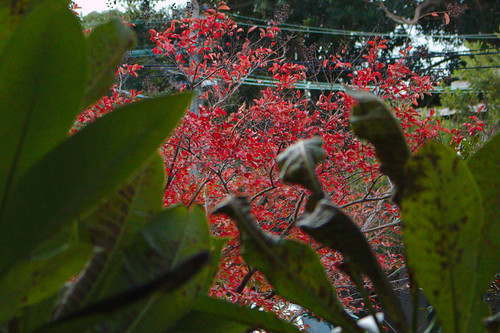
The other three are a very different type of weather shot, taken during Sydney’s extreme rainfall of late April and very early May:

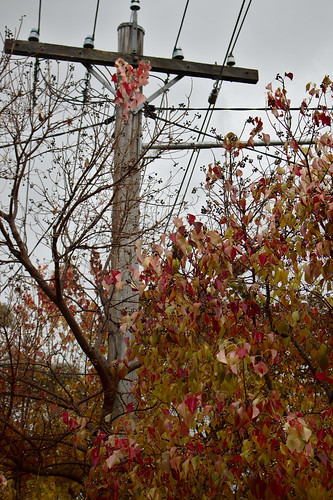
This one has the most post-processing by far: it was originally shot in portrait and in colour. I was messing around with either fast or slow shutter speeds while it poured with rain at my house; I have a number of similar photos where spheres of water are suspended in the air. None of them quite work but I will continue to play with photographing rain with a fast shutter speed. In the meantime, the slow shutter speed here works well. I made the image monochrome in order to make the rain stand out more. In the original image the green tree and the rich brown fencing and brick rather detract from showing exactly how rainy it was.
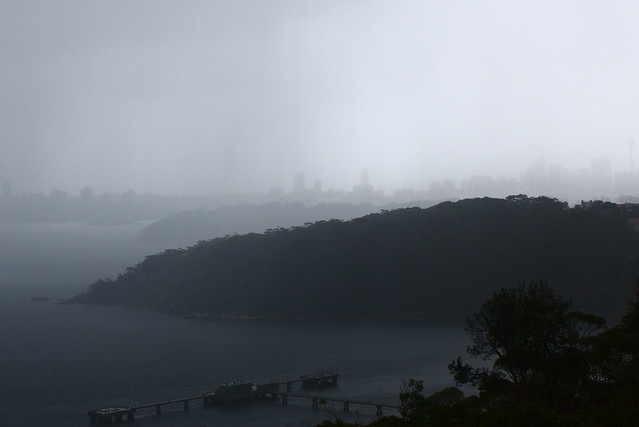
This was shot from Gunners’ Barracks in Mosman (a historical barracks, not an active one) as a sudden rainstorm rolled over Sydney Harbour. The view was good enough, but my lens not wide enough, to see it raining on parts of the harbour and not on other parts. All the obscurity of the city skyline in this shot is due to rain, not fog.
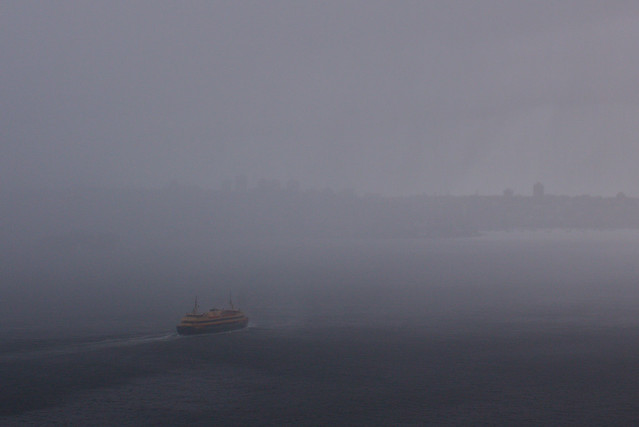
This is the same rainstorm as the above shot; they were taken very close together. It may not be immediately obvious, but the saturation on this shot is close to maximum in order to make the colours of the ferry come up at all. I was the most worried about this shot on the camera, it was very dim. It comes up better in print than on screen, too. The obscurity is again entirely due to the rain, and results in the illusion that there is only one vessel on Sydney Harbour. Even in weather like this, that’s far from true. I felt very lucky to capture this just before the ferry vanished into the rain too.
Storm over Sydney
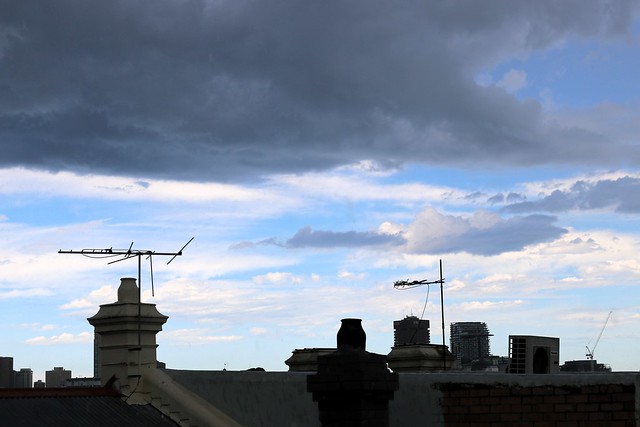
It stormed every day for a few weeks in December, and I kept missing it: either it didn’t hit my suburb or (on more than one occasion) I was taking a nap. But I finally managed to get some photos:

Weekend womanscraft: winter warmers
This article originally appeared on Hoyden About Town.
Anyone who has spent Thursday night/Friday in NSW is probably in need of some winter warmers, at least! What’s warming your innards this season? Here are a few recipes of ours, household style (that is, very imprecise measurements).
Cream of mushroom soup

Ingredients:
A few handfuls of button mushrooms.
Half an onion.
About 800mL of stock, possibly somewhat more if using a stove top.
About 100mL of cream or sour cream, or some mixture thereof.
NB: I prefer and recommend sour cream but my co-cook despises it, so we tend to make it with cream.
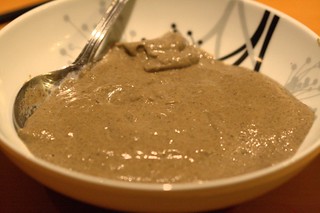
Preparation: Chop up the mushrooms and onions. Fry the mushrooms and onions together. Add the stock and simmer for 5 to 10 minutes. Add the cream and simmer briefly. Pour into a blender and blend until smooth.
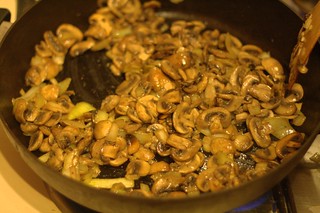
Alternative preparation: Chop up the mushrooms and onions. Place in slow cooker with cream and stock on low for 4 hours. Pour into a blender and blend until smooth.
Optional additions: we don’t cook anything much in our house in winter without thyme and bay leaves. Be sure to remove the bay leaf before blending.
Serving suggestion: grind pepper over the result.
Slow cooked chicken drumsticks
Ingredients:
An appropriate number of chicken drumsticks.
A 400g tin of diced tomatoes for about every 8 drumsticks.
About 100mL of stock for every drumstick.
A splash of white wine.
As many olives as you think sounds good.
Optional: onion garlic, thyme, bay leaf, etc.
Preparation: roll/dip/immerse the drumsticks in plain flour and briefly brown them in a fry pan (perhaps with onions and garlic). Place them in a slow cooker with all other ingredients and slow cook on high for 4 hours.
Serving suggestion: we serve with couscous.
Red lentil daal
For this we follow a recipe pretty closely, namely Stephanie Alexander’s recipe in The Cook’s Companion. It’s very similar to her published recipe in Fairfax’s Cuisine, except we haven’t been using chilli or mustand seeds.
I’ve also tried this in a slow cooker (don’t pre-soak the lentils, have all the pot ingredients in for 8 hours on low) but it ended up being too smooth for my tastes (I have a very strong aversion to some types of very smooth food, namely well-mashed potatoes, ripe avocados, and a few other things, and this daal went into that range).
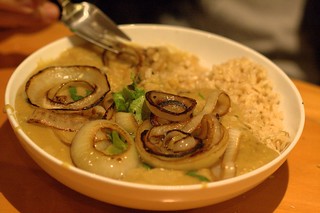
Apple crumble
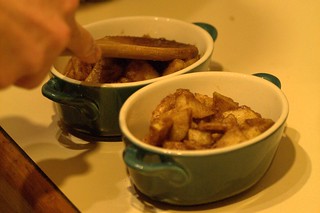
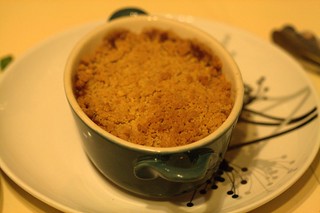
Another dish where we follow a (simple!) recipe closely, specifically Donna Hay’s recipe for individual portions. We had great luck also, when we had some passionfruit to spare, juicing several of them and mixing the juice with the apple slices for passionfruit crumble.
A few other warmers you might fancy:
- Skud’s apple and oat crumble for breakfasts.
- Tom yum goong can go either way, seasonally, but at this time of year if you make it spicy enough it will warm most of the lower half of your face.
- Lemon delicious pudding, another great dessert to make in one container or individual portions.
What’s warming you, this winter?
Anti-pseudonym bingo
This article originally appeared on Geek Feminism.
People testing the Google+ social network are discussing increasing evidence that, terms of service requirement or not, Google+ wants people to use their legal names much as Facebook does. Skud shares a heads-up from a user banned for using his initials. Then, for example, see discussion around it on Mark Cuban’s stream, Skud’s stream and Sarah Stokely’s blog.
Let’s recap really quickly: wanting to and being able to use your legal name everywhere is associated with privilege. Non-exhaustive list of reasons you might not want to use it on social networks: everyone knows you by a nickname; you want everyone to know you by a nickname; you’re experimenting with changing some aspect of your identity online before you do it elsewhere; online circles are the only place it’s safe to express some aspect of your identity, ever; your legal name marks you as a member of a group disproportionately targeted for harassment; you want to say things or make connections that you don’t want to share with colleagues, family or bosses; you hate your legal name because it is shared with an abusive family member; your legal name doesn’t match your gender identity; you want to participate in a social network as a fictional character; the mere thought of your stalker seeing even your locked down profile makes you sick; you want to create a special-purpose account; you’re an activist wanting to share information but will be in danger if identified; your legal name is imposed by a legal system that doesn’t match your culture… you know, stuff that only affects a really teeny minority numerically, and only a little bit, you know? (For more on the issue in general, see On refusing to tell you my name and previous posts on this site.)
Anyway, in honour of round one million of forgetting about all of this totally, I bring you anti-pseudonymity bingo!

Text version at bottom of post.
What squares would you add? Continue reading “Anti-pseudonym bingo”
Sexist joke bingo
This article originally appeared on Hoyden About Town.
In collaboration with Hoydenizens and others, a bingo card for arguments in defence of sexist jokes, specifically, the variants on “but it was FUNNY”.

Text version at bottom of post.
Extra suggestions:
- the catch-all “it’s just a joke”
- “why the fuss? it was one itty bitty teeny weeny joke!”
- “you don’t understand my culture at all”
Don’t forget your bingo basics, that is: “One only gets to yell BINGO! if somebody on the internet is advancing an assortment of those arguments simultaneously.” Sometimes, for extra Internet points, you might be able to play (‘ware, porn images) porny presentation bingo or general anti-feminism bingos I and/or II simultaneously.
You can use this bingo card under Creative Commons Zero, that is, public domain (without credit and freely modifiable). Here’s the SVG. There’s a version at the Buzzword Bingo generator that randomises the square placements and uses full sentences, if you are so inclined.

This bingo does assume a male joke-teller, the management acknowledges that it is not only men who tell sexist jokes.
Text version:
| sorry, but I found it funny | oversensitive much? | take it as a compliment | wasn’t even sexual | he’s not used to women |
| so cute when you’re angry | actually at men’s expense | heard a woman tell it once | edgy satire of our PC society | you heard it out of context |
| your complaint is what’s sexist | you seem very uptight about sex | FREE SQUARE: LOL | wasn’t meant that way | thought police |
| my wife thought it was hilarious | works when I’m with friends | just his way | I’m offended by your complaint | you’d tell it about a man |
| attracted attention to his message | you enjoy being offended | absolutely no sense of humour | I found it funny and I’m a woman | acceptable on TV |
Writing a good online diary
Assuming that you have good reasons for keeping an online diary, there are a few things you can do to improve your chances of making your diary readable. I’ll begin by stating the general principles, and then by reviewing a few breakable rules of thumb that, in my experience, are good indicators of an interesting diary.
The general principle of good writing is to determine your audience, and write for them. An online diarist will normally encounter some tension here — the diarists are often writing partly for themselves or their future selves, and the desire to record events that were important to them may conflict with the desire to record events in an interesting way. You will need to decide to what extent you are intending to resolve this tension in the audience’s favour.
It is the case, if I am part of your audience, that your choice of material is generally meaningless to me, and the use to which you put your material is everything, which is why most of these tips tend towards the stylistic.
Tell a story
Of the beginning, middle and end structure, online diarists struggle most with the ending, often because they don’t know it yet. The most successful stories are often trivial anecdotes. However, there may be an ongoing story that you don’t want to record only in hindsight. In this case, you will want to return to it periodically.
It is very very hard to make a story out of emotions you are still experiencing, unless you’re a brutally honest and particularly insightful person, so if you want to write a powerful emotional entry, you may be better off writing an entry that looks back a year or more.
Write long entries
A long diary entry gives you the chance to tell a story, rather than writing an instant message to your readership, and most good online diaries contain at least the odd long entry scattered in their archives.
Very few online diarists seem to be poets, and so generally very few short entries will not become the highlights of your diary.
Drama is the biggest online diary cliche
If your entry is an allusion to misery that only your three best friends in the world can comprehend, your entry will be boring. The high points of an online diary are very seldom the most dramatic entries, save in the case of diaries that resemble an emotional car crash. For the rest, you will need to hone your ability to make the prosaic interesting, because it is actually much easier to do that than to make secretive drama interesting.
Make your entries complete within themselves
Again, if your entry is full of allusions to events you cannot describe in full, and people you cannot say anything about, and feelings that you are unwilling to share, your entry will be boring. If you need to censor something that is crucial to understanding a story, you may as well censor the entire story. In other cases, tell the story in such a way that it is a complete anecdote, even if it is not totally uncensored. If your reader can tell that you’ve left part of the story out, your entry is not as good as it could be.
A subtle style will serve you well
A diary with a unique voice is often an interesting read. One of the easiest ways to achieve this is to let your spoken style influence your written style. It should be relatively sparing, but a touch of spoken mannerisms in a diary makes it more readable.

Writing a good online diary by Mary Gardiner is licensed under a Creative Commons Attribution-ShareAlike 4.0 International License.
Why keep an online diary?
I think there are several bad reasons to keep an online diary, including using it as a poor substitute for a paper diary, using it to experiment with hyperlinking writing, or using it as a forum for your opinions. Each of these needs is better served by alternative forms. On the other hand, online diaries are maligned as being necessarily uninteresting due to their trivial nature. Trivial and uninteresting do not always go hand in hand, as diarists and letter writers have appreciated for hundreds of years.
The online diary is a format held in peculiar contempt, for several reasons. Most of those reasons are due to the usual meaning of ‘diary’ — that is, a more-or-less secret record of one’s life, written, presumably, for your satisfaction alone, and deriving much of its power from the fact that it has no readers, freeing the author both from the stylistic constraints of writing for an audience, and from the judgements of that audience.
The online diary format naturally loses much of that power. The disadvantages of the online diary format compared to the paper diary format include less honesty (or less sweeping honesty anyway), and much less privacy. It also leaves the author wide open to charges of narcissism, since they are writing about themself for an audience of other people.
So, let’s free the online diary from those constraints. You do not keep an online diary for the same reasons you keep a paper diary. The disadvantages include a lack of complete honesty and privacy. If you want to write with complete honesty and privacy you should keep a paper diary or correspond in private with trusted friends who will destroy your missives rather than hand them to anyone else.
I also suggest that you do not keep an online diary in order to experiment with stylised writing, because you’re likely to attract the wrong audience. Audiences seeking experimental writing styles don’t expect to find it in online diaries, and audiences reading online diaries don’t expect highly stylised writing, or content that deviates radically from the normally online diary content (that is, a person’s record of their life).
Most of the good stylised writing I’ve seen on the Web has been noticably free from the constraints of chronology. Online diaries are tied to a date based format, and people who are interested in telling stories or linking ideas together would be better off with a more integrated site, all of which is an ongoing work. I consider gruntle, raze, and the Jargon File to be excellent examples of the power that loosely organised, heavily hyperlinked sites offer to writers interested in experimenting with style and content that doesn’t fit in a chronological format. If you want to tell stories, I highly recommend this form over the online diary format.
If you’re interested in writing opinion pieces, rather than snippets of your daily life, I suggest you consider blogging, rather than keeping an online diary. Blogging and online diaries are both presently primarily chronological formats, and there is a gray area between them, since people use the same tools for both. The primary distinction between the stereotypical blog and the stereotypical online diary is the amount of linking in the former. Blogs link to websites, link to each other, comment on each other, discuss each other, discuss links, and discuss ideas. If you’re interested in taking part in intellectual crossfire, the blogging tools and communities will be much more satisfying than the online diary format.
Where experimental sites link internally, and blogs link externally, online diaries are largely hyperlink-free. The form requires authors to relate chosen aspects of their life on a loosely chronological basis. They attract readers who like to follow simple story lines, who like to feel involved in the lives of others. As often as not, the readership is made up of people who know the author and people who would like to.
So, what are good reasons to keep an online diary? If you need pre-digital examples of online diary-like writing, consider letter writing one hundred years or more ago. Letters of this time were often gossipy, personal, entertaining, bitchy and informative. In retrospect, some of the writing in informal letters is not only historically interesting, but very very good. So, if you think that one hundred years ago you would have liked to sit in your drawing room and write to your sister in the next town about your housekeeping, giving interest to the mundanities of your life, then online diary writing is probably a format you would enjoy.
Why keep an online diary? by Mary Gardiner is licensed under a Creative Commons Attribution-ShareAlike 4.0 International License.