Travel tip: Wentworth Falls Lake

I’ve frequently had cause to try and meet people in the Blue Mountains in a kid-friendly place, and I’ve found it surprisingly hard to do so. There’s teeny playgrounds of various types. There’s all the big tourist attractions which might work for older kids but about which mine couldn’t give a damn.

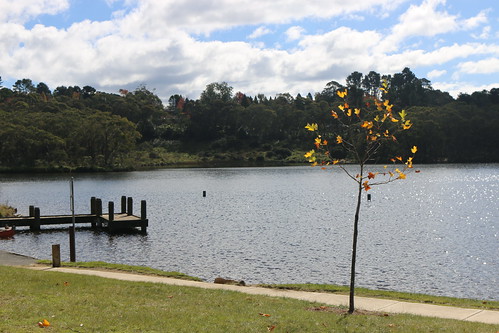
After poking at a map for a while, I discovered Wentworth Falls Lake, which seems to hit a decent amount of criteria for people with little kids. There’s two small but not uninteresting playgrounds, a number of fairly level and even paths, picnic tables scattered about, electric barbecues and a sheltered eating area, general space, and a decent-sized (albeit unfenced) bit of water to please the eye:

Wentworth Falls Lake

I’ve apparently managed to catch the train past this about 50 times without realising that it was a place worth remembering.

Note: it’s in the town of Wentworth Falls, it’s not at the actual falls. It’s on the north of the highway, the falls are on the south.

Not the Sydney Project: Questacon

This entry is part 3 of 11 in the series The Sydney Project

This year is my sonÂ’s last year before he begins full time schooling in 2015. Welcome to our year of child-focussed activities in SydneyÂ… only without the Sydney bit this once.

We rudely interrupt the Sydney Project to bring you a Canberra attraction: Questacon. In short, Questacon works nicely for V in a way that the Powerhouse did not, probably because it’s pretty shameless about catering entirely to children, complete with buttons, lights and hard hats.

We were there on a very busy day: the Saturday of the Easter weekend, the middle weekend of NSW school holidays. It was merely obnoxiously busy; I guess being used to Sydney crowds was helpful. That said, we did get there at 9:15, just after it opened. And as it was, the admission tickets to Mini-Q, the under 6 area, which is in limited numbers sessions on busy days, were only available from 11:30 onwards. I think they’d completely gone by about 10:30 in the morning. Go early, go often.

We’ve been once before, about a year ago, and Questacon was a hit to the point where for some time afterwards he asked to “see the science again!”. It took him longer to warm up to it this time. Much like last time, he shot through Measure Island without engaging. It took him a while to settle into Wonderworks, eventually getting interested in the Energy Machine and Frozen Shadow. Much to my disappointment, he’s never given a toss for my precious Harmonograph. (Much of Wonderworks has been there since I was a kid. Questacon’s exhibits are surprisingly timeless in their appeal.)
Best exhibit

Andrew and I and his father were very taken with the Cloud Chamber, which is in its own little-visited room from the steps between Wonderworks and Awesome Earth (closed for renovations), in which subatomic particles leave continuous trails through a cloud of vaporised alcohol. Andrew is keen to bring a banana next time. V was not willing to stand still for a story about how all the time, everything is being hit with tiny tiny particles moving at high speeds. Perhaps not one for the littlies.

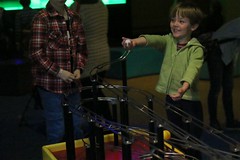
V’s favourite exhibit is pretty unique to him. He can roll ping pong balls down a ball rollercoaster for about an hour at a time. Other children come, roll five or ten balls and go. He stays. We only extracted him with a promise to return after.

Blue tunnel

Next up was one for the watching adults, Excite@Q. V was most naturally drawn to the blue tunnel, and he was one of several smaller children jostling under Whoosh to grab a scarf and stuff it back in the wind tunnels. But we were there for one thing: to see our four year old agree to do Free Fall. I wrote about this elsewhere:

It’s a horizontal bar suspended over a very steep slide. You hold the bar. You let go. You drop freely for three metres or so before hitting the slide and sliding to the floor of the room.

The ride is, as you’d hope, very into consent. You go to the top. You get a briefing about how it works. You are told, repeatedly, that it’s OK to say no. And the day we were there, about three quarters of children did say no. (It’s a bit of a study in gender performance actually. Adult men by and large grab the bar, drop themselves down to dangle, let go and are done. Everyone else takes far far longer.)

V loves slides and heights, and so we asked him if he wanted a go. He said yes. He was dressed in the safe suit for it (I guess no risk of catches or tears), he waited in the queue and watched child after child look at the drop and shake their head and walk back down the stairs with an adult for a hug. Andrew took him to the top. He got the chat about whether he wanted to say no. He gave them a puzzled look. He got his instructions. He took them very seriously.

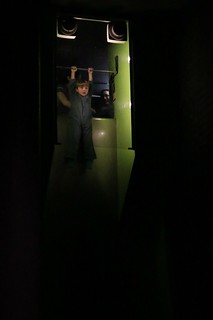
He held the bar:
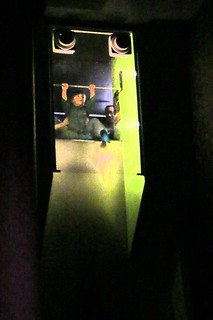
Preparing for free fall

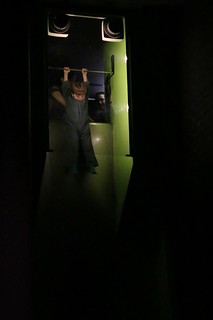
He dropped his weight from it:

Dangling

He looked down:

Looking down

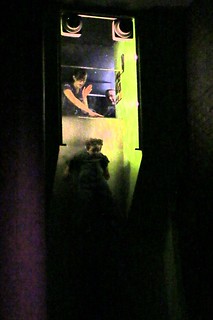
And he let go:

Fall

He seemed to have fun, if a mystified about why this was such a very big deal.
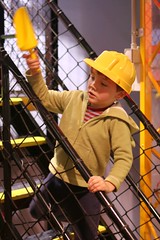
Vincent the builder

After Free Fall, his ticketed time for Mini-Q came up. I didn’t go in, but apparently it was all construction all the time in there.

Finally, for bonus points, I put my camera down somewhere in Wonderworks, and someone found it and handed it into staff. “People who come to Questacon are generally very honest,” the information desk staffer told me, although somewhat spoiling the effect by saying she’d been tempted to keep the camera herself.

Cost: $23 adults, $17.50 children 4 and over, younger children free.

Recommended: yes, has something for the jaded adult radioactivity fans and the child who wants to drop from extraordinary heights, wear a hard hat in a playground, and roll ping pong balls down a slide for an hour alike. Try not to go on holiday weekends, and try not to leave your camera lying around.

More information: Questacon website.

The Sydney Project: Powerhouse Museum

This entry is part 2 of 11 in the series The Sydney Project

This year is my son’s last year before he begins full time schooling in 2015. Welcome to our year of child-focussed activities in Sydney.

This was our second visit to the Powerhouse Museum, both times on a Monday, a day on which it is extremely quiet.

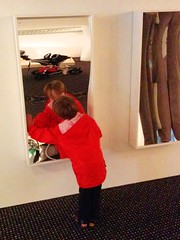
Bendy mirror

The Powerhouse seems so promising. It’s a tech museum, and we’re nerd parents, which ought to make this a family paradise. But not so. Partly, it’s that V is not really a nerdy child. His favourite activities involve things like riding his bike downhill at considerable speeds and dancing. He is not especially interested in machinery, intricate steps of causation, or whimsy, which removes a lot of the interest of the Powerhouse. Museums are also a surprising challenge in conveying one fundamental fact about recent history: that the past was not like the present in significant ways. V doesn’t really seem to know this, nor is he especially interested in it, which removes a lot of the hooks one could use in explaining, eg, the steam powered machines exhibit.

We started at The Oopsatoreum, a fictional exhibition by Shaun Tan about the works of failed inventor Henry Mintox. This didn’t last long; given that V doesn’t understand the fundamental conceit of museums and is not especially interested in technology, an exhibit that relies on understanding museums and having affection for technology and tinkering was not going to hold his attention. He enjoyed the bendy mirrors and that’s about it.

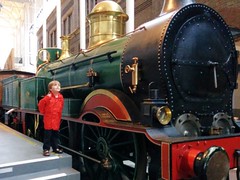
V v train

I was hoping to spend a moment in The Oopsatoreum, but he dragged me straight back out to his single favourite exhibit: the steam train parked on the entrance level. But it quickly palled too, because he wanted to climb on and in it, and all the carriages have perspex covering their doors so you can see it but not get in. There’s a bigger exhibit of vehicles on the bottom floor, including — most interestingly to me — an old-fashioned departures board showing trains departing to places that don’t even have lines any more, but we didn’t spend long there because V’s seen it before. He also sped through the steam machines exhibit pretty quickly, mostly hitting the buttons that set off the machines and then getting grumpy at the amount of noise they make.

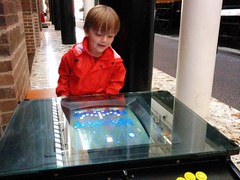
Gaming, old-style

He was much more favourably struck with the old game tables that are near the steam train. He can’t read yet, and parenting him recently has been a constant exercise in learning exactly how many user interfaces assume literacy (TV remote controls, for example, and their UIs now as well). The games were like this to an extent too; he can’t read “Press 2 to start” and so forth, so I kept having to start the games for him. He didn’t do so well as he didn’t learn to operate the joystick and press a button to fire at the same time. He could only do one or the other. And whatever I was hoping V would get out of this visit, I don’t think marginally improved gaming skills were it, much as I think they’re probably going to be useful to him soon.

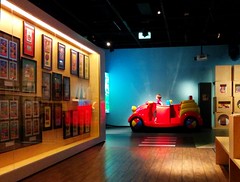
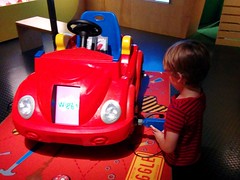
Big red car

We spent the most time in the sinkhole of the Powerhouse, the long-running Wiggles exhibition. This begins with the annoying feature that prams must be left outside, presumably because on popular days one could hardly move in there for prams. But we were the only people in there and it was pretty irritating to pick up my two month old baby and all of V’s and her various assorted possessions and lump them all inside with me. I’m glad V is not much younger, or I would have been fruitlessly chasing him around in there with all that stuff in my arms.

Car fixing

It’s also, again, not really the stereotypical educational museum experience. There’s a lot of memorabilia that’s uninteresting to children, such as their (huge) collection of gold and platinum records and early cassette tapes and such. There’s also several screens showing Wiggles videos, which is what V gravitates to. If I wanted him to spend an hour watching TV, I can organise that without leaving my house. He did briefly “repair” a Wiggles car by holding a machine wrench against it.

Overall, I think we’re done with the Powerhouse for a few years.

Cost: $12 adults, $6 children 4 and over, younger children free.

Recommended: for my rather grounded four year old, no. Possibly more suited to somewhat older children, or children who have an interest in a specific exhibit. (If that interest is steam trains, I think Train Works at Thirlmere is a better bet, although we cheated last year by going to a Thomas-franchise focussed day.)

More information: Powerhouse website.

The Sydney Project: Art Baby

This entry is part 1 of 11 in the series The Sydney Project

This year is my son’s last year before he begins full time schooling in 2015. I’ve therefore decided to embark on a self-imposed challenge to go and do different child-focussed activities in Sydney and review them!

Art Baby is a preliminary Sydney Project entry, because it wasn’t an activity for preschoolers! Instead, it’s an activity for carers of babies, who tour the Museum of Contempoary Art with their babies.

Entrance to the Museum of Contemporary Art, nighttime
by Robert Montgomery

Mostly, it’s a short (45 minute) tour of one of the exhibitions (it was Volume One today), and the fact of having babies in tow is largely irrelevant. (Most of the babies today were two or three months old, much too young to do much touching or exploring.) I very much enjoyed our tour guide, who significantly contributed to the artworks with some background about each artist, and with her personal reactions to the art works. Fine art has really grown on me in recent years, as I’ve come to understand many genres — fine art in this case, but not it alone — as a conversation, and that you need to come at it with a cheat sheet that brings you up to speed on the conversation. A good tour or audio guide is the way to go with fine art museums, given that I’m unlikely to ever follow the conversation as a practitioner or serious student. Today’s tour, by an art educator and artist, was an excellent insider briefing.

The baby-relevant part of the tour is the conclusion in the Creative Learning room where the older children would do the Art Play (3yo and under) and Art Safari sessions (3–5yo). This includes a piece specifically commissioned for the children’s room, a child-safe and welcoming artwork for them to interact with. (Much of the museum is an attractive nuisance for children, with many bright, changing objects that they must not touch. It’s a shame. This adult would like a museum of fine art you can beat upon.) Afterwards, everyone has coffee (included in the price) and goes their separate way.

I’m keen to trial Art Safari with my 4yo now.

Cost: $20 plus booking fee.

Recommended: yes. It’s a good introduction to the MCA collection, and the timing is suitable for people with babies in tow. You could also just attend a normal tour, of course, but sometimes it’s fun to be part of a WITH BABY market segment.

More information: Art Baby website.

The 62nd Down Under Feminists Carnival

This article originally appeared on Hoyden About Town.

In blue on a white background, the DUFC logo: in a square with rounded corners, there is the female/feminine symbol; with the Southern Cross inside, above which it says 'Down Under' and below 'Feminists Carnival'.

Welcome! This post is the 62nd monthly Down Under Feminists Carnival. This edition of the carnival gathers together June 2013 feminist posts from writers living in Australia and New Zealand. Thanks to all the writers and submitters for making this carnival outstanding, amazing, sad, outraging and uplifting.

Highlighted new(er) Down Under voices

I’ve highlightede posts that come from people who began been blogging at their current home in June 2012 or later, such posts are marked with (new blog) after the link. I know this is a very imperfect guide to new writers, since some may have simply started new blogs or switched URLs, or be well-known as writers in other media, but hopefully this may be a quick guide to feeds you may not be following yet.

Also, this carnival observes the rule that each writer may feature at most twice. Apologies to the fine submissions that were dropped under this system.

Feminist theory

Cristy is kicking off a feminist book club, from historical feminism and first wave onwards.

Joanna Horton reviews Joan Smith’s Misogynies, twenty four years on.

Party politics and government

In late June, Julia Gillard was deposed as Australian Prime Minister. Feminist commentary on Gillard’s media portrayals, treatment in Parliament, and defeat in a leadership ballot included:

Orlando got in before the spill with the questions the governing Labor party ought to be asking itself (not about the leadership).

Julie found that potential women candidates for office can’t commit due to time constraints.

Orlando salutes Emily Wilding Davison and other radical activists for women’s right to vote.

Ethnicity, racism, colonisation

Utopiana discusses lateral violence in the wake of her critique of Indigenous beauty pageants. (new blog)

Kim Mcbreen recaps a talk she gave about understandings of gender and sexuality in Māori traditions.

LudditeJourno chronicles news stories about pressure on indigenous people to assimilate.

Barbara Shaw recounts more than five years on income management in the Northern Territory.

The Koori Woman blogs on hope after the apology and anger after the Intervention for Reconciliation Week 2013.

Celeste Liddle reflects on international gatherings for indigenous people.

Misogyny, sexism, harassment, assault

Hayleigh wants to go outside her house without being objectified (new blog).

AJ Fitzwater promises to ally herself with people who speak out or who can’t speak out about bad behaviour in the speculative fiction community or the SFWA.

Amy Gray argues that the treatment of Adrian Earnest Bayley, who murdered Jill Meagher, shows that the Australian legal system does not deal with rapists well.

tigtog explains that it is the very indifference of creeps to desire that makes them creepy.

newswithnipples takes the mainstream media to task for widespread fail of the highest order.

bluebec does not want to excuse the abuses perpetrated by the Catholic Church on the grounds that they also do good works.

LudditeJourno reviews the many lessons about rape that the Steubenville rapes show aren’t being learned.

Scuba Nurse points out that a rape, abuse or victimisation narrative resulting in the eventual victory of the survivor isn’t miraculously unproblematic.

Bodies

Hayleigh is tired of being chased around Facebook by weight-loss ads (new blog).

Eliza Cussen lists five mistakes she’s constantly correcting about abortion, including the myth that it’s legal throughout Australia (new blog).

Genevieve writes about healing after post-abortion trauma (pro-choice perspective).

Fat Heffalump debunks fat-shaming as a pro-public health act.

Workplace, employment and education

Anjum Rahman writes about the right to work, in the context of people with disabilities, and ethnic minorities (new blog).

blue milk writes about the Australian Coalition’s parental leave scheme and adds a followup in response to critique.

Rachael Ward asks why so many of the testing materials in the General Achievement Test in Victoria related to men’s achievements.

Arts, music, crafts and media

Holly Kench writes that stories with diversity don’t need to be about being different; they may be about belonging with difference (new blog).

The results of the Triple J Hottest 100, 20 Year Edition music poll aired in early June, and as with the all-time edition in 2009, women musicians were very badly represented. Commentary:

Chally is reviewing LGBT young adult books, check out her reviews of Is He Or Isn’t He?, Beauty Queen and more.

Transcendancing recaps Karen Pickering’s talk on the secret feminism of the Country Women’s Association (CWA).

Jo Qualmann analyses the disappearing women of Doctor Who in light of the season finale.

AlisonM observes how very different Facebook ads are, depending on your selected gender.

canbebitter analsyes Cee Lo Green’s Fuck You, concluding that Fuck You is misogynist. Later in the month canbebitter presents an alternative queer reading of Fuck You.

Scarlett Harris reviews Paper Giants 2: Magazine Wars in light of current developments in magazine wars.

bluebec criticises recent coverage of polyamory in the press.

QoT is unimpressed by “feminist” clickbait.

New blogs

Blogs started in or after June 2012 featured in this carnival were:

Next carnival

The 63rd carnival will follow at can be bitter in early August. Keep an eye on Down Under Feminists Carnival HQ for submission instructions.

Volunteers are needed to host carnivals from October onwards. Volunteer via the contact form.

Open thread: technical difficulties

This article originally appeared on Geek Feminism.

You may have noticed that Geek Feminism has been regularly down this month displaying errors about “503 Service Unavailable”. We sure have. We’re working with our host to try and resolve the issue; hopefully we’re on our way. We wanted to let you know that we have noticed.

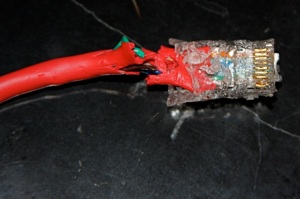
Chewed up network cable by Jeremiah Ro, CC BY-SA
by Jeremiah Ro, CC BY-SA

While we’re here, if you’re interested in following our new posts on Twitter, we’ve unfortunately lost access to our former Twitter handle @geekfeminism: you can now follow @GeekFeminismOrg.

Finally, this is itself an open thread for comments on any subject fitting our policy!

About open threads: open threads are for comments on any subject at all, including past posts, things we haven’t posted on, what you’ve been thinking or doing, etc as long as it follows our comment policy. We’re always looking for fluffy, fun, silly, cute or beautiful open thread starters, please post links to Pinboard or Delicious with the “gffun” tag.

Remembering Malcolm Tredinnick

I flew home from the US yesterday and when I arrived in Sydney I got a message from my husband saying that Malcolm Tredinnick had died. According to this piece by Simon Dulhunty, he was found on Monday to died at home in Sydney, possibly after a seizure, while I was at PyCon 2013.

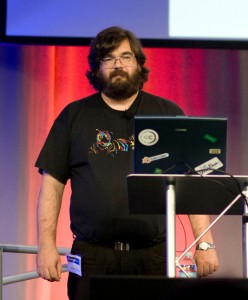
Malcolm Tredinnick speaking to an audience
Malcolm Tredinnick speaking at DjangoCon 2008 (by Sebastian Hilling CC BY-NC)

I’ve known Malcolm slightly since my first linux.conf.au in Sydney 2001. In late 2004 I interviewed for a job at CommSecure (since closed) where he was then working, having been a lead developer of and continuing to maintain and develop a real-time data delivery system for the Hong Kong stock exchange. (The eventual end of that contract was the reason CommSecure later closed.) He was also my boss for about half of 2005 until I left to begin my PhD in early 2006.

I still caught up with him at technical events, the last long conversation I remember with him was at PyCon AU 2011 where my husband Andrew and I had a very Malcolm conversation with Malcolm, which roved over the paperwork hassles of having no fixed address (Malcolm travelled a lot and went through periods where he housesat or lived in serviced apartments for a while), the Australasian chess community, and some gentle mutual trolling between him and Andrew over narrative testing.

What I will remember most about Malcolm is that he was a teacher at heart. I never personally had this relationship with him, but I knew several people at CommSecure and elsewhere who Malcolm had tutored or mentored in programming, often over a very long period of time. Elsewhere I know he had taught mathematics (long before I knew him, he very nearly completed a PhD in mathematics when his area suddenly became fashionable and about 50 years of work was done in 6 months by incoming mathematicians) and chess. I will also remember his dry and sadonic approach to nearly everything (for a very recent example, Malcolm gives useful parenting advice), combined with “really, how hard could it be?” used both straightforwardly and distinctly otherwise. Goodbye Malcolm.

Update, funeral plans: Ray Loyzaga who was Malcolm’s close friend, and long-time founder-CEO of CommSecure, has announced that Malcolm’s funeral will be at 2:30pm Thursday April 4, at Camellia Chapel, Macquarie Park Cemetary, North Ryde, Sydney.

Other memorials:

Malcolm online:

Creative Commons License
Remembering Malcolm Tredinnick by Mary Gardiner is licensed under a Creative Commons Attribution-NonCommercial-ShareAlike 4.0 International License.

Citation delusions: "The most influential paper Gerard Salton never wrote"

In trying to finalise my PhD revisions, I am giving some background on text categorisation.

Extremely briefly, the problem of text categorisation is this: you have a document and some (usually pre-defined, unless you’re clustering) categories. For example, the categories might be news and editorial. Or academic article, newspaper article and blog entry. The choice of categories is application dependent.

Then you have a document you wish to assign to a category. Is it news, or editorial? The typical way of doing this is to assemble a set of training examples: pre-assigned news and editorial pieces. Then you measure the similarity of your new document to the pre-assigned collections, and whichever category it is most like is your document’s category. You might notice that I have not here defined “measure the similarity” and “most like”: that’s often the research question. How can you represent the collections efficiently so that they can be compared against new documents? What are good measures of similarity?

A fairly common way to picture this is (for historical reasons, as we’ll see), a vector. For each word in the vocabulary (the vocabulary being the set of terms used in every document in the training examples, typically, sometimes you might try and smooth the morphology out or similar), you construct a numerical representation. Say the vocabulary is no-good, bad, rotten, and a document reads “no-good no-good bad”, you might describe it as a vector , showing two uses of the first vocabulary item, 1 of the second and none of the third. (Again, whether you count vocabulary items, or weight them in various ways, is a research question. You may also notice that this counting-of-occurences model is a “bag of words” approach, that is, it does not distinguish between “bad rotten” and “rotten bad” even though in language word order and syntactic structure is meaningful. It’s possible to transform the vectors so that this orthogonality of individual words does not hold.)

For reasons that I won’t go into here, I am trying to discuss this model briefly in my PhD thesis — actually, more briefly than I did above — and therefore looking to cite the originator of the idea. I started coming across citations in other papers that looked something like: “Gerard Salton [and others] (1975). A vector space model for information retrieval.” Sounds good. It’s got the key words in it, and quite a few citations!

I like to sight before citing though, which means I found this interesting paper:

David Dubin (2004). The Most Influential Paper Gerard Salton Never Wrote, Library Trends 52(4):748–764.

Gerard Salton is often credited with developing the vector space model (VSM) for information retrieval (IR). Citations to Salton give the impression that the VSM must have been articulated as an IR model sometime between 1970 and 1975. However, the VSM as it is understood today evolved over a longer time period than is usually acknowledged, and an articulation of the model and its assumptions did not appear in print until several years after those assumptions had been criticized and alternative models proposed. An often cited overview paper titled “A Vector Space Model for Information Retrieval” (alleged to have been published in 1975) does not exist, and citations to it represent a confusion of two 1975 articles, neither of which were overviews of the VSM as a model of information retrieval. Until the late 1970s, Salton did not present vector spaces as models of IR generally but rather as models of specific computations. Citations to the phantom paper reflect an apparently widely held misconception that the operational features and explanatory devices now associated with the VSM must have been introduced at the same time it was first proposed as an IR model.

Naturally such a subtle treatment of the history of the model is not great for my immediate purposes: I need That One Citation! (As best I can tell from Dubin, if I have to pick one it should be G. Salton, (1979). Mathematics and information retrieval. Journal of Documentation, 35(1), 1–29.) but it’s fun to come across the analysis of an idea in this form.

Update: if you want a reasonable overview of text classification/topic classification/topic assignment, the survey of choice seems to be Fabrizio Sebastiani (2002). Machine learning in automated text categorization, ACM Computing Surveys, 34(1):1–47. You know, modulo 11 years now.

Kin: the director's commentary

Some additional or rephrased thoughts on kinship, now that I’m not working to a deadline, nor as tired.

Family of origin. There’s luck and privilege involved here, both in having a family of origin you want to have a relationship with, and that wants to have a relationship with you. When there’s choice about it, it’s most often only available to legal adults, at least when it comes to a relationship with one’s parents. I choose to have strong, central relationships with my family of origin, this is active work but work I can only do due to luck and privilege.

Family of choice. There’s some more freedom here, but not everyone goes into life or even into adulthood with the skills, time, energy, mindset etc to form strong bonds with unrelated people. I’ve reached 30 without really doing enough work here.

Children. In talking about the legal relationship, I’m assuming a fair bit more luck and privilege: that is, reproductive control. In that case, one is not legally required to have children in the same way that children must have parents/guardians. In either case, one’s relationship with one’s children is in an interesting place as something like family of origin (traditionally endorsed, legally recognised[1], tightly societally scripted) and like something else: a very intimate relationship with someone you don’t know at all and who will change quite a lot, very quickly. And in some circumstances, one can choose this relationship without any input from the other party (unlike being assigned your parents, in which one usually has no choice, or being assigned your siblings, in which neither sibling typically has any choice). It’s a very odd thing.

So for me my relationship with my child is somewhat outside the “family of origin”/”family of choice” narratives that I’d at least had a long time to consider. It’s not the only relationship one could have that has these features, but it’s the major one I’ve had, and I don’t know that I can write well about it until the story has played out more.

[1] Some luck and privilege here!

Proving Australian citizenship when parents are born after 1986

Update January 2018: the Department of Home Affairs provides a Evidence of Australian Citizenship document to those whose claim to Australian citizenship is not one of the more obvious routes.

I know people who’ve had trouble with this, and won’t tell their specific stories, but a note now that I am applying for a passport for my son.

Australian citizenship is no longer by right of birth: if you were born on or after 20 August 1986, there are various more complicated ways it is acquired. One is being born in Australia and having at least one parent who is an Australian citizen or permanent resident at the time of your birth. Therefore, my son’s passport application has this section:

Please mark which of these documents you will provide at interview (you must present the original):
to prove that the child is an Australian citizen or to prove that one of the child’s parents was either an Australian citizen or a permanent resident of Australia at the time of the child’s birth.

  • The child’s Australian passport issued on/after 01/01/2000 and valid at least two years
  • One parent’s full Australian birth certificate (parent born prior to 20/08/86)
  • One parent’s Australian passport (issued on/after 20/08/86, valid two years)
  • One parent’s Australian citizenship certificate
  • One parent’s Australian permanent resident status

Both my husband and I were born in Australia before 1986, and in addition we happened to hold Australian passports before our son was born in any case, so we have a surfeit of evidence that will satisfy them that he’s a citizen.

But people born in, say, September 1986 are turning 27 this year, and therefore there’s lots of parents and soon-to-be parents whose Australian birth certificates are not sufficient proof of their own Australian citizenship, let alone their child’s status. So it’s very easy to imagine a situation existing right now where someone will need to show up with a grandparent’s birth certificate in addition to a parent’s and their own, and so on. By 2040 or earlier a great-grandparent may be required if no one in the family has held passports in intervening generations (great-grandparent born before August 1986, has a child at age 18+ in 2004, a grandchild in 2022 and a great-grandchild in 2040).

The easiest way around this for citizen-parents seems to be making sure one holds an Australian passport — because it stands on its own, unlike post-1986 birth certificates — before a child’s birth, which is not really foremost in one’s mind at the time. Oh, and be sure to keep it in a safe place until you or any of your children need evidence of their citizenship (usually but not always when they first need a passport themselves), because without it they’ll be back in the same documentation pickle. An increasing number of Australian-born people are going to have to go through the prior process of assembling potentially burdensome proof of citizenship involving either a string of ancestral birth certificates*, or a bunch of evidence of Australian residence on their 10th birthday (see Table B in documenting citizenship). I’d have trouble now proving my own Australian residence at age 10, frankly.

Australia is far from alone in not awarding citizenship by right of birth alone, so I assume there’s either a lot of people around the world who struggle to get passports, or other countries have processes that are more mature and less reliant on finding an ancestor who was unconditionally a citizen.

* Or worse, trying to get hold of 40 year old evidence of someone’s permanent residency, which I suspect is not as available for purchase later on as birth certificates are.