Weekend womanscraft: winter warmers

This article originally appeared on Hoyden About Town.

Anyone who has spent Thursday night/Friday in NSW is probably in need of some winter warmers, at least! What’s warming your innards this season? Here are a few recipes of ours, household style (that is, very imprecise measurements).

Cream of mushroom soup

Closeup photo of about ten button mushrooms

Ingredients:
A few handfuls of button mushrooms.
Half an onion.
About 800mL of stock, possibly somewhat more if using a stove top.
About 100mL of cream or sour cream, or some mixture thereof.

NB: I prefer and recommend sour cream but my co-cook despises it, so we tend to make it with cream.

Preparation: Chop up the mushrooms and onions. Fry the mushrooms and onions together. Add the stock and simmer for 5 to 10 minutes. Add the cream and simmer briefly. Pour into a blender and blend until smooth.

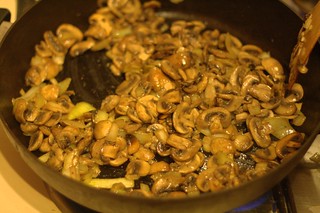
Photo of mushrooms and onions in a frying pan

Alternative preparation: Chop up the mushrooms and onions. Place in slow cooker with cream and stock on low for 4 hours. Pour into a blender and blend until smooth.

Optional additions: we don’t cook anything much in our house in winter without thyme and bay leaves. Be sure to remove the bay leaf before blending.

Serving suggestion: grind pepper over the result.

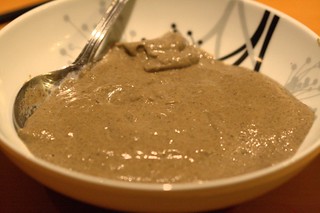
Closeup photo of a bowl of cream of mushroom soup

Slow cooked chicken drumsticks

Ingredients:
An appropriate number of chicken drumsticks.
A 400g tin of diced tomatoes for about every 8 drumsticks.
About 100mL of stock for every drumstick.
A splash of white wine.
As many olives as you think sounds good.
Optional: onion garlic, thyme, bay leaf, etc.

Preparation: roll/dip/immerse the drumsticks in plain flour and briefly brown them in a fry pan (perhaps with onions and garlic). Place them in a slow cooker with all other ingredients and slow cook on high for 4 hours.

Serving suggestion: we serve with couscous.

Red lentil daal

For this we follow a recipe pretty closely, namely Stephanie Alexander’s recipe in The Cook’s Companion. It’s very similar to her published recipe in Fairfax’s Cuisine, except we haven’t been using chilli or mustand seeds.

I’ve also tried this in a slow cooker (don’t pre-soak the lentils, have all the pot ingredients in for 8 hours on low) but it ended up being too smooth for my tastes (I have a very strong aversion to some types of very smooth food, namely well-mashed potatoes, ripe avocados, and a few other things, and this daal went into that range).

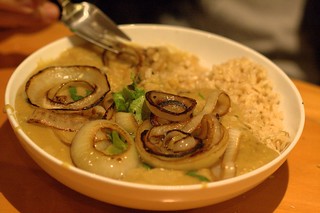
Closeup photo of a bowl full of daal, with fried onions on top and brown rice behind.

Apple crumble

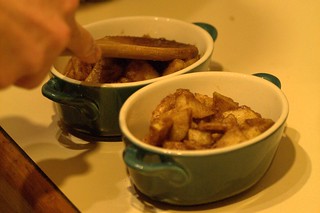
Closeup photograph of cutup apple being placed in cooking vessels.

Another dish where we follow a (simple!) recipe closely, specifically Donna Hay’s recipe for individual portions. We had great luck also, when we had some passionfruit to spare, juicing several of them and mixing the juice with the apple slices for passionfruit crumble.

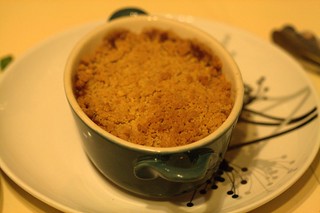
Closeup photo of an individual portion of apple crumble, just after cooking.

A few other warmers you might fancy:

  • Skud’s apple and oat crumble for breakfasts.
  • Tom yum goong can go either way, seasonally, but at this time of year if you make it spicy enough it will warm most of the lower half of your face.
  • Lemon delicious pudding, another great dessert to make in one container or individual portions.

What’s warming you, this winter?

More falsehoods programmers believe about time

Noah Sussman has Falsehoods programmers believe about time, including:

All of these assumptions are wrong

  1. There are always 24 hours in a day.
  2. Months have either 30 or 31 days.
  3. Years have 365 days.
  4. February is always 28 days long.
  5. Any 24-hour period will always begin and end in the same day (or week, or month).

As is usual with these kinds of things, he’s only scratching the surface (even though there’s a lot more than in that excerpt). Andrew and I came up with several more already, on the subject of timezones:

  1. All timezones are vertical lines around the globe evenly spaced in 15 degrees intervals.
  2. All timezones are a whole number of hours offset from UTC.
  3. All timezones are no more than 12 hours offset from UTC.
  4. Two cities within some sufficiently small distance must be in the same timezone.
  5. Two cities with the same longitude must be in the same timezone.
  6. A city further to the east of another city must have a time ahead of or equal to the more western city.
  7. There will only be one timezone within any political boundary.
  8. Within a sufficiently large political boundary, there will be different timezones.
  9. Timezone designations like ‘EST’ are unambiguous.*
  10. Daylight savings shifts occur on the same day around the globe.
  11. Or at least within a hemisphere.
  12. Or at least within a continent.
  13. Or at least within a nation.
  14. Daylight savings shifts occur on predictable dates announced ‘sufficiently far’ in advance that there can be an exhaustive listing of them accurate for the next couple of decades.
  15. Well, at least the next few years.
  16. OK, surely at least this month?

* Both Australia and the United States call their east coast timezone this in winter, and guess what: it’s never the same time in New York as it is in Sydney, and the daylight savings status is seldom the same either. (If you’ve seen Australians call it ‘AEST’, well, yes, we do. Sometimes.)

Useful LaTeX packages: linguistic examples

This entry is part 4 of 4 in the series LaTeX packages

This is the conclusion of a short series of entries on LaTeX packages I found useful while preparing the examination copy of my PhD thesis.

Today’s entry is a package for displaying linguistic examples (ie, samples of text which you then want to discuss and analyse).  The LaTeX for Linguists Home Page is a good general resource for linguists and computational linguists using LaTeX. I discuss gb4e here because I had to do some messing around to get it to display example numbers the way I want (and the way my supervisor wanted: he likes in-text references to look like “example (4.1)” rather than “example 4.1”), and to get it to work with cleveref, and no one seems to have written that up to my knowledge.

gb4e

gb4e is a linguistic examples package.

usepackage{gb4e}

Input looks like:

begin{exe}
ex This is an example sentencelabel{example}
ex This is another example sentence.
end{exe}

This is a cleveref reference to cref{example}.
This is a normal reference to example (ref{example}).

You can mark sentences with * and ? and so on:

begin{exe}
ex[*] {This is an sentence ungrammatical.}
ex[?] {This is an questionably grammatical sentence.}
end{exe}

You can do sub-examples:

begin{exe}
ex This is an example.
ex
begin{xlist}
ex This is a sub-example.
ex This is another sub-example.
end{xlist}
end{exe}

A few things to do to make gb4e play really nicely. First, some cleveref config. gb4e doesn’t yet automatically tell cleveref how to refer to examples, so you need to tell it that the term is “example”, and second, if you want braces around the number (“example (1.1)” rather than “example 1.1” you need to tell it to use brackets:

% tell cleveref to use the word "example" to refer to examples,
% and to put example numbers in brackets
crefname{xnumi}{example}{examples}
creflabelformat{xnumi}{(#2#1#3)}
crefname{xnumii}{example}{examples}
creflabelformat{xnumii}{(#2#1#3)}
crefname{xnumiii}{example}{examples}
creflabelformat{xnumiii}{(#2#1#3)}
crefname{xnumiv}{example}{examples}
creflabelformat{xnumiv}{(#2#1#3)}

Also, by default, the gb4e numbering does not reset in chapters. That is, your examples will be numbered (1), (2), (3) etc right through a thesis. You probably want more like (1.1), (1.2), (2.1), (2.2), ie chapter.number. Change to this with the following in your preamble:

% Store the old chapter command so that
% our redefinition can still refer to it
letoldchapterchapter
% Redefine the chapter command so that it resets the
% 'exx' counter that gb4e uses on every new chapter.
renewcommand{chapter}{setcounter{exx}{0}oldchapter}

% Redefine how example numbers are shown so that they are
% chapter number dot example number
renewcommand{thexnumi}{thechapter.arabic{xnumi}}
You could also get it to reset in sections by replacing chapter and thechapter with section and thesection in the above.

Thanks to the TeX Stack Exchange community for their help with this. See Section based linguistic example numbering with brackets for more information.

Useful LaTeX packages: within document references

This entry is part 3 of 4 in the series LaTeX packages

This is part of a short series of entries on LaTeX packages I found useful while preparing the examination copy of my PhD thesis.

Today’s entry is packages relevant to preparing within document references. These are both fairly new to me, although not absolutely now.

hyperref

This package turns cross-references and bibliography references into clickable links in your output PDF (at least if you generate it with xelatex or pdflatex), without you having to do anything other than the ref (or cleveref’s cref) and cite and so on commands.

usepackage{hyperref}

You will probably want to modify its choice of colours to something more subtle:

usepackage[citecolor=blue,%
    filecolor=black,%
    linkcolor=blue,%
    % Generates page numbers in your bibliography, ie will
    % list all the pages where you referred to that entry.
    pagebackref=true,%
    colorlinks=true,%
    urlcolor=blue]{hyperref}

Use black if you want the links the same colour as your text.

One note with hyperref: generally it should be the last package you load. There are occasional exceptions, see Which packages should be loaded after hyperref instead of before?

cleveref

cleveref is a LaTeX package that automatically remembers how you refer to things. So instead of:

see chapter ref{chapref}

you use the cref command:

see cref{chapref}

It handles multiple references nicely too:

see cref{chapref,anotherchapref}

will generate output along the lines of “see chapters 1 and 2”.

Use

Cref{refname}

to generate capitalised text, eg “Chapter 1” rather than “chapter 1”

To use it:

usepackage{cleveref}

It shortens the word “equation” to “eq.” by default, if you don’t like that, then:

usepackage[noabbrev]{cleveref}

For some packages that don’t yet tell cleveref how to refer to their counters, you will get output like “see ?? 1” rather than “see example 1”. You use the crefname command in the preamble to tell it what word to use for each unknown counter, examples of crefname will be shown tomorrow for gb4e.

Useful LaTeX packages: tables and figures

This entry is part 2 of 4 in the series LaTeX packages

This is part of a short series of entries on LaTeX packages I found useful while preparing the examination copy of my PhD thesis.

Today’s entry is packages relevant to preparing tables or figures. Again, some are pretty widely known and some aren’t.

rotating

If you have a big table or figure that should be rotated sideways onto its own page:

usepackage{rotating}

And then you can replace the table and figure commands with:

begin{sidewaystable}
%Giant table goes here
end{sidewaystable}
begin{sidewaysfigure}
%Giant figure goes here
end{sidewaysfigure}

dcolumn

The dcolumn package produces tabular columns that are perfectly aligned on a decimal point (ie all the decimal points in that column are exactly underneath each other), which is usually how you want to display decimal numbers.

usepackage{dcolumn}

% create a new column type, d, which takes the . out of numbers, replacing the .
% with a cdot and aligning on it.
newcolumntype{d}[1]{D{.}{cdot}{#1}}

Now that you have defined the column type, you can use d in the tabular environment, where the numeric argument is the number of figures to expect after the decimal point. You don’t have to use exactly that number of figures in every entry, just that that’s how much room it will leave.

% a tabular enviroment with a 1 and 3 figures after the decimal point column
begin{tabular}{d{1}d{3}}
1.6 & 1.657
\
2.0 & 6.563
\
7 & 6.26
\
end{tabular}

One annoying aspect of this package is that for the headers of that column, which probably aren’t numbers, you will need to use multicolumn to get them to display nicely.

% a tabular enviroment with a 1 and 3 figures after the decimal point column
begin{tabular}{d{1}d{3}}
multicolumn{1}{c}{Heading 1} & multicolumn{1}{c}{Heading 2}\
1.6 & 1.657
\
2.0 & 6.563
\
7 & 6.26
\
end{tabular}

You can mix the d column type with the usual l, r and p column types.

threeparttable

You can’t use footnote in a floating table. This is one of several packages that allow table footnotes in various ways.

usepackage{threeparttable}

threeparttable doesn’t cause tables to float on its own, so you usually want to wrap in a table command:

begin{table}

begin{threeparttable}

% Normal bits of your table go here, and use tnote{a} and
% tnote{b} and so to generate a note mark

begin{tablenotes}
tnote General note
tnote General note 2
tnote[a] Note for mark a
tnote[b] Note for mark b
end{tablenotes}

end{threeparttable}

caption{Caption goes here}
end{table}

Unfortunately you need to generate the a, b, c (or whatever) numbering manually.

The general tnote entries are useful for things like “Bold entries are highest in the column”, so that they don’t need to go in the caption.

Useful LaTeX packages: bibliography

This entry is part 1 of 4 in the series LaTeX packages

I’m going to post a short series of entries on LaTeX packages I found useful while preparing the examination copy of my PhD thesis. Largely this is just so that there’s a reference if my wiki page goes away, but also because I think many people use LaTeX the way I use it, that is, I got wedded to a bunch of packages 10 years ago and never really looked around for more recent stuff.

Today’s entry is a pretty slow start: the bibliography packages I used are pretty standard.

natbib

This is one of the most sophisticated and widely used packages for Harvard-style references (ie, “(Surname, Year)” rather than “[1]” style references).

usepackage[round]{natbib}
bibliographystyle{plainnat}

Inside your text use citep for a reference in parentheses “(Surname, Year)”, and citet for a in-text reference “Surname (Year)”. Its important to note that the plain cite command is equivalent to citet, which you may not expect.

You can use citeauthor to get just “Surname” and citeyear to get just “Year”.

bibentry

This is a useful add-on to natbib, which allows you to insert full bibliography entries into the body of your text. This is useful in the declaration portion of a thesis (where you say something like “this thesis incorporates revised versions of the following published articles”).

usepackage{bibentry}
nobibliography*

Then later on when you want to insert a full bibliography entry into the middle of your text:

bibentry{citationkey}

Getting a passport in Australia

See Lindsey Kuper on a expedited US passport, here we have another “life in Australia” comparison piece.

Step 1: obtain passport form. If you are an adult renewing an existing adult passport that has been expired for less than 24 months, you can do this online. Otherwise, obtain form from nearest post office.

Step 2: track down someone — usually just another passport holder — to be your photo referee (ie, to agree that it is you in the picture). Gather relevant documentation, that is, proof of identity and of citizenship. If you were born in Australia on or after 20 August 1986, see below.

Step 3: ring up local post office for passport interview, usually granted within the week. If you need it sooner, call several post offices in turn or go to the Passport Office (in a capital city).

Step 4: attend post office. Have them take your photo, these days, because if they don’t approve it, they can take it again. Have interview, which in fact largely consists of having your documentation and photo checked for validity.

Step 5: pay fee ($233), extra $103 for priority.

Priority passports are printed to be mailed within 2 business days, other applications within 10. They arrive registered post (ie, signature required). If you require one within 2 days, it seems you need to attend a Passport Office in person and hope they can help.

Given that I understand it takes weeks and weeks to get a USA passport if not expedited, 10 days is not too bad.

Born in Australia on or after 20 August 1986? Tricky! This is when Australia stopped granting citizenship by right of birth alone. So you need proof of citizenship, which can include:

  • evidence that you were born in Australia and that one of your parents was either a citizen or permanent resident at the time of your birth
  • evidence that you were born in Australia and that you were still a resident of Australia on your 10th birthday (school records and so on)
  • evidence that you were born in Australia and were not eligible for any other citizenship
  • see also

This diversion has been known to be lengthy. 🙁 It’s also just about impossible to get one as a minor if your guardians don’t agree to you travelling.

Have a small child with you?

Good luck with that, because the photo standards require straight on face shot with open eyes and neutral facial expression. Try getting your pre- or semi-verbal child to do that.

Should you give birth privately?

A few people have been researching their options over the last few years about giving birth in Australia, and have asked me what I think about having private health insurance or giving birth in a private hospital.

Background: maybe you shouldn’t ask me! I’m not a health professional, I’m a mother of one, and he was born in a public hospital, in which I was a public patient.

And now, crucial fact about private hospital cover: it pays much of your hospital stay fees and some of your doctor’s in-hospital fees. It does not pay for private consultations with a doctor in an outpatient/private room setting.

You know what obstetricians charge a lot for? The “pregnancy management” fee, to cover your outpatient care in pregnancy. If I recall correctly, the Medicare rebate for this is on the order of $400 to $500. In Sydney, private obstetricians may charge upwards of $4000 for this fee. Who covers the difference? You do. (OK, full disclosure, the Medicare Safety Net may help too, I don’t know the details except that MSN actually cut benefits specifically for obstetricians a few years ago because they’d all upped their fees to incorporate the MSN rebate. So, mostly you do!) Also, anaesthetists in the private hospitals usually end up with a decent gap fee, if you have an epidural or Caesearean.

So, private system birthing is expensive regardless of insurance.

Finally, tests like ultrasounds are usually Medicare plus out-of-pocket too.

Now, birth choices in Australia.

Homebirth. There are some very small number of hospitals in Australia that will allow their midwife staff to attend some homebirths. It’s very easy to get disqualified from such a program. I would be on several grounds (some more legit than the one I’m about to give you), including the simple fact that my son’s birthweight was over 4.0kg.

You might also birth with a privately practicing midwife, or, in theory, with a private midwife collaborating with an obstetrician as backup (there are very few such arrangements so far). Most, although not all, private midwives will also only work with pretty low-risk women (singleton pregnancies, head-down, no high blood pressure or diabetes, that sort of thing, about 80% of pregnancies get a low-risk classification IIRC).

Is private insurance useful? Some private health funds provide some limited cover for this, I believe, on the order of $1k to $2k of the midwife’s fee, which is around $5k last time I looked. In the collaboration setup Medicare contributes too, I think?

Birth centre These are midwife-only maternity units attached to public hospitals. (Sometimes at some physical distance, eg Ryde Hospital only has a birth centre, with transfers to Royal North Shore several suburbs away.) You need to be assessed as low risk and if that assessment changes (and this isn’t uncommon, eg, your baby is breech or you get diabetes or pre-eclampsia) you get summarily transferred to the doctors and your whole care team often is suddenly switched out from under you. (Also they usually don’t do epidurals, I think? So the transfer rate for pain relief is not insubstantial I believe.)

Is private insurance useful? No, this is publicly funded.

Public hospital, midwife’s clinic If you go to a public hospital, and are assessed as low risk, almost all of your pregnancy management will be by midwives. Often they “caseload” now, meaning you see the same one each time. Again, if you become high risk, swish, off to the doctors.

Is private insurance useful? No, this is publicly funded.

Public hospital, doctor’s clinic. If you aren’t low risk, this is you. (This was me.) Chronic health problems or pregnancy complications (like pre-eclampsia) put you here. For your appointments, or at least most of them, you see an OB registrar or staff specialist. On high rotation, often, that is, you won’t usually see the same one many times. If you have a vaginal birth it may still be midwife-only, or largely midwife managed.

Is private insurance useful? No, this is publicly funded.

Public hospital, private doctor’s patient. In this case, you choose your doctor, see them mostly in their own clinic, birth in a public hospital (with you or your private insurer paying for the facilities) with the doctor of your choice attending. This is subject to gap fees for the doctor.

Is private insurance useful? Yes, pays for your accommodation and some of the OB’s and anaethestist’s (if needed) gap.

Public hospital, private midwife’s patient. This depends on a midwife/obstetrician collaborative practice. As I said, rare, but there’s at least one that allows a public hospital birth (private admission) with the midwife of your choice: Melissa Maiman in Sydney.

Is private insurance useful? Yes, pays for your accommodation. Not sure what happens if an OB and/or anaethestist are needed.

Private hospital, private doctor’s patient. There’s no midwife-managed option. If you’re birthing in a private hospital, you need a doctor of your choice attending. Again, pre-birth consultations in their own clinic, and subject to gap fees.

It’s definitely worth noting that while your private doctor will be an obstretrician and can manage higher risk pregnancies, for really serious stuff like prematurity earlier than a certain point, pregnancies with more than 2 babies on board (I think) and similar, they will actually refer you into the public system!

Is private insurance useful? Yes, pays for your accommodation and some of the OB’s and anaethestist’s (if needed) gap.

Public hospital, high risk clinic. I don’t know much about this, I’m told it’s the next level up in risk, and it well might be my next pregnancy. Joy. This is where you end up with OBs with a high risk interest, maternal-fetal medicine specialists (OBs with a formal subspecialty in very high risk pregnancies), renal physicians, endocrinologists, etc. This often involves referral to a tertiary hospital. (Sometimes specialists can consult without you being in one of these, like, an endocrinologist might monitor diabetes or thyroid hormones with you in the regular doctor’s clinic or seeing a private OB.) Birth choices guides don’t talk about this option very much, because you don’t really have a choice at this point (except birthing unattended or with a very risk-tolerant private midwife).

Is private insurance useful? I’m not sure, to be honest. It probably depends on the risk profile of your actual birth, I guess? If your birth is able to be attended by a regular private OB, maybe they let you do this? But you can do this publicly too.

Further reading on birthing choices
My Birth has a lot of information on birth procedures and the outcomes of different birthing providers, from a low intervention advocacy standpoint. One thing of note which gets picked up a lot by low intervention advocates is that despite the private birthing system referring all their hardest cases back to public, and despite the public patient profile being poorer with less good preventative health care and so on, private hospitals have much higher intervention rates.

Conclusion

It really depends on where you want to birth and with who attending. If the idea of the same doctor doing your pregnancy management and attending your birth appeals, that’s tending towards private birthing and thus private health insurance. But it has high out of pocket costs on top of the insurance premiums. (Note also that private health insurance policies are expensive if you include obstetric coverage, and will always have a 12 month waiting period for it, so you must obtain it before pregnancy.)

I was reasonably happy as a doctor’s clinic patient for my first birth. If I was low-risk I’d probably likewise go public, ideally with a birth centre or caseload midwife pregnancy+birth.


Sunday Series: Discworld

This article originally appeared on Hoyden About Town.

Warning: highly opinionated post follows. Friendly disagreement more than welcome.

It’s been a couple of years since an entirely gratuitous Terry Pratchett thread, and a Twitter discussion asked about favourite Pratchett novels, with a focus on readers new to Pratchett. What think you?

My overall favourite is Night Watch, but I think it would be a terrible place to start reading: you need the context of the earlier Night Watch sub-series for background. Night Watch follows Guards! Guards!, Men At Arms, Feet of Clay, Jingo and The Fifth Elephant. You could possibly skip Feet of Clay and Jingo and have most of the background, but that’s still a fair commitment. You want The Fifth Elephant because it introduces the major characters in an ongoing multinational inter-species political struggle (Monstrous Regiment, Thud!, Unseen Academicals, Snuff), but it’s also probably not strictly necessary as background to Night Watch.

The Night Watch sub-series is also interesting technically, as Pratchett has created two absurdly powerful political characters in this series (Vimes, the head of police, and Vetinari, the ruler of Ankh-Morpork), and has to come up with increasingly aggressive scenarios to actually challenge them. He has written elsewhere about finding this annoying when he wants to write interesting stories in Ankh-Morpork without Vimes sticking his nose into them.

It’s worth warning that Night Watch is one of the darker novels, with offscreen torture and onscreen immediate-aftermath-of-torture. Small Gods has similar warnings (religiously inspired torture), if you’re OK with that it is good and very self-contained, and has also served as an entry point for a number of people.

The first Discworld I ever read was Hogfather and I think it’s actually not a bad starting point, since it’s a fairly self-contained story and contains a bunch of core Discworld themes concerning how magic and divinity work. It also has a great heroine who unfortunately, in my opinion, otherwise appears in pretty mediocre Discworld novels.

Probably for most Hoyden readers I’d recommend starting with Equal Rites or Wyrd Sisters and reading through the Witches novels, which is where I went after Hogfather. The Tiffany Aching books didn’t exist at the time, but they’re very much in the spirit of the Witches novels, except that the Witches seem much more organised in them: Pratchett can’t leave well enough alone when it comes to creating power structures. See tigtog’s post about the Witches for more.

I find the Rincewind/wizards sub-series pretty unworthwhile, and still haven’t actually read all of it, so I can’t speak to that fairly.

Edited to add: there is a well-known reading order guide, which lays out the various sub-series in a flowchart style, but I cannot find an accessible version. Hence this post refers directly to the sub-series wiki pages.

Product review: GoGet carsharing

We’ve been non-car owners again for a few weeks and members of GoGet car sharing for a month or so. These are my initial impressions.

This is against a background of our car being primarily used for occasional errands, and weekend excursions either locally (to the beach etc) or to regional cities. We also used to use our car for our son’s daily childcare run, but since we moved, his new childcare is in walking distance. I wouldn’t recommend GoGet to anyone who has a daily errand, this review is largely comparing it to having an occasional-use personal car.

Good things compared to car ownership:

  1. most areas where there is a car at all, there’s more than one. An out-of-action car does not mean “no car use at all until car repaired”
  2. they take care of on-road costs and insurance. Of course, this is bundled into subscriber fees, but it both flattens them over the year and works out cheaper for our usage. I think in theory they aim for a car for every 10 subscribers or so? We’re on the Frequent member plan, so I guess you could say our on-road costs are $360 a year.
  3. they take care of repairs. Again, bundled in, but flattened and so on.
  4. they take care of having a free parking spot by paying the council for guaranteed spots.
  5. (maybe arguably good) they turn the fleet over far more often than most people I know replace their cars.

Good things compared to car rental:

  1. the cars are just sitting there, in our case quite close by. You just get online, book, and walk up and take one. You only sign away your life in triplicate once. You don’t have to budget in a trip to the car rental place, a wait in a queue, a briefing on the terms and conditions and an inspection of the car.
  2. the insurance is reasonable rather than the typical car rental deal with a $3500+ excess unless you pay them 1/2 the rental cost again. With GoGet, if you can wear a $1500 excess it’s built in to the base pricing, or you can pay about $18 per day to bring it down to $300.
  3. you have to return the car with at least 1/4 of a tank of fuel, which is a lot easier to achieve than the full tank rental companies require.
  4. both the possibility of hourly bookings and the hour saving in pickup time make them way more useful for errands and so on.
  5. close to instantaneous bookings, subject to availability, whereas rental companies often struggle with sub-24-hours-notice requests

Bad things:

  1. Bookings start and finish on the hour. In pathological cases (say you need a car from 1245 to 1315) you pay for two or three hours of use in order to use the car for an hour or so.
  2. They’re for-profit, presumably this could be done cheaper not-for-profit. This is a bad thing-asterisk though: as I know very well, NFPs don’t magically appear out of thin air. Someone would still have to set up an entire car sharing company except with only a salary to motivate them.
  3. GoGet’s big thing is “we pay for fuel”. And they do pay in the sense of providing fuel cards, but they also have a 39c per kilometre usage charge for bookings that aren’t a day long booking. 40c per kilometre adds up fast!
    In theory the day booking rate (24 hours and 150km free for $68) kicks in as soon as your per-hour spend exceeds the day rate, for most cross-metro trips you’re probably going to nearly hit that.
  4. (potentially) GoGet does not accept any member who has a major traffic offence in the last 10 years of driving, and all applications for membership are at the discretion of their insurer. This contributes to the cheaper insurance compared to car rental, but it obviously disadvantages people who do have a traffic record or a history of at-fault accidents.
  5. not an enormous amount of choice wrt make and model, less than many larger rental centres. Really your choice boils down to little-medium-big in whichever make and model are nearby. (For us little == Toyota Yaris, medium == Hyundai i30s and i30 wagons, and big == Hyundai iMax.)
  6. some contention for them. Our experience is that with weekends, we really need to plan our trip the day before to have a good chance of a single car in Glebe being free over the entire block of time we need, and it’s probably worse in suburbs with less cars (Glebe has at least 10, and Pyrmont and Ultimo another 15 or so). Long weekends are worse because people take them away, and the iMaxes get booked really early most weekends.
  7. lack of flexibility with end time. That is, if we want to go somewhere and book a car accordingly but then someone invites us to dinner or whatever, we may not be able to stay because the car needs to be back. We haven’t had to try for last-minute use extensions yet, so we don’t know how often we will find that the car has 3 hours free just after our booking.
  8. if something goes wrong with your booking, they give you a $25 credit on your account, which unless the error is very minor is really not enough. To be fair, they do shift the booking to another car if they can, but on weekends this would be hard, see 6.
  9. fitting children’s car seats is a pain in the neck.
  10. their setup has an annoying feature whereby if it is the very first time that you in particular have used a given car in the fleet, the booking needs to take place about 15 minutes before your slot, so that the car can download your access data. Less important once you’ve used the car nearest to you for the first time.

In the medium term, this is likely to be a sufficiently good replacement for our occasional-use car.