
Blogging for Geek Feminism, a short history

With yesterday’s release of Spam All the Links, I’ve finished my long awaited project of departing the Geek Feminism blog.

I was involved in the blog on, if not from the first day of its existence, at least from the first week of it. My involvement in the blog was huge, and comprises among other things:

  • over 200 posts to the blog
  • founding and for a long time running the Ask a Geek Feminist, Wednesday Geek Woman and Cookie of the Week series
  • doing a linkspam post by myself multiple times a week for about a year
  • recruiting the initial team of Linkspammers and setting up their manual, mailing list and of course, the script that supports them
  • recruiting several other bloggers, including Tim, Restructure! and Courtney S
  • a bunch of sysadmin of the self-hosted WordPress install (it’s now hosted on WordPress.com)

My leaving the blog is delayed news. I initially told the co-bloggers I was leaving close to a year ago now (mid-August, if I’d waited much longer on writing this I could have posted on the one year anniversary), because my output had dried up. I feel in large part that what happened was that I spent about ten years in geekdom (1999–2009) accumulating about three years of material for the blog, and then I ran out of things to write about there. I also have two more children and one more business than I had when I was first writing for it, and, very crucially, one less unfinished PhD to avoid. But I had a handover todo list to plod my way through, and Spam All the Links was the last item on it!

I remain involved in Geek Feminism as an administrator on the Geek Feminism wiki, on which I had about 25% of total edits last I looked, although the same sense of being a dry well is there too.

The blog was obviously hugely important for me, both as an outlet for that ten years of pent up opinionating and, to my surprise, because I ended up moving into the space professionally. I’m glad I did it.

Today, I would say these are my five favourite posts I made to the blog:

“Girl stuff” in Free Software, August 2009 (original link):

Terri mention[ed] that she had resisted at times working on things perceived as ‘girl stuff’. In Free Software this includes but is not limited to documentation, usability research, community management and (somewhat unusually for wider society) sometimes management in general. The audience immediately hit on it, and it swirled around me all week.

Why we document, August 2009 (original link):

I do not in fact find writing the wiki documentation of incidents in geekdom very satisfying. The comment linked at the beginning of the post compared the descriptions to a rope tying geekdom to the past. Sometimes being known as a wiki editor and pursued around IRC with endless links to yet another anonymous commenter or well-known developer advising women to shut up and take it and write some damned code anyway is like a rope tying me to the bottom of the ocean.

But what makes it worth it for me is that when people are scratching their heads over why women would avoid such a revolutionarily free environment like Free Software development, did maybe something bad actually happen, that women have answers.

(I’d be very interested in other people’s takes on this in 2015, which is a very different landscape in terms of the visibility of geek sexism than 2009 was.)

Why don’t you just hit him?, December 2010 (original link):

This is the kind of advice given by people who don’t actually want to help. Or perhaps don’t know how they can. It’s like if you’re a parent of a bullying victim, and you find yourself repeating “ignore it”, “fight back with fists” or whatever fairly useless advice you yourself were once on the receiving end of. It’s expressing at best helplessness, and at worst victim-blaming. It’s personalising a cultural problem.

You are not helpless in the face of harassment. Call for policies, implement policies, call out harassment when you overhear it, or report it. Stand with people who discuss their experiences publicly.

Anti-pseudonym bingo, July 2011 (original link):

Let’s recap really quickly: wanting to and being able to use your legal name everywhere is associated with privilege. Non-exhaustive list of reasons you might not want to use it on social networks: everyone knows you by a nickname; you want everyone to know you by a nickname; you’re experimenting with changing some aspect of your identity online before you do it elsewhere; online circles are the only place it’s safe to express some aspect of your identity, ever; your legal name marks you as a member of a group disproportionately targeted for harassment; you want to say things or make connections that you don’t want to share with colleagues, family or bosses; you hate your legal name because it is shared with an abusive family member; your legal name doesn’t match your gender identity; you want to participate in a social network as a fictional character; the mere thought of your stalker seeing even your locked down profile makes you sick; you want to create a special-purpose account; you’re an activist wanting to share information but will be in danger if identified; your legal name is imposed by a legal system that doesn’t match your culture… you know, stuff that only affects a really teeny minority numerically, and only a little bit, you know?

But I’m mostly listing it here because I always have fun with the design of my bingo cards. (This was my first time, Sexist joke bingo is better looking.)

I take it we aren’t cute enough for you?, August 2012 (original link):

… why girls? Why do we not have 170 comments on our blog reaching out to women who are frustrated with geekdom? I want to get this out in the open: people love to support geek girls, they are considerably more ambivalent about supporting geek women.

The one I’m still astonished I had time for was transcribing the entire Doubleclicks “Nothing to Prove” video. 2013? I don’t remember having that kind of time in 2013!

Thanks to my many co-bloggers over the five years I was a varyingly active blogger at Geek Feminism. I may be done, at least for a time and perhaps in that format, but here’s to a new generation of geek feminist writers joining the existing one!

Hand holding aloft a cocktail glass
from an image by Susanne Nilsson, CC BY-SA
Image credit: Cheers! by Susanne Nilsson, Creative Commons Attribution-Sharealike. The version used in this post was cropped and colour adjusted by Mary.

Code release: Spam All the Links

The Geek Feminism blog’s Linkspam tradition started back in August 2009, in the very early days of the blog and by September it had occurred to us to take submissions through bookmarking services. From shortly after that point there were a sequence of scripts that pulled links out of RSS feeds. Last year, I began cleaning up my script and turning it into the one link-hoovering script to rule them all. It sucks links out of bookmarking sites, Twitter and WordPress sites and bundles them all up into an email that is sent to the linkspamming team there for curation, pre-formatted in HTML and with title and suggestion descriptions for each link. It even attempts to filter out links already posted in previous linkspams.

The Geek Feminism linkspammers aren’t the only link compilers in town, and it’s possible we’re not the only group who would find my script useful. I’ve therefore finished generalising it, and I’ve released it as Spam All the Links on Gitlab. It’s a Python 3 script that should run on most standard Python environments.

Spam All the Links

Spam All the Links is a command line script that fetches URL suggestions from
several sources and assembles them into one email. That email can in turn be
pasted into a blog entry or otherwise used to share the list of links.

Use case

Spam All the Links was written to assist in producing the Geek Feminism linkspam posts. It was developed to check WordPress comments, bookmarking websites such as Pinboard, and Twitter, for links tagged “geekfeminism”, assemble them into one email, and email them to an editor who could use the email as the basis for a blog post.

The script has been generalised to allow searches of RSS/Atom feeds, Twitter, and WordPress blog comments as specified by a configuration file.

Email output

The email output of the script has three components:

  1. a plain text email with the list of links
  2. a HTML email with the list of links
  3. an attachment with the HTML formatted links but no surrounding text so as to be easily copy and pasted

All three parts of the email can be templated with Jinja2.

Sources of links

Spam All the Links currently can be configured to check multiple sources of links, in these forms:

  1. RSS/Atom feeds, such as those produced by the bookmarking sites Pinboard or Diigo, where the link, title and description of the link can be derived from the equivalent fields in the RSS/Atom. (bookmarkfeed in the configuration file)
  2. RSS/Atom feeds where links can be found in the ‘body’ of a post (postfeed in the configuration file)
  3. Twitter searches (twitter in the configuration file)
  4. comments on WordPress blog entries (wpcommentsfeed in the configuration file)

More info, and the code, is available at the Spam All the Links repository at Gitlab. It is available under the MIT free software licence.

Is harassment in your community unwelcome? Adopt a Community Anti-Harassment Policy!

This article originally appeared on Geek Feminism.

Last week, the Geek Feminism community announced that we’ve adopted a code of conduct in our community. Our code begins:

The Geek Feminism (GF) community is dedicated to providing a harassment-free experience for everyone, regardless of gender, gender identity and expression, sexual orientation, disability, physical appearance, body size, race, or religion. We do not tolerate harassment of participants in any form.

This code of conduct applies to all Geek Feminism sponsored spaces, including our blog, mailing lists, and wiki, as well as any other spaces that Geek Feminism hosts, both online and off. Anyone who violates this code of conduct may be sanctioned or expelled from these spaces at the discretion of the Geek Feminism Anti-Abuse Team.

We took quite a long time to do this, after two harassment incidents associated with the Geek Feminism community (albeit, one probably not by people who are actually active in our spaces and who therefore can’t be excluded from them). We’d love it if others learned from our example and adopted a policy within their own communities. To that end, as of today, our Community Anti-Harassment Policy is available for re-use under Creative Commons Zero/public domain and we are beginning to develop associated resources, just as we have done over the past few years for the Conference anti-harassment policy

Here’s what you need:

  1. a policy (remember, ours is available for re-use, either as is, or in a modified form)
  2. a contact point where harassment reports can be received
  3. a group of responders who receive reports and have the power to act on them up to and including excluding harassers from your community

If your community does not have an obvious way to create a group of responders, start discussing how you can create one. In many communities, there is likely to be an existing volunteerocracy at the very least. Can these people reach consensus that your community should be safer from harassment, and that they are unwilling to work with harassers? Simply announcing to people that they must cease a behaviour, or they must leave the community, is in fact very effective as long as there is basic consensus around community norms. For online groups technical structures can help, but social structures are in fact the root of anti-harassment. You don’t need ops or admin power or the crown of the ancient rulers to enforce anti-harassment policies in your community, you need consistent anti-harassment responses by people with social power.

If you don’t know that your community has concensus on being anti-harassment. as a start you can declare your own personal anti-harassment stance, and publicly call for your community to adopt a anti-harassment policy, and a structure that enables the response team to exclude people from the community.

As Geek Feminism shows, activist groups or groups that have advocated for anti-harassment are not safe from internal harassment and still need a policy. And groups with no known harassment incidents are also not safe; it’s quite likely that people in your community have experienced harassment they felt unable to identify or report. Take steps to ensure harassing behaviour becomes known, and that it is known to be unacceptable.

One specific model we encourage you to avoid is the Our community is amazing! So wonderful! We rock! PS no harassment model in which you spend a lot of time affirming your community’s goodness and make a general statement about anti-harassment in passing. We discourage putting this in your anti-harassment policy for these reasons:

  1. you probably do not know the extent of harassment in your community without a policy and a reporting mechanism, and may not rock as much as you think
  2. stating that you are “anti-harassment” without saying what harassment means to you doesn’t give your existing community and potential new members the information they need to find out if their safety needs are a close enough match for your community’s norms

Stating your community’s great work or exemplary behaviour can be really useful for establishing social norms and letting people understand what joining your community means. They form a good basis for specific policies. But don’t make such statements in your anti-harassment policy, make them in a separate document listing your community’s values and goals. And it may be best to say that you aspire or intend to create an amazing space, rather than that you have definitely attained that goal. Statements that you are definitely no questions amazing may be used to silence people with critical feedback and in the end reduce your amazingness.

We also discourage private anti-harassment policies (shared only within a community or within its leadership), for reasons outlined by the Ada Initiative [disclaimer: I co-founded the Ada Initiative].

Do you already have a community anti-harassment policy, or have we convinced you to adopt one? List your community on the Community anti-harassment adoption page! And thank you.

Open thread: never say “fake geek” again!

This article originally appeared on Geek Feminism.

Hello again! Hopefully everyone is enjoying our newly working blog (no one is seeing regular 503 errors right? RIGHT? no seriously, let us know if you are). We’re celebrating with an open thread for comments on any subject fitting our policy!

Feature item for this open thread is Nothing to Prove (subtitled version available in Amara) by geek sister musicians The Doubleclicks. The band talk about the song and video on their blog. Additional images can be submitted on geekgirlvideo.tumblr.com. Transcript at the bottom of this post.

(
{“video_url”: “http://www.youtube.com/watch?v=s4Rjy5yW1gQ”}
)

Various reminders:

  • (Re-)Follow us on Twitter! Our new, working, Twitter handle is @GeekFeminismOrg (follow); we’ve permanently lost access to @geekfeminism.
  • Sharing links: we no longer can access links for linkspams submitted via delicious.com. Currently most of our regular linkspam submitters are signed up to Pinboard.

About open threads: open threads are for comments on any subject at all, including past posts, things we haven’t posted on, what you’ve been thinking or doing, etc as long as it follows our comment policy. We’re always looking for fluffy, fun, silly, cute or beautiful open thread starters, please post links to Pinboard with the “gffun” tag.

Partial transcription of video:

Transcriber’s note: the video clip consists of many short videos of a geek or sometimes two geeks holding up a sign to the camera. for time reasons, I am only transcribing the signs, not giving a description of people’s appearance or their surroundings, other than noting geeks who appear to me to be men. I’m aware that several of them are geek celebrities, but I haven’t looked them up. Signs are in square braces.

[Opening credits: “Nothing to Prove”, a music video by the Doubleclicks.]

I entered this scene through rejection and honesty

[Two people: Hi there! We are geek girls.]
[I started playing DnD in 6th grade. I never stopped.]

Nerds weren’t mean, they were weird and that worked for me

[I learned to read with comic books.]
[I’ve been a gamer since before I can remember.]

After 10 years of teasing when social skills failed me

[I grew my hair out / so I could dress up as Princess Leia.]

Dungeons & Dragons cured all that ailed me

[I played Myst when it was released. I was 11. It was the GREATEST DAY OF MY LIFE!]

We read books, we played games, we made art, we watched Lost

[My Transformers played with my Cabbage Patch Kids.]
[I received my first console when I was nine years old.]

We said things like “D20”, “shipping” and “Mana cost”

[My regular Saturday night “date” was the 5th doctor.]
[Comics taught me women can be beautiful & powerful.]

It felt good to be myself, not being mocked

[Founder and president of my high school Star Trek fan club.]
[I spend HUNDREDS of hours on cosplay.]

Still self-conscious, though, we whispered things about jocks

[Adult and child: I’m raising the next generation of Geek Girls!]
[Accounting associate by day, Elf Ranger by night.]

But one day, you grow up, come into your own

[I was obsessed with Star Trek: The Next Generation and had a super huge crush on Jonathan Frakes. / Now we’re friends. It’s weird.]

Now geek’s not rejection – it’s a label I own

[I write code for particle accelerators.]
[I’m in ur HOUSE OF IDEAS writin ur COMICS.]

Then ignorant haters come to prove me wrong

[Two people: being a geek girl is really awesome / … except when it isn’t.]

Tell me I’m not nerdy enough to belong

[I love video games but BOYS tell me I’m not a REAL GAMER.]

I’ve got nothing to prove

[That look of surprise when I talk about Star Trek? It gets old.]

I’ve got nothing to prove

[Why are you surprised I want to be an ASTRONAUT when I grow up?]

I’ve got nothing to prove

[I’m a SCIENTIST not a secretary.]

(rising music)

[I own a comic + game shop but people just assume I’m humoring my geek husband.]

Fake Geek Girl test – that’s a funny one, go ahead

[People say I only play video games because of my boyfriend but I owned over 200 games before I even met him!]

How many comic books are there I haven’t read?

[I work at a comic book store. Male customers tend to ignore me completely or ask if there is a man around to help them.]

I know it feels good to have a contest you win

[Being ASIAN and a GEEK doesn’t mean I have to like ANIME.]

It would feel even better if I wanted in

[I was told I traded my cleavage for free comics.]

So women aren’t geeks, so is that your conclusion?

[I have to use a gender-neutral pen-name just to be respected.]

That this is some secret club based on exclusion?

[I was told I “sound smart for a girl in a pink skirt.”]

12-year-old dorks would say you’re being selfish

[A con vendor told me that the smaller dice sets were for women to wear and show off (accessories). The regular ones were for men to, you know, play games with.]

And then they’d go write in their journals in Elvish

[Two people: Here’s a message for the haters, elitists and bullies / from us, the geek girls and our friends]

I’ve got nothing to prove

[Man: No one gets to tell you how to be a geek.]

I’ve got nothing to prove

[Man: If someone has to pass a test to hang out with you / YOU’RE the problem. ]

I’ve got nothing to prove

[You think I do this for your approval? Mwa ha ha. / Get over yourself.]

(instrumental)

[Man: There are no fake geeks / … only real jerks.]
[Who died and made you Batman?! Wait. Was it your parents? / In that case I’m very sorry. / Never mind.]
[I don’t need you to tell me how much I like anything.]
[We’ve both been ridiculed for our hobbies. Be supportive. We’re on the same side.]

I’ve got cred but honestly, I shouldn’t need it

[I don’t need to go to a con to be a geek. I am & I haven’t.]

This world needs all kinds of folks to complete it

[Please don’t let my gender turn you into an elitist. We love the same things for the same reasons.]

You’ve got gamers, and artists and comic subscribers

[Don’t tell my daughters that Lego, Robots and Superheroes are for boys.]

Cosplayers, crafters and fan-fiction writers

[Geek equality equals geekuality now!]

You can stop – never say “fake geek” again

[I was a geek before I saw a cult film or played a game. I don’t need your approval in the end.]

Our club needs no bouncers – all who want in get in

[Be respectful and I won’t eat you.]

But go ahead, if you want, to own that role fully

[Men: Staring ≠ respecting. Men are women too!]

I ain’t got nothing to prove to a bully!

[I’m a geek and I’m awesome. / And I don’t need your permission.]

(instrumental)

[DON’T PANIC.]
[Man: Don’t be a dick.]
[I’m older than ‘your Mom’ and I still love MMORPGs!]
[I’m a geek. / Search your heart. You know it to be true.]
[I founded a camp to teach girls how to program.]
[I am a cardboard-flipping card gamer.]
[You can’t take the geek from me.]
[Buuugs!]

I’ve got nothing to prove

[I’m a geek!]
[I am a geek! (and I am good at sports)]
[I’m a geek!]
[I’m a geek]

I’ve got nothing to prove

[I’m a geek!]
[I am a RPG nerd!]
[I am a geek!]
[I’m a geek ♥]

I’ve got nothing to prove

[I’m a geek]
[Man: I will do anything for $5]
[I am a costume geek!]

(instrumental)

[I cosplay for attention. LOL NOT.]
[I’m me. NERD.]
[I’m a geek!]
[I’m a fraking NERD!]
[I’m a cosplayer.]
[(sign held off-screen)]
[I’m a NERD.]
[I am a geek grrl!]
[I am a geek]
[I’m a geek!]
[I am a GEEK]
[I am a GEEK!]
[I am a tabletop geek girl!]
[I’m a / Browncoat / Comic book collator / Convention panelist / Tabletop gamer / Fanfic writer / Geek]
[I solved the [Rubik’s] cube in 36 seconds on TV 30 years ago. Now I publish the card game Fluxx.]
[I just knew that one day Star Trek would be cool. Take that EVERYONE from junior high!]
[I turned nerd watching the 90s Xmen with my Dad.]
[Child and adult,: I am a geek girl in training. I love the Science Channel. / I am a scifi/fantasy book, gadget, games (before kids), science and technology, artsy fartsy geek. aka a general all-purpose geek girl.]
[Trek-obsessed cosplaying grammarian librarian.]
[I got my husband into GAMING.]
[I am a geek!]
[It’s not easy. But I’m a geek.]
[I crochet my own Elder Gods!]
[I have been playing video games for almost 28 years!]
[Two people: Geek friends = great friends!]
[When I ran a two-week line up for the first Star Wars prequel, my homeroom teacher called me an EMBARRASSMENT and said I was ruining my school’s reputation.]
[My Mom let me read her copy of The Jedi Academy trilogy when I was 10!]
[I was born making Vulcan hands.]
[I often contemplate the merits of a Hogwards education.]
[I got my PhD in electrical engineering with a research focus in computational neuroscience.]
[I am a Wizard, Jedi, Scooby, Xman, Baker Street Irregular, Companion, Brownvoat, Starfleet Officer, Dread Pirate, Walker, Wizard, Geek.]
[Ich bin ein Aussenseitern.]
[I’m geeky enough for me.]
[I teach robotics to kids, make my own cosplays, and I work as a professional NPC at my local comic book store. (And I watch lots of geek TV shows.)]
[I was the one who introduced my fiancé to D&D. To me he is the newbie.]
[I was BORN pulling things apart & putting them back together. Now I do science on a boat. #geekforlife]
[Write fanfiction. Do cute and sexy cosplay. BE YOURSELF. Do what you want.]
[Adult and child: I can be a ballerina AND kill cylons! / Why are you surprised I want to be an ASTRONAUT when I grow up?]
[When I was six my family brought me to PAX. I loved it!]
[I said I liked Illusion of Gaia. He asked me how many red jewels the game contained.]
[Chem teacher told me I would never make a good SCIENTIST. I start my PhD in biology in September.]
[Don’t worry if you haven’t read, watched and played everything, given time you will explore!]
[In high school and university guys were shocked that I played video games and read sci-fi/fantasy books.]
[I am a geek! YAY!]

Haters are gonna hate!

[Two people: Geek girls are awesome and we are not going away! / Deal with it.]

(credits roll)

Transcript notes: subtitling used the Amara tool, lyrics are available in the Youtube description for the video. In order to capture the signs towards the end that are only displayed for two frames, I downloaded the video with youtube-dl and stepped through it frame-by-frame using Totem and Máirín Duffy’s instructions for frame stepping.

Open thread: technical difficulties

This article originally appeared on Geek Feminism.

You may have noticed that Geek Feminism has been regularly down this month displaying errors about “503 Service Unavailable”. We sure have. We’re working with our host to try and resolve the issue; hopefully we’re on our way. We wanted to let you know that we have noticed.

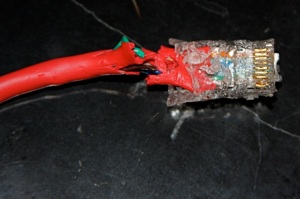
Chewed up network cable by Jeremiah Ro, CC BY-SA
by Jeremiah Ro, CC BY-SA

While we’re here, if you’re interested in following our new posts on Twitter, we’ve unfortunately lost access to our former Twitter handle @geekfeminism: you can now follow @GeekFeminismOrg.

Finally, this is itself an open thread for comments on any subject fitting our policy!

About open threads: open threads are for comments on any subject at all, including past posts, things we haven’t posted on, what you’ve been thinking or doing, etc as long as it follows our comment policy. We’re always looking for fluffy, fun, silly, cute or beautiful open thread starters, please post links to Pinboard or Delicious with the “gffun” tag.

Why is someone’s entire adult life relevant to their job application?

This article originally appeared on Geek Feminism.

Over at Captain Awkward’s advice column, there’s a question about how to deal with a recent name change when potential employees may call references that know you by a former name. The advice moves a little into how to deal with “resume gaps” in general:

Prospective employers will ask difficult questions about gaps in employment, changes of field, etc., but often they are doing it because they want to see how you react to the question before they decide if it is an actual issue. They want to make sure that you didn’t lie on your resume. They want to see if you have a coherent reason for whatever it is. And they want to see if you react with grace under pressure, or if you turn into a defensive weirdo… [P]lenty of people take time out of the workforce to care for kids, go to school, look after aging relatives, etc. and then are in the position of trying to get back into the workforce. If an employer is going to hold your years as a caregiver or student against you in making a hiring decision, that is their bad. Do not apologize! Do not talk about how your skills are “rusty”! If they say “I notice it’s been a few years since you’ve been working in this field, what’s up with that?” say “Yes, I was lucky enough to be able to take some time off to care for my mom at the end of her life,” or “Given the cost of day care, it made sense for one of us to stay home with the kids for a while” or “Yes, it was strange to be a grad student-by-day, bartender-by-night, but my customers were great and I learned a lot from having such a public-oriented position” and then ask a question about the position at hand.

It’s possible to disagree for pragmatic reasons with the advice to disclose here (see for example annalee’s comment on that post), but I wanted to move away from the question of what individual jobseekers should do — to be clear: I don’t fault Captain Awkward discussing that, it’s an advice column! — to the general question of why this comes up. Why do resume gaps matter, exactly? Why is a job candidate who has several unexplained years on their resume a worse candidate for a job?

Here’s my hunch about why it matters: because it’s a proxy for discriminating against (former or currently) ill or disabled people and carers, pretty much. And people with a history of institutionalisation, and others. So at an individual level you can disclose on the principle that while it sucks that there are powerful bigoted people out there, it’s better to find out that they’re bigoted against you before you’re working for them. Or you can not disclose on the principle that while it sucks that there are powerful bigoted people out there, you might be able to stay mostly under their radar when you are working for them. Not the most excellent choice in the world!

This seems in some ways hackable to me. This isn’t a new insight, but part of the problem with hiring is the need to choose one person (or N people), and, typically, having more than N applicants. You need some tools to eliminate people, so people come up with petty absolutes about resumes that are in the wrong font, or are one page long, or aren’t one page long, or that cover letters that use “I am writing to apply for” rather than “I am applying for” or whatever you like. And of course it’s easy to fall into bigotry too. The ideal worker bee is young and male and “flexible” and so on. If society has squashed someone down by keeping them out of the workforce, you don’t want your organization to have to pay the price for the squashing, so let’s require an age-21-to-present-time employment history too. Some people have that, after all.

There’s a real problem with resume gaps, which is that they might be actually relevant time that the person doesn’t want to talk about with you (for example, the employer they defrauded), but I think it’s at least worth questioning the idea of pushing down on everyone who has ever been out of the workforce in order to find them, and there’s definitely also a desire to ferret out “flakes” (people who you want to discriminate against) among some employers.

One possibility then is that by consciously letting go of the idea that your hiring skills guarantee getting the single best hire, or the belief that your resume filtering skills and interviewing skills are helping you past a certain point, and choosing randomly from the best M applicants as selected by your hopefully-consciously-avoiding-bigotry hiring process. And by letting go of your belief that you need total control in order to select The One, perhaps you can let go of at least some received wisdom about seeing “red flags” in any sign that someone may have done something with their weekdays other than work, and that they may not want to talk to you about that.

What received truths of hiring do you think are bogus or discriminatory?

I take it we aren’t cute enough for you?

This article originally appeared on Geek Feminism.

A few times within the lifetime of this blog, there’s been a major emergency in geekdom: a geek girl has needed a confidence boost.

I hear you cough. Someone just said “geek girl” on Geek Feminism, the home of “ahem, geek women, THANK YOU”?

No really, I mean it, a geek girl. A prepubescent girl has been bullied or heard some gender essentialist crap, and a call to arms goes out. The best known is probably Katie Goldman, the then seven year old whose mother wrote in November 2010 that Katie was being bullied for liking Star Wars, a boy thing:

But a week ago, as we were packing her lunch, Katie said, “My Star Wars water bottle is too small.  It doesn’t hold enough water.  Can I take a different one?”  She searched through the cupboard until she found a pink water bottle and said, “I’ll bring this.”

I was perplexed.  “Katie, that water bottle is no bigger than your Star Wars one.  I think it is actually smaller.”

“It’s fine, I’ll just take it,” she insisted.

I kept pushing the issue, because it didn’t make sense to me.  Suddenly, Katie burst into tears.

She wailed, “The first grade boys are teasing me at lunch because I have a Star Wars water bottle.  They say it’s only for boys.  Every day they make fun of me for drinking out of it.  I want them to stop, so I’ll just bring a pink water bottle.”

Katie’s story went viral including at the official Star Wars blog and a year later CNN reported that at GeekGirlCon when a brigade of Storm Troopers formed an honor guard for Katie, and that there’s an annual Wear Star Wars day as a result.

We had our own smaller burst of geek support on the Geek Feminism blog in May this year, for five year old Maya, who was turning away from her love of cars and robots. 170 comments were left on our blog for Maya, second only to Open Letter to Mark Shuttleworth (200 comments) in our history. In addition, it wasn’t an especially difficult thread to moderate as I recall: a few trolls showed up to tell Maya goodness knows what (sudo make me a sandwich LOL?) but in general people left warm, honest, open stories of their geek life for Maya.

Here’s something I was struck by: when I tweeted about Maya’s post, back in May, I saw replies from men saying that they were crying (with joy, I assume!) about the response to Maya. I have to say I do NOT see a lot of admitted crying about other posts on our blog, no matter how positive or inspirational. (People love the existence of the Wednesday Geek Women posts, but they are consistently our least read and commented on posts.) Or crying about stories that are negative and horrifying either.

It’s going to be hard to stand by a statement that I don’t begrudge Katie and Maya their outpouring of support, but: I don’t begrudge Katie and Maya their outpouring of support. I don’t think they should have less of it.

… but I think geek women and other bullied or oppressed geeks should have more.

Thus I do want to ask why girls? Why do we not have 170 comments on our blog reaching out to women who are frustrated with geekdom? I want to get this out in the open: people love to support geek girls, they are considerably more ambivalent about supporting geek women.

I’ve compared harassment of adults with bullying of children before: they have a lot in common. What they don’t seem to have in common is a universal condemnation from geekdom: bullying children? Totally evil*. Harassing adults? Eh… evil, except you know, he’s such a great guy, and he hasn’t got laid in a while, and (trigger warning for rapist enabling) he does have the best gaming table, so what are you gonna do, huh?

There are a number of reasons, I know, even aside from the (provocative!) title of the blog post. Some of them are more sympathetic than others:

  • Talking to adults about overcoming difficulties is harder. There can’t always be as much optimism or tales of It Gets Better. For some adults, that’s bullshit. (It’s not always true for children either and telling children this can be a disservice too, but it is more culturally comfortable.)
  • Adults are often angry when they’ve been mistreated. In this case, feminists are often angry. It’s harder to engage with angry people. They (we) are less appealing. We may not be grateful for your thoughts. Sometimes we pick them apart publicly if we don’t like them enough. And call you mean names.
  • When a child is bullied by another child, the bad guy is reassuringly definitely not you.
  • Children don’t talk back, or can’t. If an adult says that It Gets Better, the appropriate role for the child is to smile and look grateful. (This is also true of women when listening to men, but generally somewhat less so.)
  • Many of us are more familiar with the experience of being a bullied child than being a harassed or oppressed adult, and can be empathetic more easily.
  • We really really want to believe that things will be basically OK for Katie and Maya, even if they haven’t been for us and people we love.

There’s no easy answer. Many of us are very deeply invested in It Gets Better rhetoric, because the alternative is sure pretty sucky. But at the same time, if you’re doing one thing to stop gendered bullying this year, say, leaving the 170th supportive comment for a five year old girl, while kind, was probably not the single best use of your one thing. Join the fight. Make it better yourself. And, since you aren’t in fact limited to one thing, leave kind or supportive or co-signed righteously angry comments too, while you’re at it, and not only for children.

* At least, in the context of these discussions. I am far from believing that geeks are universally actively working to save children from bullying, nor that they are incapable of perpetrating child abuse.

Online harassment as a daily hazard: when trolls feed themselves

This article originally appeared on Geek Feminism.

Trigger warning for discussion of and graphic examples of threatening online harassment.

Seen s.e. smith’s post on blogging and harassment yet? You’re about to see it everywhere (on the social justice blogs) because it’s very powerful and true:

by the time I’d clocked around 20 threats, and was up to around 30 readers, I’d learned the art of triage. The quick skim to find out if there was any actually personal threatening information, like identifying details, or if it was just your garden variety threat with no teeth behind it. I kept them all in a little file in case I needed them later, and forwarded the worst to the police department, not in the belief they would actually do anything, but in the hopes that information would be there, somewhere, in case it was needed someday.

“I hope you get raped to death with a gorsebush,” one email memorably began. I gave the letter writer some style points for creativity, but quickly deducted them when I noted he’d sent it from his work email, at a progressive organisation. I helpfully forwarded it to his supervisor, since I thought she might be interested to know what he was doing on company time. “Thanks,” she wrote back, and I didn’t hear anything more about it. Several months later I attended a gala event the organisation was participating in and watched him sitting there on stage, confident and smug”¦

I was careful in all the ways they tell you to be, to make it difficult to find my house, for example, and most of the rape threats, and the death threats, the casual verbal abuse from people who disagreed with my stances on subjects like rape being bad and abortion being a personal matter, weren’t really that threatening in that they didn’t pose a personal danger to me, and I was rarely concerned for my safety. That wasn’t the point, though, which is what I told a friend when she got her first rape threat and called me, sobbing. I wished she’d been spared that particular blogging rite of passage, but unfortunately she hadn’t been.

“They want you to shut up,” I explained. “That’s the point of a rape threat. They want to silence you. They want you to shrink down very small inside a box where you think they can’t find you.”

And it works. I see it happening all the time; blogs go dark, or disappear entirely, or stop covering certain subjects. People hop pseudonyms and addresses, trusting that regular readers can find and follow them, trying to stay one step ahead. Very few people openly discuss it because they feel like it’s feeding the trolls, giving them the attention they want. Some prominent bloggers and members of the tech community have been bold enough; Kathy Sierra, for example, spoke out about the threats that made her afraid to leave her own home. She’s not the only blogger who’s been presented not just with vicious, hateful verbal abuse, but very real evidence that people want to physically hurt her, a double-edged silencing tactic, a sustained campaign of terrorism that is, often, highly effective.

[That is a relatively short excerpt, read the whole thing.]

I think it’s time to take a look at the reflexive “don’t feed the trolls” advice, frankly.

It was developed, I think, for Usenet (at least, the earliest known usage of the term ‘troll’ in this sense is from alt.folklore.urban in 1992, which suggests that that formulation probably originates similarly), and was adopted by email lists and blogs in due course. I’ve always been suspicious of it in the case of forums like email lists where messages can’t be recalled: some people implement it as just leaving the troll to continue sending messages into the void – except that it’s not a void. Experienced people may have blocked the troll, inexperienced people are there to be frightened either specifically by the troll or by the apparent unremarkableness of the troll’s behaviour. (This is one of the reasons I am less and less on-board with the free software community’s continued preference for public mailing lists. I like my email client a lot too, but I like spaces where harassment can be removed quickly from all reader’s view more.)

There’s certainly some wisdom in “don’t feed the trolls”. Consider for example Gavin de Becker’s advice in The Gift of Fear: if you, say, return harassing phone calls on the 50th time, you’ve only taught your harasser that they need to call 50 times to get a response. They need to learn that they cannot reach you, that there is nothing they can do to make you reply to them.

So far it seems sensible, but what it doesn’t account for is having multiple harassers, who either may not be aware of each other or who may be actively encouraging each other and coordinating attacks (via hate blogs or forums or the more wildcard ‘lulz’ variants thereof). It’s not so clear there that en masse silence is a useful strategy, it varies by case, and the off-hand use of the “everyone knows that you don’t feed the trolls!” wisdom that was (arguably) effective in the case of lone trolls is in effect a message to people being targeted for harassment by a coordinated group, or who have a number of individual harassers, that no one gives a shit. Don’t talk about it, we don’t care about your problems.

It also means that we are continually surprised by the size and scope of the problem. Death threats? With your address attached? Weekly? This is a problem not only because of the continuing coziness of the “yeah right, never happens to me” crowd, but because we often aren’t sharing information among targets.

It’s not just you.

It’s not just you.

Every single time, there is someone who has been hurt by thinking it’s just them.

I by no means advocate compulsory reporting of harassment, in fact I am very strongly committed to empowering survivors by allowing them a coercion-free space to do whatever the hell they please in terms of reporting or not. But “don’t feed the trolls” isn’t any more coercion-free than “stop hir hurting someone else! report now!” The coercion is this: thirty years of Internet are saying keep this to yourself, damn you (stop hir hurting someone else)!

Thirty years of Internet, per above, don’t have the whole story.

This scale of harassment of bloggers also brings us into a realm where people without the financial resources of celebrities to, eg, pay Gavin de Becker’s people to read their mail for them and alert them only to genuine immediate threats, have to deal with the same scale of harassment. This isn’t totally new to the Internet (being, eg, the family member of someone who has either committed or been the victim of a well-publicised unusual crime, has long attracted the same kind of attacks) but it is hard enough for rich powerful people to protect themselves mentally and physically from this level of hostile attention, let alone people with the typical resources of a social justice blogger (generally relatively privileged yes, able to afford state-of-the-art personal security, no).

On that, I’m honestly not sure what to do except that it scares me. There appears to be no known effective defence against sufficiently many motivated harassers. There doesn’t even appear to be a lot of giving a toss about it.

Update: Hey folks, on reflection I realise that my last paragraph kind of invites advice, but it’s probably safe to assume that if you’ve thought of doing X in response to trolls that so have people like s.e. smith, and either X is in their arsenal, it doesn’t work, or it isn’t reasonably possible for them (that is the cost-benefit trade-offs don’t favour it).

Responses from people with unusual expertise on personal security or on community management and similar areas giving facts advice or facts might be useful, but if your expertise is “average experienced netizen” please step back and give people affected a chance to talk.

Technology protest: what do you do?

This article originally appeared on Geek Feminism.

Social Media Collective at Microsoft Research write about some responses to social media protest:

It’s common, and easy, to say “just don’t use it.” There’s actually a term for this– technology refusal– meaning people who strategically “opt out” of using overwhelmingly prevalent technologies. This includes teens who’ve committed Facebook suicide because it causes too much drama; off-the-grid types who worry about the surveillance potentials of GPS-enabled smartphones; older people who think computers are just too much trouble; and, of course, privacy-concerned types who choose not to use Facebook, Twitter, Foursquare, websites with cookies, or any other technology that could potentially compromise their privacy. (This does not include people who can’t afford internet access or computers, or who live in areas without cell towers or broadband access.)… [There is] the idea that refusal is the only legitimate way to protest something one thinks is problematic, unconscionable, unethical, or immoral… I generally do not buy this idea. Here are three reasons why.

The Cost of Opting Out

Opting-out of watching The Bachelorette because I think it romanticizes sexism doesn’t impact me the same way that choosing not to have a cellphone does. If I choose not to have a cellphone, I am choosing to exist in a world where social norms have adapted to cellphones without adapting myself. Face it, someone without a cellphone requires everyone who interacts with that person to make special accommodations for them… not having a cellphone puts one at a serious disadvantage…

The Civic Responsibility to Critique

Members of a community (nation, state, book group, dining club, whatever) have a responsibility to criticize and suggest alternatives to things they find problematic, whether those are government principles, media representations, website policies, or laws. In fact, this is such a cultural norm that the right to protest is enshrined in the European Convention on Human Rights, the International Covenant on Civil and Political Rights and the US Constitution…

It’s Not Free

Social software is not free [the blog means price for those of you who immediately thought about liberty]… Only the most staunch pro-market capitalist would argue that a customer has no right to complain about a product or service that she is paying for, either directly or through the exchange of personal information.

I was, frankly, tempted to let this slide by in a linkspam, but we’re a bit quiet around here this week, so, let’s talk about varying forms of technology protest. Here are some of mine:

I left Facebook and will probably leave LinkedIn (just need to get some opinions from colleagues on whether this will be professionally damaging) over those sites’ like of using users to advertise products (LinkedIn just turned this on, here’s how to opt-out and here is their response to criticism), and Facebook’s continual cycles of making information shared with advertisers or applications and later making it opt-out in response to another wave of protest.

I am undecided on Google+: I intensely dislike their wallet-name policy, perhaps especially given that the initial policy was “name you are known by”, but it also has a lot of the features I miss about Facebook (in-line comments, longer entries than Twitter), so the cost of opting-out is a consideration for me there.

I keep some data in the cloud and use some Google services, although not as many as a lot of tech people (my personal email is not in Gmail, for example). There’s some cost of opting-out there too: cloud computing may be a trap but I notice Richard Stallman has an organisation that pays people to be his sysadmins (or could, at least, I can’t say I am certain whether RMS admins his own boxes). I could host my own Status.net instance, Diaspora, etc, but I don’t have the time or money. There’s also reader/friend cost: many more people follow me on Twitter than on Identi.ca as it is, almost no one ever logs into Diaspora that I’ve seen. I am simply not powerful enough to force my friends to follow me to different sites, so to some extent I stay where they are.

Most recently, I bought an Amazon Kindle which is fairly well evil (ie, so DRMed it’s possible that it will grow legs in the night, scan and eat my paper books, and make me ring Jeff Bezos in future for permission to read them). This is actually a response to even more nastiness to some degree: at least Amazon sells some recent e-books to Australian customers, relative to almost all of the ePub vendors anyway, and moreover sells them at the US price as opposed to the special markup (about 100%) Australians pay for anything electronic or Internetty. So that’s flat-out poor options, there.

I am committed to the right to complain about things I use in general: to be honest I think a lot of the “leave if you don’t like it” criticism, at least from people who are themselves apathetic, is rooted in “it’s not cool to care about things, don’t make me watch you caring”.

How about you? What services do you stick with and complain/protest about, and why? Which ones have you left/not signed up for despite temptation, and why?

Note: a bit of amnesty would be nice in this post. We’re talking about people’s choices, and frantic attempts to convert everyone to your version of technology purity will stop the conversation. If someone says that they are actively seeking an alternative to service X that has property Y, that would be a good time to mention service Z, which offers X-like functionality with more Y. Otherwise, let people talk.

Pseudospam: nymwars continue

This article originally appeared on Geek Feminism.

We have enough nymwars links for them to be their own linkspam, and likely our commenters have more to add too.

Lots of dedicated discussion and link tracking at googleplus.dreamwidth.org and Botgirl Questi’s collection of #plusgate articles.


Front page image credit: Masked by Harsha K R, Creative Commons Attribution Sharealike.