This year is my sonÂ’s last year before he begins full time schooling in 2015. Welcome to our year of child-focussed activities in Sydney.
The Australian Museum has two programs for kids: Tiny Tots and Mini Explorers, which are patterned something like Art Safari, with the children doing an activity themed to match a current exhibit.
V did Tyrannosaurs Big and Small, which went with the Tyrannosaurs: Meet the Family exhibit. The Tyrannosaurs Big and Small activities ended in June, although the Tyrannosaurs exhibit is continuing through to July 27.
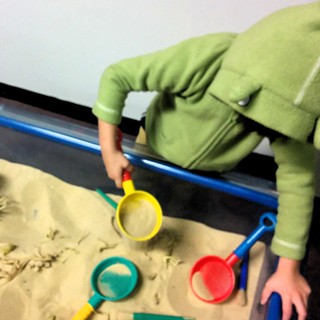
This activity benefited compared to Art Safari in the amount of time available to the children. They started off in an education room with several activities. They first had a short talk about dinosaurs, specifically, working out how big dinosaurs are based on one or two bones. Honestly, this seemed to thoroughly lose most of the children, V included. Most of the remainder revolved around a very shallow imitation of archaeology: finding plastic dinosaurs hidden in sand, or in jars filled with dried lentils. V has not yet absorbed any awe of archeology and regarded this as an exercise in playing with sand rather than a moment of entering into the noblest profession a child can conceive of. The other activity was taking dinosaur shapes cut out of paper (necks, legs and such) and gluing them together into one’s very own dinosaur, which V got quite into.
So no great educational inroads were made, but fun was had. And it didn’t manage to trigger V’s perfectionist tendencies and cause a lot of flouncing and dramatic self-recriminations.
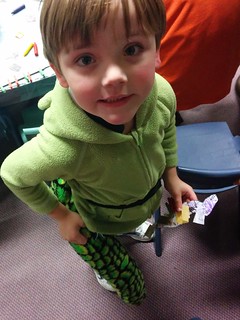
All the children were then given a dinosaur tail to wear — I appreciated the staff saying that wearing one was entirely up to the child, although V was perfectly willing — and a giant mass of children and parents headed down to the main exhibit. In theory we were supposed to be measuring the various tyrannosaurs and otherwise filling out an activity sheet, in practice we were mostly keeping tabs on our children and keeping the fossils safe from them. Or I was, anyway.
The exhibit itself is great, I’m intending to go back by myself before it’s up to properly appreciate it. The main attraction is Scotty. Andrew was very impressed by the faked shadow they’ve put behind Scotty, which moves and roars periodically. They’ve also done an amusing video which is mock security footage of the museum being invaded by dinosaurs, including live footage of the viewers themselves, surrounded by invading dinos. This took up a lot of V’s time. Less good for children — and what I’m going back for — is the bits about how, for example, the coloration of dinosaurs is being determined.
The sad thing about taking a young child to this sort of thing is that you cannot impress on them how unusual it is. Australian museums are not full of world-class T. rex skeletons! You won’t get to see this very often! Appreciate it while itÂ… oh never mind.
The only downside was that the ticketing was rather poorly integrated into the massive assembly line that is admittance to the main exhibit. Andrew arrived late and without a phone, and they had to page me down to the information desk to explain that he had a ticket to this workshop, not one of the timed tickets to Tyrannosaurs. We also didn’t know for sure if we were even going to see the main Tyrannosaurs exhibit and nearly bought separate tickets to it. Whoops.
Cost: $12 children and $24 adults, which was reduced a lot for museum members. The year-round equivalent is Mini-Explorers, which is $10 children and $15 adults.
The exhibit alone is $13 children and $22 adults. Odd.
Recommended (kids’ activity): cautiously. They’re well designed programs with a fair amount of thought put into them, but they are, basically, a craft activity and an “opportunity” to chase your child through a museum exhibit. It might be best saved for an exhibit that your child is likely to be unusually interested in.
Recommended (Tyrannosaurs exhibit): hell yes, circle July 27 on your calendar with danger signs and scary notation.
This year is my sonÂ’s last year before he begins full time schooling in 2015. Welcome to our year of child-focussed activities in Sydney.
Art Safari is one of the Museum of Contemporary Art’s kids’ activities: a program where pre-school children look at a few pieces of art in the galleries and do some related art of their own. I enjoyed the Art Baby tour a lot and was keen for V to have a go at Art Safari. We were joined by another four year old, A—, and her family.
Starting in the cafe with an enormous chocolate milkshake was a non-core part of the experience but got things off to a good start, except that the cafe was a bit of a horror show of mothers’ groups and Mountain Buggy strollers (guilty as charged on the stroller) and my memory of it is of a fair bit of flurrying and crowdedness. We had some trouble getting V and A— to say goodbye to their milkshake remnants and to go to the classroom for their exercise.
They started off with some circle time talking about colours and what things they could think of that had each colour. Which led me to discover that I have the shouty kid who wants to give every answer, specifically, who wants to bellow periodically every time a new colour word comes to mind. At this age, it’s a bit awkward to figure out the division of discipline: am I supposed to step in and tell him to quit it with the bellowing, or is that all under control? (I see this play out each week at swimming lessons too, with parents evenly divided between those hissing warnings to their children to pay attention and work hard, and those with their nose in a book.)
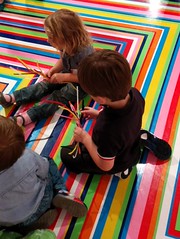
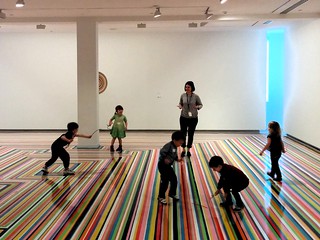
I think there’s a lot of scope for kids to interact with some contemporary art, and the art chosen for this was a good example: a whole coloured floor to pace and march around and to match their coloured pipe cleaners with. Good choice.
A less good choice was the security guard who came over and told me that there is a “no backpacks, no exceptions” rule. I assume this is because backpacks are so liable to knock over art works whichÂ… obviously is a problem, but it would have been really annoying if I’d had my baby in a front pack and then needed to, I guess, carry the backpack around in my hands, since I can’t dangle it off the baby. It’s just generally not the greatest thing in the world, to have no socially acceptable way to lump around the giant haul of nappies and wipes and changes of clothes and such that a young baby requires. I think I’m supposed to leave most of it in the car I don’t own. (Tangent: I wasn’t babywearing that day, but I often do, and it is quite common in babywearing discussions around this issue for it to emerge that many babywearers either are never far from their cars, or never far from their adult partners.) Probably the best way for the MCA to deal with this would have been for the instructor to mention it before we all left the classroom, so I could have left the bag there.
V found the first activity — making interlocking circles out of pipe cleaners — a bit frustrating (he couldn’t figure out how to twist the pipe cleaner around itself to close the circles), and I was disappointed that the session doesn’t allow enough time for the instructor to notice and help floundering children. That said, each child did have a parent with them, so of course I was able to help him out myself just before he vanished into a big pile of “I can’t, I can’t, it’s so haaaard, I can’t!”
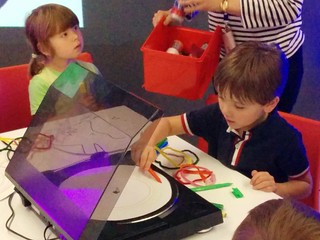
Afterwards we went back to the classroom for an activity he found much more intuitive and fun, holding a texta against a piece of paper as it spun on an record player, so as to draw circles and spirals. I think the instructor tried to briefly mention that this was an older way of playing music, but V in particular, and I think children of this age generally, don’t really grasp that the past was noticeably different from the present and have no interest in cooing over more cumbersome ways of playing music that predate their parents’ era as well. (Although, that must have been fun, back when people got to play music with TEXTA MACHINES!)
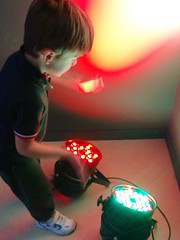
Almost as an aside, the instructor pointed the children at lights that changed colour when you clapped near them, which is nearly as much fun as textas. This was a good microcosm of the whole experience; just slightly rushed. I feel like if each part of it had 10–15 more minutes, V would have had more fun. That said, he was very proud of the art he’d made.
Cost: concession is $16.85, general admission is $21.95. I’m honestly not sure if both parents and children are supposed to buy a ticket. I bought one for me and one for him.
Recommended: not for the price. It’s a fine activity, it was however slightly rushed throughout.
This year is my son’s last year before he begins full time schooling in 2015. Welcome to our year of child-focussed activities in Sydney.
This was our second visit to the Powerhouse Museum, both times on a Monday, a day on which it is extremely quiet.
The Powerhouse seems so promising. It’s a tech museum, and we’re nerd parents, which ought to make this a family paradise. But not so. Partly, it’s that V is not really a nerdy child. His favourite activities involve things like riding his bike downhill at considerable speeds and dancing. He is not especially interested in machinery, intricate steps of causation, or whimsy, which removes a lot of the interest of the Powerhouse. Museums are also a surprising challenge in conveying one fundamental fact about recent history: that the past was not like the present in significant ways. V doesn’t really seem to know this, nor is he especially interested in it, which removes a lot of the hooks one could use in explaining, eg, the steam powered machines exhibit.
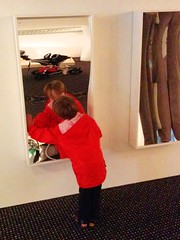
We started at The Oopsatoreum, a fictional exhibition by Shaun Tan about the works of failed inventor Henry Mintox. This didn’t last long; given that V doesn’t understand the fundamental conceit of museums and is not especially interested in technology, an exhibit that relies on understanding museums and having affection for technology and tinkering was not going to hold his attention. He enjoyed the bendy mirrors and that’s about it.
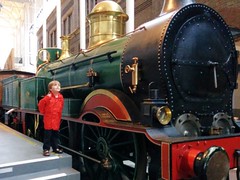
I was hoping to spend a moment in The Oopsatoreum, but he dragged me straight back out to his single favourite exhibit: the steam train parked on the entrance level. But it quickly palled too, because he wanted to climb on and in it, and all the carriages have perspex covering their doors so you can see it but not get in. There’s a bigger exhibit of vehicles on the bottom floor, including — most interestingly to me — an old-fashioned departures board showing trains departing to places that don’t even have lines any more, but we didn’t spend long there because V’s seen it before. He also sped through the steam machines exhibit pretty quickly, mostly hitting the buttons that set off the machines and then getting grumpy at the amount of noise they make.
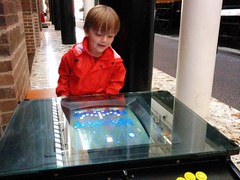
He was much more favourably struck with the old game tables that are near the steam train. He can’t read yet, and parenting him recently has been a constant exercise in learning exactly how many user interfaces assume literacy (TV remote controls, for example, and their UIs now as well). The games were like this to an extent too; he can’t read “Press 2 to start” and so forth, so I kept having to start the games for him. He didn’t do so well as he didn’t learn to operate the joystick and press a button to fire at the same time. He could only do one or the other. And whatever I was hoping V would get out of this visit, I don’t think marginally improved gaming skills were it, much as I think they’re probably going to be useful to him soon.
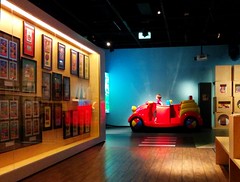
We spent the most time in the sinkhole of the Powerhouse, the long-running Wiggles exhibition. This begins with the annoying feature that prams must be left outside, presumably because on popular days one could hardly move in there for prams. But we were the only people in there and it was pretty irritating to pick up my two month old baby and all of V’s and her various assorted possessions and lump them all inside with me. I’m glad V is not much younger, or I would have been fruitlessly chasing him around in there with all that stuff in my arms.
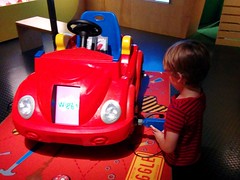
It’s also, again, not really the stereotypical educational museum experience. There’s a lot of memorabilia that’s uninteresting to children, such as their (huge) collection of gold and platinum records and early cassette tapes and such. There’s also several screens showing Wiggles videos, which is what V gravitates to. If I wanted him to spend an hour watching TV, I can organise that without leaving my house. He did briefly “repair” a Wiggles car by holding a machine wrench against it.
Overall, I think we’re done with the Powerhouse for a few years.
Cost: $12 adults, $6 children 4 and over, younger children free.
Recommended: for my rather grounded four year old, no. Possibly more suited to somewhat older children, or children who have an interest in a specific exhibit. (If that interest is steam trains, I think Train Works at Thirlmere is a better bet, although we cheated last year by going to a Thomas-franchise focussed day.)
This year is my son’s last year before he begins full time schooling in 2015. I’ve therefore decided to embark on a self-imposed challenge to go and do different child-focussed activities in Sydney and review them!
Art Baby is a preliminary Sydney Project entry, because it wasn’t an activity for preschoolers! Instead, it’s an activity for carers of babies, who tour the Museum of Contempoary Art with their babies.
by Robert Montgomery
Mostly, it’s a short (45 minute) tour of one of the exhibitions (it was Volume One today), and the fact of having babies in tow is largely irrelevant. (Most of the babies today were two or three months old, much too young to do much touching or exploring.) I very much enjoyed our tour guide, who significantly contributed to the artworks with some background about each artist, and with her personal reactions to the art works. Fine art has really grown on me in recent years, as I’ve come to understand many genres — fine art in this case, but not it alone — as a conversation, and that you need to come at it with a cheat sheet that brings you up to speed on the conversation. A good tour or audio guide is the way to go with fine art museums, given that I’m unlikely to ever follow the conversation as a practitioner or serious student. Today’s tour, by an art educator and artist, was an excellent insider briefing.
The baby-relevant part of the tour is the conclusion in the Creative Learning room where the older children would do the Art Play (3yo and under) and Art Safari sessions (3–5yo). This includes a piece specifically commissioned for the children’s room, a child-safe and welcoming artwork for them to interact with. (Much of the museum is an attractive nuisance for children, with many bright, changing objects that they must not touch. It’s a shame. This adult would like a museum of fine art you can beat upon.) Afterwards, everyone has coffee (included in the price) and goes their separate way.
I’m keen to trial Art Safari with my 4yo now.
Cost: $20 plus booking fee.
Recommended: yes. It’s a good introduction to the MCA collection, and the timing is suitable for people with babies in tow. You could also just attend a normal tour, of course, but sometimes it’s fun to be part of a WITH BABY market segment.
Almost all of the children we first met at age 1, and then at ages 3 and 5, are returning from tonight in Life at 7, with only Loulou not appearing. This time, the two documentaries are Tackling Temperament (now on iView) and Finding Your Tribe (now on iView), screening a week apart.
People with Australian IP addresses can also catch up on the earlier documentaries for a limited time:
Are you watching Life at 7? Please play along in comments, I enjoyed (and was frustrated by) the previous documentaries, and I’m looking forward to seeing the new series.
This is part of Tansy Rayner Roberts’s Blog Book Week challenge, about favourite childhood reading, how we read these books, and why we remember them.
I haven’t forgotten that I promised to do Ruth Park’s My Sister Sif and I still intend to, but while I’m tracking it down for a re-read, I’ve another Sydney novel in the interim: Melina Marchetta’s Looking For Alibrandi.
Spoilers for Looking For Alibrandi abound!
Warning: self-harm is a plot element in this novel, and it’s discussed in this entry.
Background/plot summary: Looking For Alibrandi is a 1992 young adult book by Australian author Melina Marchetta. Seventeen year old Josephine Alibrandi is in her final year of a expensive private Catholic high school, preparing for the HSC (the Higher School Certificate, which is the statewide final school exams in NSW). She is a scholarship student, the daughter of Christina Alibrandi, a single mother who had a child at sixteen and was exiled from her Italian-Australian family until her father died, in the recent past from the novel’s point of view.
Christina insists that Josie has a relationship with Christina’s mother, Josie’s Nonna Katia, but Christina’s own relationship with Katia is strained due to their long estrangement and Katia’s coolness to her throughout her childhood. At the beginning of the novel Josie is more concerned with school problems in any case: her quartet of outsider friends fight for recognition in their upper class Anglo-dominated school. Josie is school vice-captain to her mortal enemy, perfect blond Ivy, daughter of a wealthy surgeon, as captain.
But Josie’s home life suddenly undergoes another change. Josie’s father, Michael Andretti — son of Christina’s childhood next door neighbours, now a barrister — moves back to Sydney for a year to be welcomed briefly into unknowing Katia’s home as one of the family. Josie confronts him and they agree to have no contact, only to ring him from school frantically to extricate herself from a legal threat by a classmate’s father. After this they have an initially uneasy but gradually warmer relationship. In the meantime, Katia begins telling Josie stories of her immigration to Australia and her married life in rural Queensland in total social isolation, until the arrival of her sister from Sicily. Josie begins to see Katia as more of a person and less of an oppressively tradition-bound stereotypical grandmother.
Events at school also demonstrate to Josie that she’s not as much of a complete outsider as she thought, including a revelation by the principal after some irresponsibility towards younger students on Josie’s part that she was in fact voted school captain at the beginning of the year but that it was awarded to Ivy, who the principal felt was more responsible. While at the beginning of the novel Josie wants nothing more than a relationship with John Barton, her solidly upper-class debating friend, she ends up with Jacob Coote, captain of a nearby public school, as a boyfriend, and has to navigate being middle class to his working class.
It eventually becomes clear to Josie as Katia’s stories of her past continue that Katia’s Anglo-Australian friend Marcus Sandford was in love with her, and eventually Katia slips up and Josie works out her grandmother’s secret: Marcus and Katia were lovers and Marcus was in fact Christina’s biological father, which accounted both for Christina’s father’s loathing of her and of his swift condemnation of her when she became pregnant as a teenager.
Josie very briefly reaches a feeling of peace with herself and her story before her tranquillity is suddenly destroyed again: her friend John Barton commits suicide the night before the HSC exams begin, and she is told this by Ivy, who was even closer to John, crying out the front of the school. In the aftermath of this Jacob Coote breaks up with Josie, not sure what he wants from his future himself in the wake of knowing Josie’s relative class privilege and John’s death in spite of his class privilege. The novel ends with Josie about to find out her university entrance ranking, still relatively at peace with herself, but less sure of her place in the world and her ambitions.
Martin Place by Alpha, CC BY-SA
I think I read Looking For Alibrandi a couple of years after it was published: definitely when I was in high school. I recall it being a book that you had to wait some time for at the school library. (It gets assigned as an English text now, but I never read it in that context.) It has crushes and alcohol and uneasy relationships with friends and a pretty intent focus on high school academic achievement, all of which were pretty familiar to me, even if the rich competitive Sydney folk weren’t so much. (At some point John Barton despairs over his poor ranking in a mathematics competition compared to Sydney Grammar, a reference I understood better when I knew former Maths Olympians from Grammar while at uni!)
Again, it’s very evocative of Sydney: I in fact live now pretty close to where Christina and Josie lived in Sydney. There’s a speech day in Martin Place, truanting at the Sebel and a few other landmarks although it’s not quite as firmly inner west as Saving Francesca and The Piper’s Son (the latter of which is about twentysomethings, and with which I identify even more closely as someone who went to Sydney Uni).
To be honest, as a result of this book I even have a sneaking fascination with Stanmore Maccas, where Josie gets a part-time job briefly, and I felt rather betrayed when the movie version changed it to Oporto!
John Barton’s death was “that bit” in the book, as in “have you got to that bit yet? Oh, you’ll know what I mean when you get to it.” It was my main frame of reference in the aftermath of the actual suicide of someone I knew at school, while of course not fitting exactly.
Again with the fanon style questions: this is the twentieth anniversary of Looking For Alibrandi‘s publication. If we took 1992 as the year Josie was seventeen, she is now thirty-seven. Did she end up doing a law degree like her father, but which she had begun to doubt she was as interested in as she’d thought? Did Christina and Michael reunite, as the novel implies they are considering? Did Josie and Ivy end up with an unexpected friendship, as they are stumbling towards? Did Josie, who would have won Least Likely To Leave Well Enough Alone if Australian schools did yearbooks, attempt to track down Marcus Sandford?
I don’t have as strong a fanon in my head for this as for Playing Beatie Bow but if I had to guess, Josie did Arts/Law and dropped out after the Arts component (quite a lot of people in combined law degrees do this). I have no idea what she’d do instead though. I think there’s too much hurt between Christina and Michael to reunite, although probably Josie and Katia both pushed strongly for it. I don’t know what to make of Josie and Ivy! And I would put money on Josie telling herself that she doesn’t mean anything by nosing around in the S section of the phonebook and so on, and of course meaning something by it, finding out that, as always, people’s lives aren’t as simple as she thought.
This is part of Tansy Rayner Roberts’s Blog Book Week challenge, about favourite childhood reading, how we read these books, and why we remember them.
I’m going to write about two Ruth Park books this week, Playing Beatie Bow and My Sister Sif.
Spoilers for Playing Beatie Bow ahoy!
Background/plot summary: Playing Beatie Bow is a 1980 older children’s book by New Zealand/Australian author Ruth Park. In it, fourteen year old Abigail sees a strange young girl (thin, wearing odd clothes, “furry” shorn head) watching her babysitting charges play, especially when they play “Beatie Bow”, a ghost game. One day she gives chase to the girl and finds herself in Sydney in the same area, only in 1873. She quickly incurs a head injury after being knocked down in the street by Samuel Bow, a war veteran who himself has a brain injury and “takes spells” (flashbacks) as a result. It emerges that the strange girl is his daughter, Beatie, who had found herself several times in the twentieth century watching a game featuring her own ghost.
The Rocks, circa 1900, State Records NSW, CC BY
While both parties hide their knowledge from each other for a while, the Bow and Tallisker (Beatie’s mother’s name) families who share a house in the Rocks know that Abigail is from a different time and will not help her return to the twentieth century. It emerges that some of the women in their family have a psychic Gift as a result of their Orkney heritage, and that every fifth generation it is imperiled, with a prophecy that of the adults in that generation, one is to be barren and one to die, risking there not being another generation. When this happens, the family is visited across time by The Stranger, in this case Abigail, who is destined to save enough of them to continue the Gift. The family has recently had scarlet fever and only a few members of the fifth generation survive: Beatie; her older brother Jonah; and her younger brother, Gilbert, yet to recover his health after the fever; and their cousin Dorcas (“Dovey”). Abigail is initially desperate to return home, but falls in love with Jonah, a sailor, when he has shore leave, and is more conflicted, especially since Jonah is betrothed to Dovey.
Eventually Samuel Bow causes a house fire, from which Abigail saves Dovey and Gilbert. She returns to the twentieth century that same day, under the care of Beatie, still cross with Abigail for pursuing Jonah. Shortly after returning she researches the family history in the newspapers, which suggests that Jonah probably died at sea shortly after she left. She then has a vision which shows that Beatie became a scholar, and that Jonah married Dovey but indeed died young at sea. She tries and fails to warn the family across time. Abigail is overwhelmed with grief that she cannot speak of.
Before long her own parents reunite after years of separation and move with her to Norway. In the final pages of the novel, she returns to Sydney five years later to discover by chance that the Crowns, her former babysitting charges, are descendants of Gilbert Bow through their mother, and (it is heavily implied) Abigail begins a relationship with their uncle Robert Bow after the novel ends. She realises that instead of her role as The Stranger being to save Dovey from the fire for Jonah as the family had believed, it was to save Gilbert.
I think I received Playing Beatie Bow as a gift from a book-loving relative. I wasn’t born when it was written, and probably read it in about 1992 or a bit later, when I was slightly younger than Abigail is for most of the novel. I remember finding the twentieth century portions rather strange for a while: this relative was in the habit of giving me high quality very recent books, and I didn’t realise for a while that the book was more than a decade old and the portrayals of Abigail’s high school experience (secondhand, as she thinks of them with contempt over summer) were using slang and events from the late 1970s! At the time I knew almost nothing about the 1970s, so it sounded rather as if Park had made up a bunch of plausible sounding teenage slang.
The Rocks in 2009, by Richard Taylor, CC BY
Abigail’s teenage alienation was a bit of a foreign country to me at the time. The novel begins with her spending the summer being angry about all sorts of things: her father leaving her mother for another woman, which has alienated Abigail so much she has changed her given name to one that isn’t connected with her father’s affection; her peers at school and their teenage crushes; her mother’s decision to re-partner with her father after his long-lived relationship with another woman. Interestingly, a big part of the novel is Abigail, via falling in love with someone else’s fiancé, coming to a realisation that there’s more going on with love than people falling in love to spite her. The coda at the end in which Abigail has demonstrably grown up emotionally in her nine-odd months in 1873 and then her five years in Norway was also important to me: the Norway part of the arc, being realism, maybe more important than the time-travelling.
It was probably also one of the first encounters I had with a critique of the idea that history is a uniform progression from worse conditions to better conditions (yeah I know, a pretty obvious misconception in hindsight): this critique is put into the mouth of Jonah who is utterly uninterested in the magic that awaits his world in the twentieth century.
Sydney always makes novels memorable for me, too. I didn’t grow up in Sydney, but rather in regional NSW, and as a teenager it tended to signify freedom to me. I was always very excited to have a book with a strong Sydney-centric sense of place: besides Playing Beatie Bow I think only Melina Marchetta’s novels were as evocative for me. (Only Looking For Alibrandi was actually published when I was a child, I was 22 and already lived in Sydney when she published Saving Francesca, and a new mother in my late twenties when The Piper’s Son came out.) Playing Beatie Bow is very thoroughly set in The Rocks around Argyle Street, and grounded in the local geography to the point where I believe it’s possible to identify the set of stairs that led Beatie into the twentieth century and Abigail into 1873.
Fan service insight for other dedicated Beatie Bow readers: there’s very brief speculation by Robert Bow at the end of the novel that his niece Natalie Crown, Abigail’s former babysitting charge and the only other person who could see Beatie watching them play, has the Gift, but otherwise the form the Gift takes in Gilbert’s descendants and what it means to have it with very little cultural connection to the Orkneys and its supernatural origins there, is totally unexplored.
I worked this over several times when I was younger: if I was counting the generations correctly, the fifth generation of Talliskers/Bows/Crowns after Gilbert ought to be Natalie and her brother Vincent, which should make them subject to the “one to be barren, one to die” curse (by the way, the inevitable “cursedness” of being childless is called out in the novel, by Beatie who deeply wants to be, and ends up being, the childfree one). If Abigail and Robert had children, the fifth generation would contain their children also. This last is of course a stretch given that about the first week of Abigail and Robert’s relationship is shown in the novel, but hey, fanon calling.
In addition, in the novel, Granny Tallisker, who had the strongest Gift, spends some time trying and failing to work out why on earth Abigail is their Stranger, since they expected someone with a family relationship. Neither of them at that point knows about the relationship with the Crown children, or for that matter that Gilbert is to live. But if a family relationship is required, Abigail doesn’t have this it unless she goes on to partner with Robert Bow.
In any event, whatever happens to Robert and Abigail, it seems that the Crowns are due a Stranger at some point in their lives. I was always surprised that Park didn’t write a sequel, given this (although as an adult, I can see why it would be difficult to preserve the tone with one novel set in 1873 and the other in the late twentieth century). In my fanon, a somewhat older Beatie ends up being their Stranger, in a reciprocal relationship to that Abigail had with her family.
Warning: highly opinionated post follows. Friendly disagreement more than welcome.
It’s been a couple of years since an entirely gratuitous Terry Pratchett thread, and a Twitter discussion asked about favourite Pratchett novels, with a focus on readers new to Pratchett. What think you?
My overall favourite is Night Watch, but I think it would be a terrible place to start reading: you need the context of the earlier Night Watch sub-series for background. Night Watch follows Guards! Guards!, Men At Arms, Feet of Clay, Jingo and The Fifth Elephant. You could possibly skip Feet of Clay and Jingo and have most of the background, but that’s still a fair commitment. You want The Fifth Elephant because it introduces the major characters in an ongoing multinational inter-species political struggle (Monstrous Regiment, Thud!, Unseen Academicals, Snuff), but it’s also probably not strictly necessary as background to Night Watch.
The Night Watch sub-series is also interesting technically, as Pratchett has created two absurdly powerful political characters in this series (Vimes, the head of police, and Vetinari, the ruler of Ankh-Morpork), and has to come up with increasingly aggressive scenarios to actually challenge them. He has written elsewhere about finding this annoying when he wants to write interesting stories in Ankh-Morpork without Vimes sticking his nose into them.
It’s worth warning that Night Watch is one of the darker novels, with offscreen torture and onscreen immediate-aftermath-of-torture. Small Gods has similar warnings (religiously inspired torture), if you’re OK with that it is good and very self-contained, and has also served as an entry point for a number of people.
The first Discworld I ever read was Hogfather and I think it’s actually not a bad starting point, since it’s a fairly self-contained story and contains a bunch of core Discworld themes concerning how magic and divinity work. It also has a great heroine who unfortunately, in my opinion, otherwise appears in pretty mediocre Discworld novels.
Probably for most Hoyden readers I’d recommend starting with Equal Rites or Wyrd Sisters and reading through the Witches novels, which is where I went after Hogfather. The Tiffany Aching books didn’t exist at the time, but they’re very much in the spirit of the Witches novels, except that the Witches seem much more organised in them: Pratchett can’t leave well enough alone when it comes to creating power structures. See tigtog’s post about the Witches for more.
I find the Rincewind/wizards sub-series pretty unworthwhile, and still haven’t actually read all of it, so I can’t speak to that fairly.
Edited to add: there is a well-known reading order guide, which lays out the various sub-series in a flowchart style, but I cannot find an accessible version. Hence this post refers directly to the sub-series wiki pages.
xkcd suddenly exploded in my circles in 2006, thanks to the comic Randall Munroe calls Computational Linguists and most people refer to as “Fuck Computational Linguistics” getting around at the annual conference of the Association for Computational Linguistics.
I just ordered a batch through Sticker Mule, both of the full comic and of a smaller badge version I did. (They will do proofs of them, I’ll be interested to see if the “Fuck” bugs them.) In order to do so I did a vector version of the comic (via Inkscape’s “trace bitmap”), and because the original comic, and these variants, are under Creative Commons Attribution NonCommercial, I can share them with you here. If you want them, order copies from the sticker vendor of your choice!
The vector versions aren’t very clean, but neither is the original comic, so I’m hoping these look like the spirit of the original, rather than a nasty hack.
Reminder: these are licensed for free noncommercial use (the precise condition is noncommercial use with attribution to the original author, modifications OK). So don’t sell them!
Now that I’ve done the specific posts, does anyone have thoughts about the Life series in general? Here’s a few thoughts on individual scenes:
In Life at 1 I love the super-serious newborn shot of Shine looking out at the world grouchily.
Jara’na was awesome in Life at 3, it was a real shame there was so much focus on his separation anxiety rather than his inventive play and sense of the dramatic.
My favourite Life at 5 scenes were both from the Marshmallow Test. One was Anastasia looking directly into the camera and popping the single marshmallow straight in her mouth for immediate gratification, and the other was Shine delicately stepping around the room, not looking at the marshmallow. (Actually, Wyatt was pretty cute too, testing himself by putting his mouth around it but not lifting it from the plate!)
On the series as a whole:
I wish we could see more of the eleven children meeting each other, which they have clearly done several times now, but it’s only been shown for the purposes of very brief cut shots of birthday parties and racing through parks. As the series goes on age-peer relationships will grow in importance, it would make sense, although it wouldn’t be totally representative of their social interactions, to begin to show them interacting with each other.
Judging from the birthdates of the children on the website, they’re the six year old cohort this year. It sounded as if there are definitely plans for Life at 7 to film next year and presumably air in 2013, and the print version of the Sydney Morning Herald suggested that the film-makers would like to go through the teenage years, although they don’t have funding yet and perhaps would plan less frequent updates. (Perhaps only one or two during high school.) I think the series would be improved if they could go out to three or four episodes from Life at 7 onwards.
Speaking of more content, I haven’t gone through the website‘s content, anything good there?
And a conversation about introversion/extroversion from comments:
But there is much to feel concerned about, even in this small segment you have highlighted here, and I found others when I was watching the series too, like the ways in which introverted babies versus extroverted babies were discussed in terms of their performance during some of those classic experiments about attachment and seperation.
But on that subject I was also rather surprised by the interpretation of the separation experiments. I was under the impression that they were usually interpreted the other way around; that a child should show distress at separation from their primary carer, not that a approx 12mo child should be able to cope with that. (Both “shoulds” have their problems!) But Ben’s separation anxiety, and the anxiety Jara’na develops later as a toddler, are both portrayed as extremely worrying.
We view my own son as moderately extroverted, and his reaction would have been more anxious than any of those shown except Ben’s.
They said something at some point about all personality types being valuable, and my husband (who is extremely introverted) said something like “just because a personality type exists, doesn’t make it valuable!” The show doesn’t really back up this claim with a discussion of the values of introversion, or for that matter of caution about carer separation or strangers! The only Life at 1 claim about introversion is that it exists, basically.