Terms not to use when negotiating meeting times, an incomplete list

Also of use to conference organisers setting submission deadlines.

  • “midnight Tuesday”. Ambiguous between the midnight at the beginning of Tuesday and the one at the end of Tuesday. In casual usage, this usually turns out to mean the midnight at the end of Tuesday, but why be ambiguous? (And if you’re wondering why anyone is organising anything for midnight precisely, time zones. Or deadlines, “midnight Tuesday” usually means you can spend Tuesday evening on the task.)
  • “this Tuesday”. Almost always means the Tuesday immediately following, but that can be ambiguous in the case of time zones (if one of your attendees is already in the Tuesday in question) and in the case of someone reading their email belatedly.
  • “next Tuesday”, even worse, because some people mean the Tuesday immediately following, but most people (I think) mean the Tuesday a week after that, and then add in the same problem that it may already be Tuesday somewhere, and people may read their email belatedly.

I like to avoid midnight entirely, especially if you’re intending the “you have Tuesday evening to get this done” meaning. Use “11:30pm Tuesday” or “1am Wednesday”. Problem solved. If you really need it to be terribly terribly close to midnight, you can use “11:59pm Tuesday” quite often or at worst you can just spell it out “midnight at the end of Tuesday”).

For upcoming weekdays, just state the date. “Tuesday 21st”, “Tuesday 28th”. Avoid anything that requires people to know the time you wrote at.

And while we’re here, a free reminder that dates of the form 10/06/2014 are ambiguous between the 10th June 2014 (Australia, much of the rest of the world) and the 6th October 2014 (the USA). 2014-06-10 is less ambiguous and often comes with free sorting by date, but when doing meeting negotiation just write “June” and “October” and be done. You’re welcome.

Handling harassment incidents swiftly and safely

This article was written by me and originally published on the Ada Initiative’s website. It is republished here according to the terms of its Creative Commons licence.

As anti-harassment policies become more widespread at open technology and culture events, different ways of handling harassment incidents are emerging. We advocate a swift process in which final decisions are made by a small group of empowered decision makers, whose focus is on the safety of the people attending the event.

Open technology and culture communities, which often make decisions in a very public way, can be tempted to also have a very public and very legalistic harassment handling process, a judicial model, but we advocate against this. It prioritises other values, such as transparency and due process, over that of safety. Alternatively, because many members of such communities find ostracism very hurtful and frightening, sometimes they develop a caretaker model, where they give harassers lots of second chances and lots of social coaching, and focus on the potential for a harasser to redeem themselves and re-join the community.

But neither of these models prioritise safety from harassment.

Consider an alternative model: harassment in the workplace. In a well-organised workplace that ensured your freedom from harassment — a situation which we know is also all too rare, but which we can aspire to, especially since our events are workplaces for many of us — an empowered decision maker such as your manager or an HR representative would make a decision based on your report that harassment had occurred and other relevant information as judged by them, and act as required order to keep your workplace safe for you.

A well-organised workplace would not appoint itself your harasser’s anti-harassment coach, have harassment reports heard by a jury of your peers, publish the details of your report widely, have an appeals process several levels deep, or offer fired staff members the opportunity to have their firing reviewed by management after some time has passed.

Like in a well-organised workplace, we advocate a management model of handling harassment complaints to make events safer: reasonably quick and final decisions made by a small group of empowered decision makers, together with communication not aimed at transparency for its own sake, but at giving people the information they need to keep themselves safe.

The management model of harassment handling is that:

  1. you have a public harassment policy that clearly states that harassment is unacceptable, and gives examples of unacceptable behaviour
  2. you have a clear reporting avenue publicised with the policy
  3. you have an empowered decision maker, or a small group of decision makers, who will act on reports
  4. reports of harassment are conveyed to those decision makers when reported
  5. they consider those reports, gather any additional information they need to make a decision — which could include conduct in other venues and other information that a very legalistic model might not allow — and they decide what action would make the event safer
  6. they communicate with people who need to know the outcome (eg, with the harasser if they need to change their behaviour, avoid any people or places, or leave the event; volunteers or security if they need to enforce any boundaries)
  7. they provide enough information to the victim of the harassment, and when needed to other attendees, to let them make well-informed decisions about their own safety

Further reading

Creative Commons License
Handling harassment incidents swiftly and safely
by the Ada Initiative is licensed under a Creative Commons Attribution-ShareAlike 4.0 International License.
Based on a work at https://adainitiative.org/2014/07/23/handling-harassment-incidents-swiftly-and-safely/.

The Sydney Project: Luna Park

This entry is part 6 of 11 in the series The Sydney Project

This year is my sonÂ’s last year before he begins full time schooling in 2015. Welcome to our year of child-focussed activities in Sydney.

Luna Park entrance
by Jan Smith, CC BY

Luna Park is, honestly, essentially cheating on this project. Do children like amusement parks? Yes. They do. There you go.

In addition, I think four years old is basically about the right age for them. It’s old enough that children are aware that a giant painted face, tinkly music, and carousels aren’t a completely normal day in the world, young enough that the carousel is still just as magical as the dodgem cars. And too young to have horror-film associations with amusement parks, I think that helps too.

Luna Park ferris wheel
by Kevin Gibbons, CC BY

It’s also more accessible to a four year old than some more thrill-oriented parks. V isn’t scared of heights or speed, so he loves the Coney Island slides, and was annoyed to find out that he was too short for the Ranger (the ship you sit in that gets spun upside down about ten stories in the air) and the free-fall ride. He is, however, apparently afraid of centrifugal force parallel to the ground, and refused to go on any “octopus” rides.

Even the four year old who wants to go on the free-fall ride is still young enough for, well, frankly dinky rides like the train that goes around about five times in a circle while you pretend to drive it, and the space shuttles that turn in gentle circles and which slowly go up and down when you press a button. His big draw is the ferris wheel, which I found fairly horrifying this time as I read the signs about keeping limbs inside to him and then had to answer a lot of questions about “why? why do I have to keep my limbs inside?” while giant pieces of metal calmly whirled past us with their comparatively infinite strength. In a similar vein, V also enjoys the roller coaster past all reason and sense, whereas Andrew and I react with “this seemsÂ… flimsyÂ…” (I love coasters, but I like them to look overengineered).

Luna Park, where there's still a space shuttle

The only things V really didn’t like were the organised dancing groups who were encouraging children to learn their (cute!) 1930s-ish moves, and the process of choosing a child from a hat to press the lever to light up the park at night (he refused to let his name be entered), because there’s some specific types of performative attention that he really loathes. But there’s plenty of children gagging to dance along and to light up the park that an objector goes unnoticed. It’s not coercive fun.

Cost: entry is free. Rides aren’t, an unlimited rides pass for the day starts at $29.95 for a young child and goes to $49.95 for a tall child or an adult. There are discounts for buying online. (The entry is free thing sounds really useless, but it’s actually good if you have several adults, not all of whom are interested in the rides and/or are looking after babies.)

Recommended: indeed. We’ve considered getting an annual pass, in fact.

More information: Luna Park Sydney website.

Disclosure: because of a prior complaint to Luna Park about opening hours (we showed up several months ago at 2:15pm to find that an advertised 4pm closure had been moved to 3pm), we were admitted free this time. No reviews were requested or promised in return for our admission.

The Sydney Project: Tyrannosaurs Big and Small at the Australian Museum

This entry is part 5 of 11 in the series The Sydney Project

This year is my sonÂ’s last year before he begins full time schooling in 2015. Welcome to our year of child-focussed activities in Sydney.

The Australian Museum has two programs for kids: Tiny Tots and Mini Explorers, which are patterned something like Art Safari, with the children doing an activity themed to match a current exhibit.

V did Tyrannosaurs Big and Small, which went with the Tyrannosaurs: Meet the Family exhibit. The Tyrannosaurs Big and Small activities ended in June, although the Tyrannosaurs exhibit is continuing through to July 27.

Paleontology

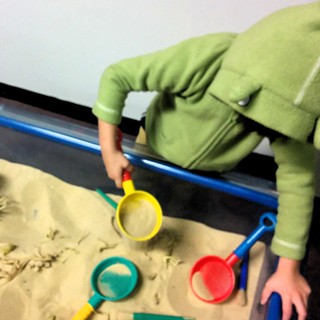
This activity benefited compared to Art Safari in the amount of time available to the children. They started off in an education room with several activities. They first had a short talk about dinosaurs, specifically, working out how big dinosaurs are based on one or two bones. Honestly, this seemed to thoroughly lose most of the children, V included. Most of the remainder revolved around a very shallow imitation of archaeology: finding plastic dinosaurs hidden in sand, or in jars filled with dried lentils. V has not yet absorbed any awe of archeology and regarded this as an exercise in playing with sand rather than a moment of entering into the noblest profession a child can conceive of. The other activity was taking dinosaur shapes cut out of paper (necks, legs and such) and gluing them together into one’s very own dinosaur, which V got quite into.

So no great educational inroads were made, but fun was had. And it didn’t manage to trigger V’s perfectionist tendencies and cause a lot of flouncing and dramatic self-recriminations.

Dino art

All the children were then given a dinosaur tail to wear — I appreciated the staff saying that wearing one was entirely up to the child, although V was perfectly willing — and a giant mass of children and parents headed down to the main exhibit. In theory we were supposed to be measuring the various tyrannosaurs and otherwise filling out an activity sheet, in practice we were mostly keeping tabs on our children and keeping the fossils safe from them. Or I was, anyway.

The exhibit itself is great, I’m intending to go back by myself before it’s up to properly appreciate it. The main attraction is Scotty. Andrew was very impressed by the faked shadow they’ve put behind Scotty, which moves and roars periodically. They’ve also done an amusing video which is mock security footage of the museum being invaded by dinosaurs, including live footage of the viewers themselves, surrounded by invading dinos. This took up a lot of V’s time. Less good for children — and what I’m going back for — is the bits about how, for example, the coloration of dinosaurs is being determined.

The sad thing about taking a young child to this sort of thing is that you cannot impress on them how unusual it is. Australian museums are not full of world-class T. rex skeletons! You won’t get to see this very often! Appreciate it while itÂ… oh never mind.

The only downside was that the ticketing was rather poorly integrated into the massive assembly line that is admittance to the main exhibit. Andrew arrived late and without a phone, and they had to page me down to the information desk to explain that he had a ticket to this workshop, not one of the timed tickets to Tyrannosaurs. We also didn’t know for sure if we were even going to see the main Tyrannosaurs exhibit and nearly bought separate tickets to it. Whoops.

Cost: $12 children and $24 adults, which was reduced a lot for museum members. The year-round equivalent is Mini-Explorers, which is $10 children and $15 adults.

The exhibit alone is $13 children and $22 adults. Odd.

Recommended (kids’ activity): cautiously. They’re well designed programs with a fair amount of thought put into them, but they are, basically, a craft activity and an “opportunity” to chase your child through a museum exhibit. It might be best saved for an exhibit that your child is likely to be unusually interested in.

Recommended (Tyrannosaurs exhibit): hell yes, circle July 27 on your calendar with danger signs and scary notation.

More information: Mini-Explorers and Tyrannosaurs: Meet the Family websites.

Your crontab file should start with “crontab -l”!

I’ve never personally had this problem, but a number of people have told me that they’ve, often repeatedly, accidentally deleted their crontab by typing crontab -r (which silently removes a crontab) rather than crontab -l (which shows you what is in it) or crontab -e (which lets you edit it). It doesn’t help that “e” and “r” are next to each other on QWERTY keyboards.

Create a single backup of your crontab contents

Since I realised this was an issue, I’ve made the first line in my crontabs the following:

@daily crontab -l > ~/crontab.backup

If you ever accidentally use crontab -r, you can use crontab ~/crontab.backup to reinstall your crontab!

Adjust @daily to a time at which your computer is likely to be on, if it’s not always on, eg 0 10 * * * for 10am daily.

For bonus points, writing this entry reminded me that I hadn’t reinstalled my laptop’s crontab on my new machine, and meant it was easy for me to find and install!

Create timestamped backups of your crontab contents

The above is simple and suffices for me, but if you don’t have a backup routine that will grab ~/crontab.backup regularly enough for your needs, you could do something like this instead:

@daily mkdir -p ~/crontab-backups; crontab -l > ~/crontab-backups/crontab-`date +%Y%m%d-%H%M%S`; find ~/crontab-backups -type f -ctime +7 -delete

Explanation:

  1. mkdir -p ~/crontab-backups makes a directory crontab-backups in your home directory if it doesn’t already exist (and doesn’t complain if it does exist).
  2. crontab -l > ~/crontab-backups/crontab-`date +%Y%m%d-%H%M%S` puts your current crontab into a file named with a datestamp (eg crontab-20140711-124450 so that you can easily have more than one
  3. find ~/crontab-backups -type f -ctime +7 -delete finds all files (-type f) in ~/crontab-backups that were created more than 7 days ago (-ctime +7) and deletes them (-delete)

Warning: you don’t want to put anything else in ~/crontab-backups, because it too will be deleted after seven days.

The Sydney Project: Art Safari at the Museum of Contemporary Art

This entry is part 4 of 11 in the series The Sydney Project

This year is my sonÂ’s last year before he begins full time schooling in 2015. Welcome to our year of child-focussed activities in Sydney.

Pipe cleaners at the MCA

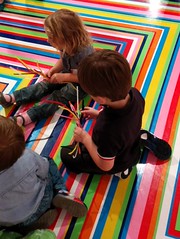
Art Safari is one of the Museum of Contemporary Art’s kids’ activities: a program where pre-school children look at a few pieces of art in the galleries and do some related art of their own. I enjoyed the Art Baby tour a lot and was keen for V to have a go at Art Safari. We were joined by another four year old, A—, and her family.

MCA milkshake

Starting in the cafe with an enormous chocolate milkshake was a non-core part of the experience but got things off to a good start, except that the cafe was a bit of a horror show of mothers’ groups and Mountain Buggy strollers (guilty as charged on the stroller) and my memory of it is of a fair bit of flurrying and crowdedness. We had some trouble getting V and A— to say goodbye to their milkshake remnants and to go to the classroom for their exercise.

They started off with some circle time talking about colours and what things they could think of that had each colour. Which led me to discover that I have the shouty kid who wants to give every answer, specifically, who wants to bellow periodically every time a new colour word comes to mind. At this age, it’s a bit awkward to figure out the division of discipline: am I supposed to step in and tell him to quit it with the bellowing, or is that all under control? (I see this play out each week at swimming lessons too, with parents evenly divided between those hissing warnings to their children to pay attention and work hard, and those with their nose in a book.)

Art adventures

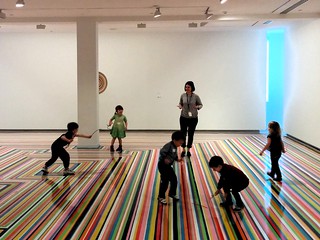
I think there’s a lot of scope for kids to interact with some contemporary art, and the art chosen for this was a good example: a whole coloured floor to pace and march around and to match their coloured pipe cleaners with. Good choice.

A less good choice was the security guard who came over and told me that there is a “no backpacks, no exceptions” rule. I assume this is because backpacks are so liable to knock over art works whichÂ… obviously is a problem, but it would have been really annoying if I’d had my baby in a front pack and then needed to, I guess, carry the backpack around in my hands, since I can’t dangle it off the baby. It’s just generally not the greatest thing in the world, to have no socially acceptable way to lump around the giant haul of nappies and wipes and changes of clothes and such that a young baby requires. I think I’m supposed to leave most of it in the car I don’t own. (Tangent: I wasn’t babywearing that day, but I often do, and it is quite common in babywearing discussions around this issue for it to emerge that many babywearers either are never far from their cars, or never far from their adult partners.) Probably the best way for the MCA to deal with this would have been for the instructor to mention it before we all left the classroom, so I could have left the bag there.

V found the first activity — making interlocking circles out of pipe cleaners — a bit frustrating (he couldn’t figure out how to twist the pipe cleaner around itself to close the circles), and I was disappointed that the session doesn’t allow enough time for the instructor to notice and help floundering children. That said, each child did have a parent with them, so of course I was able to help him out myself just before he vanished into a big pile of “I can’t, I can’t, it’s so haaaard, I can’t!”

Turntable art

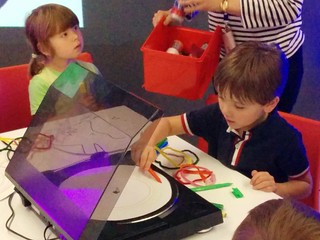
Afterwards we went back to the classroom for an activity he found much more intuitive and fun, holding a texta against a piece of paper as it spun on an record player, so as to draw circles and spirals. I think the instructor tried to briefly mention that this was an older way of playing music, but V in particular, and I think children of this age generally, don’t really grasp that the past was noticeably different from the present and have no interest in cooing over more cumbersome ways of playing music that predate their parents’ era as well. (Although, that must have been fun, back when people got to play music with TEXTA MACHINES!)

Noise and colour

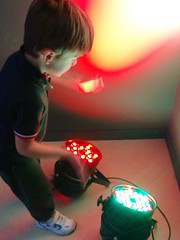
Almost as an aside, the instructor pointed the children at lights that changed colour when you clapped near them, which is nearly as much fun as textas. This was a good microcosm of the whole experience; just slightly rushed. I feel like if each part of it had 10–15 more minutes, V would have had more fun. That said, he was very proud of the art he’d made.

Cost: concession is $16.85, general admission is $21.95. I’m honestly not sure if both parents and children are supposed to buy a ticket. I bought one for me and one for him.

Recommended: not for the price. It’s a fine activity, it was however slightly rushed throughout.

More information: Museum of Contemporary Art’s kids’ activities website.

Is harassment in your community unwelcome? Adopt a Community Anti-Harassment Policy!

This article originally appeared on Geek Feminism.

Last week, the Geek Feminism community announced that we’ve adopted a code of conduct in our community. Our code begins:

The Geek Feminism (GF) community is dedicated to providing a harassment-free experience for everyone, regardless of gender, gender identity and expression, sexual orientation, disability, physical appearance, body size, race, or religion. We do not tolerate harassment of participants in any form.

This code of conduct applies to all Geek Feminism sponsored spaces, including our blog, mailing lists, and wiki, as well as any other spaces that Geek Feminism hosts, both online and off. Anyone who violates this code of conduct may be sanctioned or expelled from these spaces at the discretion of the Geek Feminism Anti-Abuse Team.

We took quite a long time to do this, after two harassment incidents associated with the Geek Feminism community (albeit, one probably not by people who are actually active in our spaces and who therefore can’t be excluded from them). We’d love it if others learned from our example and adopted a policy within their own communities. To that end, as of today, our Community Anti-Harassment Policy is available for re-use under Creative Commons Zero/public domain and we are beginning to develop associated resources, just as we have done over the past few years for the Conference anti-harassment policy

Here’s what you need:

  1. a policy (remember, ours is available for re-use, either as is, or in a modified form)
  2. a contact point where harassment reports can be received
  3. a group of responders who receive reports and have the power to act on them up to and including excluding harassers from your community

If your community does not have an obvious way to create a group of responders, start discussing how you can create one. In many communities, there is likely to be an existing volunteerocracy at the very least. Can these people reach consensus that your community should be safer from harassment, and that they are unwilling to work with harassers? Simply announcing to people that they must cease a behaviour, or they must leave the community, is in fact very effective as long as there is basic consensus around community norms. For online groups technical structures can help, but social structures are in fact the root of anti-harassment. You don’t need ops or admin power or the crown of the ancient rulers to enforce anti-harassment policies in your community, you need consistent anti-harassment responses by people with social power.

If you don’t know that your community has concensus on being anti-harassment. as a start you can declare your own personal anti-harassment stance, and publicly call for your community to adopt a anti-harassment policy, and a structure that enables the response team to exclude people from the community.

As Geek Feminism shows, activist groups or groups that have advocated for anti-harassment are not safe from internal harassment and still need a policy. And groups with no known harassment incidents are also not safe; it’s quite likely that people in your community have experienced harassment they felt unable to identify or report. Take steps to ensure harassing behaviour becomes known, and that it is known to be unacceptable.

One specific model we encourage you to avoid is the Our community is amazing! So wonderful! We rock! PS no harassment model in which you spend a lot of time affirming your community’s goodness and make a general statement about anti-harassment in passing. We discourage putting this in your anti-harassment policy for these reasons:

  1. you probably do not know the extent of harassment in your community without a policy and a reporting mechanism, and may not rock as much as you think
  2. stating that you are “anti-harassment” without saying what harassment means to you doesn’t give your existing community and potential new members the information they need to find out if their safety needs are a close enough match for your community’s norms

Stating your community’s great work or exemplary behaviour can be really useful for establishing social norms and letting people understand what joining your community means. They form a good basis for specific policies. But don’t make such statements in your anti-harassment policy, make them in a separate document listing your community’s values and goals. And it may be best to say that you aspire or intend to create an amazing space, rather than that you have definitely attained that goal. Statements that you are definitely no questions amazing may be used to silence people with critical feedback and in the end reduce your amazingness.

We also discourage private anti-harassment policies (shared only within a community or within its leadership), for reasons outlined by the Ada Initiative [disclaimer: I co-founded the Ada Initiative].

Do you already have a community anti-harassment policy, or have we convinced you to adopt one? List your community on the Community anti-harassment adoption page! And thank you.

The Ada Initiative founders on funding activism for women in open source

This article was co-written by me and Valerie Aurora. It was originally published in Model View Culture and was later published on the Ada Initiative blog. It is republished here according to the terms of its Creative Commons licence.

In December 2010, Valerie Aurora, then a leading Linux filesystems developer, announced that she was leaving software development to work on women in open source software activism full time. Behind the scenes, she asked several other geek feminist activists to join her to work on women in open source activism full time. “I don’t know what the world-wide economic capacity for paid activists [for women in open source] is, but let’s find out together!” she wrote.

In 2010, the smart money said that the world-wide economic capacity for paid activists for women in open source was well under one person. And only Mary Gardiner, then an unpaid computer science PhD student looking to leave academia, took Valerie up on the offer.

Thus began our long journey towards answering the question: “How does an activist get paid?

This article chronicles our own painful and sometimes expensive learning experiences around funding diversity in tech work, as well as advice and techniques from several other successful full-time diversity in tech activists and fundraising experts: Ashe Dryden, diversity advocate and consultant; Kellie Brownell, CiviCRM implementer at Giant Rabbit and former Ada Initiative fundraising consultant; Frances Hocutt, founding president of the Seattle Attic feminist hackerspace; and Emily May, executive director of Hollaback!.

Paying Activists and Funding Complications

The question we struggled with initially was why activism, and feminist activism in open source software in particular, should be a paid job at all. Thanks to the work of people including Kate Losse, today the tech community is increasingly aware that this kind of community-building labor is valuable and should be compensated. But in 2010, all we knew is that volunteer activism was not working. Women in open source software were working for free, burning themselves out while fighting for rights as simple as basic physical safety – let alone equal pay, equal treatment and a non-sexist culture.

And yet the expectation that women in open source should be unpaid activists was so high that in 2009, Emma Jane Westby formulated the “Unicorn Law,” which states: “If you are a woman in Open Source, you will eventually give a talk about being a woman in Open Source.” In October 2011, Skud — herself an activist and target of harassment — adapted Arlie Hochschild’s term “the second shift” to describe this phenomenon. But after ten years, and tens of thousands of hours of difficult, draining work, the percentage of women in open source software was still in the low single digits.

Valerie’s insight — radical, at the time — was that we needed full-time paid activists working on the problem in order to make any progress. We founded the Ada Initiative with the principle of paying fair market wages to anyone doing work for us more than a few hours a week. In 2010, this was a moonshot. In 2014, it’s increasingly how things are done. More and more diversity in technology initiatives are becoming paid activities, and a growing proportion of the technology industry recognizes this labour as something worth paying for.

For all this progress, relatively few “pre-fabricated” diversity in tech jobs exist, and the ones that do exist tend to be co-opted by corporations to narrowly focus on recruiting and, in effect, marketing. Many existing large diversity-in-tech non-profits are primarily corporate-funded and therefore end up compelled to do recruiting and marketing for for-profit tech corporations. An employee of a for-profit corporation who wants to advocate for significant cultural change as part of their job is stuck in an additional catch-22: they can’t criticize their competitors, because it looks like a conflict of interest, and they also can’t criticize their own employer, because that’s a great way to get fired.

Thus, full-time diversity activists who want to do effective, controversial, culture-changing work must often work out how to pay themselves, rather than taking existing jobs at tech companies or diversity in tech non-profits.

What follows is a survey of some of the most popular funding sources: corporate sponsorship, individual donations, and consulting and training.

But first…

Why you shouldn’t try them all

Often activists will reach for every funding opportunity they can: individual fundraising campaign, yes! Government grants, yes! Selling stickers, yes! Sucking up to wealthy potential donors at lavish one-on-one dinners, absolutely! But it is crucial to pick just two or three funding sources and concentrate on them.

Raising money in any form takes time, practice, dedication, and skill. Pursuing too many forms of funding will just mean that you’re bad at all of them. Some diversification of funding sources is often recommended, but the base requirement is a reliable funding source.

An activist’s choice will depend both on their mission and who they are able to reach. The Wikimedia Foundation is focusing exclusively on small donors from all over the world giving an average of $25 each and giving up pursuing most grants or large donors, in part because small donors are inherently diversified. However, the Wikimedia Foundation can use Wikipedia, one of the world’s most-read websites, as a fundraising platform, a rare advantage. No diversity in tech activists will have such a large pool of potential donors! Each individual and organization needs to assess which sources of funding are compatible with their mission, and of those sources, which they can access.

Corporate Sponsorship

The Ada Initiative, like many diversity in tech groups, initially planned on getting most of our funding from technology-related corporations. Our focus was on women in open technology and culture, which includes open source software, Wikipedia-related projects, open data, and similar areas. Our logic was charmingly naïve: since corporations reaped most of the benefit of open tech/culture, they should pay most of the cost of increasing the percentage of women in their talent pool because fairness. Also, corporations tend to have a lot of money.

Major corporate sponsorship for diversity in tech work comes in several common forms: conference sponsorships, grants for specific projects, fellowships employing a specific person for a few months, and completely unrestricted grants (our favorite). Corporate donors are attractive because, compared to the typical activist, many have effectively infinite amounts of money.

However, corporate sponsorship has clear downsides for many diversity in tech activists. The sponsor’s goal tends to be making sure the corporate sponsor has access to a diverse hiring pool. Most companies therefore prefer to support events and education initiatives that serve as recruitment opportunities in the short or medium term.

Corporate sponsorship is also often very cautious. They are looking to associate their name with a popular message, and groups who do not yet have a history of successful programs may have trouble accessing corporate donations. Organizations intending to rely on corporate donations may have to bootstrap with other funds or volunteer labor while building a history of success.

The main exception to these rules, in our experience, is smaller privately-held companies whose owners account only to themselves for how the company’s money is spent. They tend to be less conservative and more risk-tolerant than publicly owned companies. In the Ada Initiative’s case, these kinds of corporate donors were crucial to our success and included Puppet Labs, Dreamhost, Dreamwidth, and Inktank.

Early on, our philosophy at Ada Initiative was to accept any no-strings-attached corporate sponsorship as long as the company’s business model wasn’t fundamentally anathema to our mission. But since many corporations — and corporate management — are complicit in discrimination and harassment of women in tech, much of the effective work to support women in tech involves criticizing the status quo and has the potential to offend the very corporations who sponsor us. We gradually came to realize that every corporate sponsorship has an invisible condition: unspoken internalized pressure to avoid any actions that might cause that corporation to stop donating to us.

We had another motivation for our initial corporate-funded model: guilt. We felt guilty asking individual people to support our work but no such compunction when it came to corporations. We suspect this kind of guilt plagues many activists; we tend to want to help others, not ask others to help us. Our guilt about asking individuals to support our work instead of corporations drove us to end our first fundraiser early, resulting in the loss of tens of thousands of dollars from eager donors and forcing us to start another, less-efficient fundraising campaign only 5 months later. Reframing how we viewed asking individual people for donations took three years, a career counselor, a therapist, several books, and a perceptive fundraising consultant, Kellie Brownell.

So let’s talk about…

Individual Donations

Since mid-2011, the bedrock of the Ada Initiative’s funding has come from a few hundred individuals within the technology community. Being accountable to donors who are primarily interested in culture change even when it has no direct benefit to themselves allows us to take on more radical programs. This includes work that is not directly connected with hiring or careers, or that is connected with gift and alternative economies like media fandom with little direct connection to corporate profits.

Perhaps the most compelling reason to adopt an individual donor funding model is that donors often become advocates for diversity in tech themselves. Kellie Brownell, our former fundraising consultant, says, “While fundraising at the Electronic Frontier Foundation, I kept noticing that our donors were the first to take action when we asked for help.” Many an Ada Initiative donor has gone on to successfully advocate for an anti-harassment policy or a diversity scholarship in their community. We also receive many thank-you notes from people too shy, too burned out, or too busy to be advocates themselves, who are relieved that they can take action in some way by donating. Individual donors create a virtuous circle where fundraising supports our mission, and our mission increases our fundraising.

Diversity in tech organizations are increasingly bootstrapped with a crowdfunding campaign. Diversity advocate and consultant Ashe Dryden raised $20,000 in July 2013; Trans*H4CK raised $6,000 beginning in May 2013; feminist hackerspaces Double Union and Seattle Attic raised $15,000 and $11,000 respectively in November 2013; and in March 2014 Lesbians Who Tech raised $29,000 for a summit in San Francisco and $20,000 for a summit in New York.

Crowdfunding, with its constant outreach and rewards is an excellent way to interest donors and community members in an organization, but Dryden cautions that “[it was and] still is a considerably larger amount of work on top of the other work I’m doing.” At the extreme, the work required to publicise a fundraising drive and then fulfill rewards can risk exhausting the funds raised! It may also only work a limited number of times. Emily May, executive director of anti-street harassment non-profit Hollaback!, says “80% of our donors are young[…] They are incentivized to give by new exciting initiatives, but there are only so many ‘new exciting initiatives’ that [we] can launch without overwhelming our capacity.”

Activists are beginning to be able to raise enough money to pay themselves from many very small regular donations. Dryden’s funding now comes primarily from Gittip, a service that allows people to make anonymous weekly donations directly to her. She is the top Gittip recipient with an income of $750 a week, and is not the only diversity in tech activist among Gittip’s top receivers. Others include Lynn Cyrin, a trans woman of color working on a guide to class mobility and CallbackWomen, working to increase women’s representation at conferences.

Dryden says, “Community funding is great because it means I’m working directly for the community. I often tell people that the community is my employer, so I’m working directly for them, instead of what would look best for a company. It also means that I can be impartial in critiquing what’s wrong with the industry without worrying about financial ramifications either through my employer’s view not aligning with mine or people attempting to get me fired for my views, which many other activists and advocates have experienced.” Dryden’s model is beginning to approach what Sue Gardner, the outgoing executive director of the Wikimedia Foundation and an Ada Initiative board member, identifies as the future of non-profit funding: small donations from a large number of donors, requiring relatively little fundraising effort from the organisation compared to traditional models.

Every individual donor population is unique. In Dryden’s case, anonymous donors make small weekly donations on the order of $5. In the Ada Initiative’s case, we tend to have donors with high-paying technology jobs (or who own technology companies themselves) with generous bonuses, stock grants, and programs that match employee donations to non-profits. Kellie Brownell explains how we grew our individual donor base: “We adapted fundraising practices from individual major giving, for example, (1) thanking donors quickly, (2) asking what motivated them to give, and (3) reporting back later what we did with their money. Major giving practices are highly personal and aim to help donors grow in their understanding of an organization’s mission and why this mission matters to them. Once a fundraising team becomes good at doing both these things, you can develop this model further by giving donors opportunities to participate in the process.”

Relying on individual donors has downsides. Recruiting the initial slate of donors can take months of full-time work, and reminding them to give again takes more work (which is one reason why non-profits tend to prefer automatic recurring donations). Individual donors may also attempt to redirect the person or organization’s work towards less controversial programs. Dryden explains that the anonymity of her donors, which is not an option for most non-profit corporations, “removes the pressure to fit my message into what I think my larger funders would agree with, which protects the integrity of my work.”

Membership

A variant of individual donations is the membership model of funding, where funders pay membership fees instead of donating, and in return receive benefits from the organization such as access to private events, training or spaces. It often comes with input into the activist group’s governance, usually as the right to vote for or stand for the governing committee.

This model is most successful where activists are primarily working to provide ongoing benefits to a small group of people; for example, feminist hackerspaces (a.k.a., community workshops), which exist for the benefit of local women and others who are not welcomed in existing hackerspaces. Frances Hocutt, founding president of the Seattle Attic feminist hackerspace, says “We aim for members to fund the bulk of our operations because we want our community to be able to continue even if donations drop off. We are trying to build a community that is sustainable and can be self-supporting if need be.”

For organizations like the Ada Initiative, which aims to benefit a very large group of people and provide resources widely and freely, the membership model is less suitable as we have little additional benefit to offer members. Hocutt also observes that it is not ideal when activists are trying to benefit people who can’t afford membership fees: “We believe that ability to pay dues has nothing to do with a person’s ability to contribute to the creativity and energy of the Attic community, and we want to remove barriers that keep some of us from doing that.” Seattle Attic offers the ability for donors to donate memberships for people who can’t afford one, and a transport subsidy to members who don’t have access to transport.

Consulting and training

Counterintuitively, one way to raise money from donors without giving them undue influence is to provide consulting and training directly to them for a fee. This makes the terms of the relationship very clear; they receive a specific tangible benefit in return for their fee, rather than there being an unspoken expectation of a long term PR or recruiting boost.

In addition to her Gittip income, Ashe Dryden funds her work by consulting for corporations looking for help improving diversity in their organization. The Ada Initiative’s training programs include the Allies Workshop, which teaches men simple, everyday techniques to fight sexism in their workplace and open tech/culture communities. The Allies Workshop is a fairly challenging and confrontational program, as it teaches people to directly confront sexism and harassment without being transphobic, homophobic, racist, ablist, or classist. By offering it as a corporate training program on a voluntary attendance basis only, we attracted companies with employees who were ready to take personal action to support our existing strategy.

As with the membership model, providing consulting or training in return for a fee may compromise the ability of an organization to benefit the public.

“I would love a stronger earned income revenue stream, but our values of making it free to launch a Hollaback! in [any] community conflict with that,” reports Emily May, whose organization’s funding is primarily foundations (65%) and government (20%). In order to combat this effect, the Ada Initiative makes our training materials available publicly, and offers cheap and free spots at public training sessions, as well as offering training using the same materials to fee-paying clients.

Incorporation and funding

The Ada Initiative is incorporated as a 501(c)3 not-for-profit in the United States with tax-exempt status. This has some immense practical benefits in exempting us from corporate income taxes and allowing us to receive tax-deductible donations in the US.

Incorporating in some form — non-profit, B-corp, limited liability company, etc. — is not a requirement for funding diversity in tech work. We were astonished to discover how much money people would give us with the ink barely dry on our mail-order certificate of incorporation from the State of Delaware. In retrospect, we realized people were initially donating to Mary Gardiner and Valerie Aurora, not the Ada Initiative, Inc. In the tech sector, people are frequently willing to give hundreds or thousands of dollars to individuals as long as they personally trust the recipient, with or without the incentive of tax deductions or certification by some charity-related authority (e.g., the U.S. Internal Revenue Service).

The decision of whether or not to create a 501(c)3 requires weighing significant trade-offs. Preparing our application for tax-exempt status and then following various accounting and reporting rules to retain it take an astonishingly high proportion of our time — our 2012 taxation filing consumed approximately a month of staff time. In the U.S., non-profit incorporation is most suited to an organization that, like the Ada Initiative, intends to grow into a larger multi-person effort. We deliberately created an organization that would allow our projects to be continued by other activists if and when we burned out and move on to easier jobs (like writing operating systems software or leading a computational research lab).

To The Moon!

In 2010, Valerie described paying one activist to work on issues facing women in open technology and culture as a “moonshot”. In the short time since, so many activists have found that the work they do or the resources they need both should be paid for and can be paid for. The Ada Initiative, Black Girls Code, Seattle Attic, Double Union, Trans*H4ck, Lesbians Who Tech and others have joined older organizations such as the Anita Borg Institute and the Level Playing Field Institute. More are appearing every month. They are joined by community-funded individual activists such as Ashe Dryden and Lynn Cyrin.

Diversity in tech activists are using a wide variety of strategies: corporate sponsorship, yearly fundraising campaigns, monthly or even weekly small donors, foundation grants, conference sponsorships, and many more. The technology and culture around giving are changing so quickly that funding strategies that were completely impractical three years ago can now fund a full-time activist or an entire non-profit with several paid employees. Conventional fundraising experts, raised on a diet of buying email lists and snail mail appeals, are hard-pressed to keep up with these massive changes. We recommend that diversity in tech activists learn fundraising techniques from each other in addition to learning established fundraising best practices. In many ways, diversity in tech activists are outstripping received fundraising wisdom.

We can’t imagine what diversity in tech activism will look like in another four years, but we’d love to see reliance on corporate donations fall back to simply being one of many options for activists to consider. We hope that people who have benefited from the technology industry continue to give back by supporting diversity in tech activism, by joining diversity activist communities and by donating to individuals and organizations working towards a diverse and equitable tech workforce.

[Disclosure: former Model View Culture editor Amelia Greenhall and Valerie Aurora, one of the authors of this article, both serve on the board of Double Union in a volunteer capacity.]

Creative Commons License
The Ada Initiative founders on funding activism for women in open source by the Ada Initiative is licensed under a Creative Commons Attribution-ShareAlike 4.0 International License.
Based on a work at https://adainitiative.org/2014/06/10/the-ada-initiative-founders-on-funding-activism-for-women-in-open-source-from-model-view-culture/.

Travel tip: Wentworth Falls Lake

I’ve frequently had cause to try and meet people in the Blue Mountains in a kid-friendly place, and I’ve found it surprisingly hard to do so. There’s teeny playgrounds of various types. There’s all the big tourist attractions which might work for older kids but about which mine couldn’t give a damn.

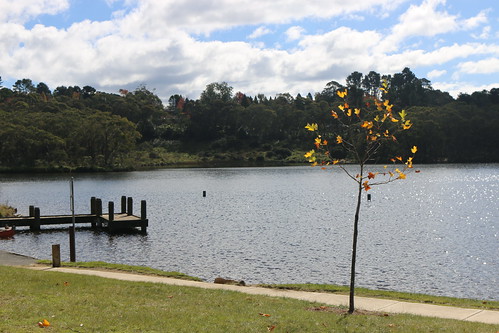
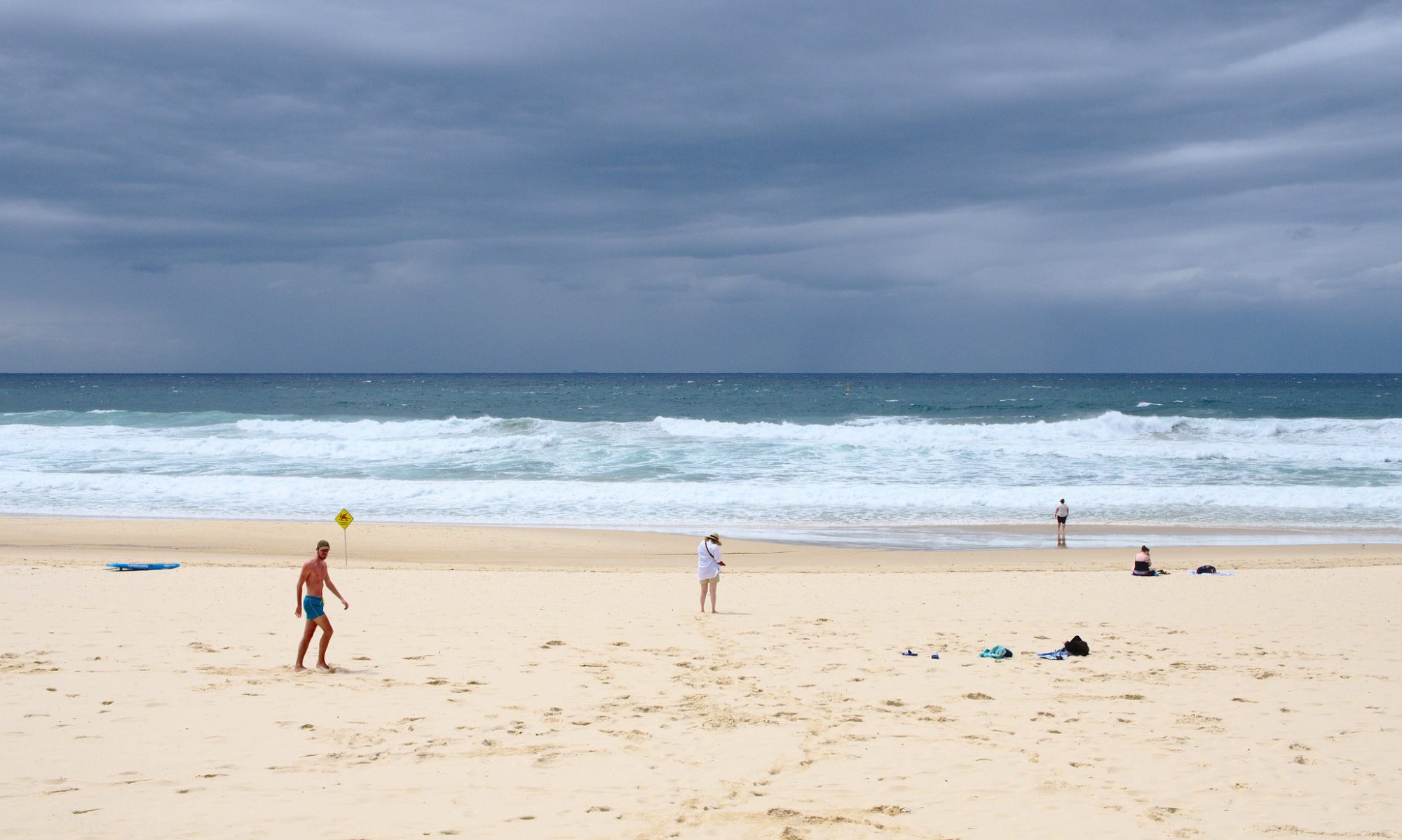
After poking at a map for a while, I discovered Wentworth Falls Lake, which seems to hit a decent amount of criteria for people with little kids. There’s two small but not uninteresting playgrounds, a number of fairly level and even paths, picnic tables scattered about, electric barbecues and a sheltered eating area, general space, and a decent-sized (albeit unfenced) bit of water to please the eye:

Wentworth Falls Lake

I’ve apparently managed to catch the train past this about 50 times without realising that it was a place worth remembering.

Note: it’s in the town of Wentworth Falls, it’s not at the actual falls. It’s on the north of the highway, the falls are on the south.

Not the Sydney Project: Questacon

This entry is part 3 of 11 in the series The Sydney Project

This year is my sonÂ’s last year before he begins full time schooling in 2015. Welcome to our year of child-focussed activities in SydneyÂ… only without the Sydney bit this once.

We rudely interrupt the Sydney Project to bring you a Canberra attraction: Questacon. In short, Questacon works nicely for V in a way that the Powerhouse did not, probably because it’s pretty shameless about catering entirely to children, complete with buttons, lights and hard hats.

We were there on a very busy day: the Saturday of the Easter weekend, the middle weekend of NSW school holidays. It was merely obnoxiously busy; I guess being used to Sydney crowds was helpful. That said, we did get there at 9:15, just after it opened. And as it was, the admission tickets to Mini-Q, the under 6 area, which is in limited numbers sessions on busy days, were only available from 11:30 onwards. I think they’d completely gone by about 10:30 in the morning. Go early, go often.

We’ve been once before, about a year ago, and Questacon was a hit to the point where for some time afterwards he asked to “see the science again!”. It took him longer to warm up to it this time. Much like last time, he shot through Measure Island without engaging. It took him a while to settle into Wonderworks, eventually getting interested in the Energy Machine and Frozen Shadow. Much to my disappointment, he’s never given a toss for my precious Harmonograph. (Much of Wonderworks has been there since I was a kid. Questacon’s exhibits are surprisingly timeless in their appeal.)

Best exhibit

Andrew and I and his father were very taken with the Cloud Chamber, which is in its own little-visited room from the steps between Wonderworks and Awesome Earth (closed for renovations), in which subatomic particles leave continuous trails through a cloud of vaporised alcohol. Andrew is keen to bring a banana next time. V was not willing to stand still for a story about how all the time, everything is being hit with tiny tiny particles moving at high speeds. Perhaps not one for the littlies.

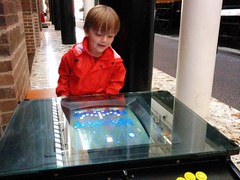
V’s favourite exhibit is pretty unique to him. He can roll ping pong balls down a ball rollercoaster for about an hour at a time. Other children come, roll five or ten balls and go. He stays. We only extracted him with a promise to return after.

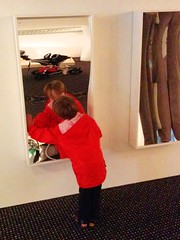
Blue tunnel

Next up was one for the watching adults, Excite@Q. V was most naturally drawn to the blue tunnel, and he was one of several smaller children jostling under Whoosh to grab a scarf and stuff it back in the wind tunnels. But we were there for one thing: to see our four year old agree to do Free Fall. I wrote about this elsewhere:

It’s a horizontal bar suspended over a very steep slide. You hold the bar. You let go. You drop freely for three metres or so before hitting the slide and sliding to the floor of the room.

The ride is, as you’d hope, very into consent. You go to the top. You get a briefing about how it works. You are told, repeatedly, that it’s OK to say no. And the day we were there, about three quarters of children did say no. (It’s a bit of a study in gender performance actually. Adult men by and large grab the bar, drop themselves down to dangle, let go and are done. Everyone else takes far far longer.)

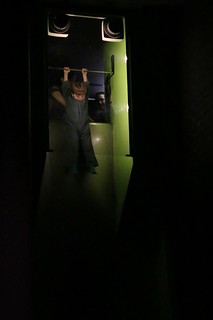
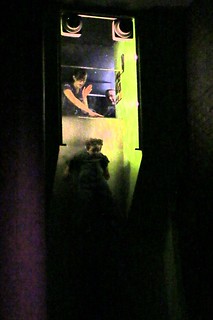
V loves slides and heights, and so we asked him if he wanted a go. He said yes. He was dressed in the safe suit for it (I guess no risk of catches or tears), he waited in the queue and watched child after child look at the drop and shake their head and walk back down the stairs with an adult for a hug. Andrew took him to the top. He got the chat about whether he wanted to say no. He gave them a puzzled look. He got his instructions. He took them very seriously.

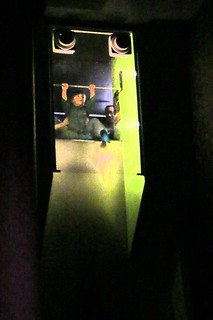
He held the bar:

Preparing for free fall

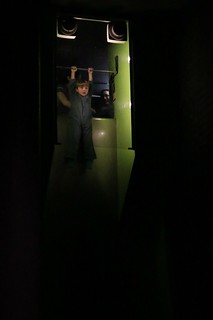
He dropped his weight from it:

Dangling

He looked down:

Looking down

And he let go:

Fall

He seemed to have fun, if a mystified about why this was such a very big deal.

Vincent the builder

After Free Fall, his ticketed time for Mini-Q came up. I didn’t go in, but apparently it was all construction all the time in there.

Finally, for bonus points, I put my camera down somewhere in Wonderworks, and someone found it and handed it into staff. “People who come to Questacon are generally very honest,” the information desk staffer told me, although somewhat spoiling the effect by saying she’d been tempted to keep the camera herself.

Cost: $23 adults, $17.50 children 4 and over, younger children free.

Recommended: yes, has something for the jaded adult radioactivity fans and the child who wants to drop from extraordinary heights, wear a hard hat in a playground, and roll ping pong balls down a slide for an hour alike. Try not to go on holiday weekends, and try not to leave your camera lying around.

More information: Questacon website.