Your first fundraiser: why fundraise?

This entry is part 2 of 9 in the series Your first fundraiser

In 2011, I co-founded the Ada Initiative, a charitable organisation promoting and supporting women in open technology and culture. Between 2011 and 2014, we ran five fundraising drives, four successfully. This article is part of a series sharing what I learned in the hope that new women in technology groups and other activist groups can skip to advanced level fundraising much sooner and spend the least time and the most joy on fundraising that they possibly can.

Why you should have a fundraising drive

In 2014, in the Ada Initiative’s article on choosing a funding model we wrote:

Often activists will reach for every funding opportunity they can: individual fundraising campaign, yes! Government grants, yes! Selling stickers, yes! Sucking up to wealthy potential donors at lavish one-on-one dinners, absolutely! But it is crucial to pick just two or three funding sources and concentrate on them.

Raising money in any form takes time, practice, dedication, and skill. Pursuing too many forms of funding will just mean that you’re bad at all of them. Some diversification of funding sources is often recommended, but the base requirement is a reliable funding source[…]

Since mid-2011, the bedrock of the Ada Initiative’s funding has come from a few hundred individuals within the technology community. Being accountable to donors who are primarily interested in culture change even when it has no direct benefit to themselves allows us to take on more radical programs. This includes work that is not directly connected with hiring or careers, or that is connected with gift and alternative economies like media fandom with little direct connection to corporate profits.

Perhaps the most compelling reason to adopt an individual donor funding model is that donors often become advocates for diversity in tech themselves…

These are great arguments for individual fundraising. Another one is that individual donors are often the most willing to take a risk on a new, untested, project; corporate donors/sponsors are more conservative and often want to see at least an informal track record to figure out what they’re associating their brand with.

If you’ve chosen individual fundraising for these or other reasons, the next question is: why do a drive as opposed to popping a donation form or Paypal donate button on your website and waiting for donations?

The first reason is simple: a drive will earn a lot more money. The Ada Initiative was a reasonably well known organisation with a reasonable amount of web traffic, but spontaneous donations outside a drive were at the rate of one or two donations a month. Our last few fundraising drives on the other hand earned hundreds of thousands of dollars and attracted as many donors in a day as we would get in the entire rest of the year. Our experience was that fundraising revenue exceeded spontaneous donation revenue by a hundred times.

There’s a tempting line of thinking around passive fundraising — I’m prone to it — which is that if your mission was truly great and your approach to it truly excellent, then the world would discover it spontaneously. Asking for money would then prove the inferiority of your mission or your organisation. Here’s a counter-argument: in order to be successful, you need to be the most invested person. If you aren’t committed to your mission, your donors won’t trust you to fufil it. Taking a risk by openly asking for money, explaining why you need it and what you’ll do with it, is one of the best ways to convince your potential donors that you have a chance at doing what needs to be done.

As we wrote in 2014, a good fundraising drive has a complementary goal: raising awareness of your organisation, and getting people involved. There’s at least two possibilities here. If you’re raising funds from the same community you’re going to benefit, your launch donors are likely to be among your key volunteers or members shortly thereafter. If you’re raising money from a different community from the one you’re going to benefit, your launch donors will be key in reaching other donors, and developing your fundraising strategy in future.

In designing your fundraising campaign, you will raise the money you need, and building a community of members and volunteers, or ongoing donors, at the same time. Good fundraising is hard work, but it isn’t a tiresome distraction from your mission. It’s how you will build the community you need to fulfil your mission.

Creative Commons License
Your first fundraiser: why fundraise? by Mary Gardiner is licensed under a Creative Commons Attribution-ShareAlike 4.0 International License.
Based on a work at https://adainitiative.org/2014/06/10/the-ada-initiative-founders-on-funding-activism-for-women-in-open-source-from-model-view-culture/.

Flickr features I’ve known and loved

As the planning for the sale of Yahoo!/Altaba to Verizon continues, I’m not the only person worried about the fate of Flickr, which has been owned by Yahoo since 2005:

I’ve got a tediously backed-up local copy of my photos and won’t have to kiss them goodbye, but as a happy Pro user of Flickr I’m really worried about its future and beginning an active search for replacements. I’m going to start evaluating possible replacements on the basis of these specific features, roughly in order of importance:

My favourite Flickr features

Embedding my foremost use of Flickr is as a photo host for my parenting blog and, increasingly, to show off my best photos. The ability to embed photographs in third-party websites is essential to me.

Locking at the photo level and guest access. It’s not easy to find non-recent photographs of my children on my Flickr account. That’s because I have a script that marks photos as private once they’re a certain age. Some other types of photos (for example, photos of other children) I often mark as private immediately.

Much of my web life runs this way: just because you can find my recent stuff doesn’t mean you get to casually browse everything I’ve done on the Internet since the beginning of time (circa 1999). I’ve taken full advantage of websites with individual locking every time I’ve used one, including WordPress sites, LiveJournal&Dreamwidth, Pinboard, and, yes, Flickr, and strongly prefer it.

At the same time, the chance of people who care about me obtaining a login to Flickr, or to social-photos-site-of-the-month in order to view pictures of a party we were at is basically nil, so the ability to share links to photos via Flickr’s guest pass system has made it useful to me for semi-private events and photos.

API access. I’m not locking all this stuff on all these sites down by hand! It’s all scripted and done via APIs.

Multiple albums for a single photo I look at my photos through several different types of, uh, “lenses”. There’s events, there’s individuals in the photos (mostly my children), and there’s my show-off albums for my favourite photos or ones most I’m likely to want to share with other people if only they’d ask to see more of my photos. I use albums for all three ways of looking at photos, and thus many of my photos are in both a “my kid at age 3” album and a “visit to the beach in November” album.

I also use tags and I might be able to modify my workflow to use tags to replace some of these features, although the result of a tag search would need to be viewable as a first class album, rarely true in my experience so far.

Creative Commons licencing. I like easily dropping my photos into a big pool of photos that might someday find good uses elsewhere and licence a lot of my non-portraits CC BY for (nearly) maximum re-usability. I fear that even sites that support CC licencing won’t end up being searched by anyone in practice, and if I note a CC licence myself in the description, it’s never going to happen.

Features I’d reluctantly sacrifice

Chromecast support. It’s been really enchanting having our TVs display great photos of our kids throughout their lives, travel we’ve done, and a lot of clouds, all via Chromecast’s support for using Flickr photos for background images, but I’m willing to give it up for my core set of features.

An app. Don’t get me wrong, I do like being able to peruse my photos on my phone, but I’d give it up if I had to. Because I do about half my photography with a DSLR, and edit essentially all my photographs, I don’t upload photos via apps in any case.

Less important

The social ecosystem. I started using Flickr regularly after a lot of people stopped, and I’m indifferent to the social features, eg favourites, comments, following other folks, putting my photos in group albums. I do use some of these, but I won’t be looking for them in a replacement.

Locking to different sets of people. I do use Flickr’s “friends” and “family” distinction a little, but in giving up social, I’m also happy to give up locking other than “locked” and “not locked”.

And now, I’m afraid, it’s well and truly time to go shopping for a new photo host. My favourite. Only not.

Your first fundraiser: what the Ada Initiative learned the hard way

This entry is part 1 of 9 in the series Your first fundraiser

In 2011, I co-founded the Ada Initiative, a charitable organisation promoting and supporting women in open technology and culture. Between 2011 and 2014, we ran five fundraising drives, four successfully.

We made a bunch of bad decisions along the way. For example, after our first drive in 2011, we stopped accepting donations, and moreover assumed that folks who had been denied the opportunity to donate in mid-2011 would still be there and keen in early 2012 (spoiler: no they weren’t). We offered t-shirts as a donor thank you gift. Worse: we offered t-shirts twice.

We also got a lot of excellent advice from fundraising experts and from our fabulous boards of directors, and through a combination of hard work (both ourselves and our volunteers!), good ideas, and good luck, had a lot of success. For several years I’ve been informally advising other women in technology groups on fundraising for the first time ever,

Over the next several weeks, I’m publishing a series of articles with my fundraising wisdom, with the hope that new women in technology groups and other activist groups can skip to advanced level fundraising much sooner. May you spend the least time and the most joy on fundraising that you possibly can!

Creative Commons License
Your first fundraiser: what the Ada Initiative learned the hard way by Mary Gardiner is licensed under a Creative Commons Attribution-ShareAlike 4.0 International License.

If you’re still maintaining a LiveJournal, your journal’s now in Russia

Signal-boosting this news as I know a few people still maintaining a LiveJournal who might choose to delete it, or change their use of LiveJournal after learning about this.

LiveJournal is now hosted in Russia

As of late December 2016, the LiveJournal servers (computers) are now hosted in Russia. While LiveJournal has been owned by Russian company SUP since 2007, the servers had until now been hosted in the US and access to them somewhat controlled by Californian law.

SUP has, to the best of my knowledge, not announced or commented on this themselves, but there’s more information at rahirah’s Dreamwidth journal with links to different evidence of the new location of the servers.

A Russian-language LiveJournaller appears to report that Russian law then allows that all the confidential information of [LiveJournal] users is available for [Russian] domestic security services in real time [note though that that’s a automated translation].

A BBC report on Russian law regarding social media in 2014 seems to confirm this:

A new law imposing restrictions on users of social media has come into effect in Russia.

It means bloggers with more than 3,000 daily readers must register with the mass media regulator, Roskomnadzor, and conform to the regulations that govern the country’s larger media outlets.

Internet companies will also be required to allow Russian authorities access to users’ information.

Thanks to my original source of information about this (found via @anatsuno on Twitter).

siderea expresses several important concerns with this:

  1. if you’re in Russia or vulnerable to Russia, and a political opponent, you could now be more easily identified by Russian security
  2. regardless of where you are, your LiveJournal could be possibly be deleted without notice for expressing opposition to Russia or its interests or for other content censored in Russia (eg LGBT-related content)
  3. the flight of LiveJournal users from LiveJournal following this news could simply kill the business and cause everyone’s journals to disappear without notice (Archive Team is storing public entries, regarding it as an at-risk site)

Readers’ connections to LiveJournal aren’t private

LiveJournal redirects secure https links back to insecure http. For example, if you visit https://ohnotheydidnt.livejournal.com/ your browser will connect, but it will be instructed to head to http://ohnotheydidnt.livejournal.com/ before loading the page. (Info from this Dreamwidth comment by mme_hardy, confirming my personal experiences with LiveJournal RSS feeds over the last several months.)

What this means is that the content of any entries you read, including locked ones by both you and other people, are trivially visible to anyone who can eavesdrop on your net connection, including (often) other people on your local network, and anyone on the path between you and LiveJournal such as your ISP and anyone with access to the data flowing across international cables or access to the data as it enters the Russian hosting facility, whereas https connections are encrypted in a way such that those people can see that data is flowing but can’t read it absent considerably more niche and intensive technical measures. (Even if HTTPS were turned on by LiveJournal, you wouldn’t be safe from the Russian law, since they can ask LiveJournal itself to turn over your data in addition to whatever nation-state attacker level techniques they can employ.)

Given my experience with LiveJournal RSS feeds, I’m fairly sure this has been true for some time, predating the move of the servers to Russia. (Here’s one other report that this was already true as of September 2016.) Regardless of timing, this speaks of, at best, disregard for the privacy of their users’ explicitly private (because friends-locked!) information. It’s 2017, mandatory HTTPS for transmission of any data that is sensitive or might, conceivably, somehow, maybe, be sensitive is an absolute minimum standard for user safety. LiveJournal doesn’t even have optional “if you have HTTPS Everywhere installed” or “if you remember to stick the s into the URL yourself” HTTPS (which would still be insufficient as you cannot control whether your readers use HTTPS when reading your journal).

Getting your content out of LiveJournal

If based on this you choose to delete your LiveJournal, here are some options to keep your entries. This list isn’t comprehensive.

If you want to move the content to another website, here’s some blogging platforms that provide imports from LiveJournal:

If you want to download your entries for private use, you can:

  • use LiveJournal’s own export tool but rather painfully (you’ll have to do one download per month), and without comments
  • use ljdump on the command line, which worked for me as of 2015 when I deleted my LiveJournal, but will require that you’re an experienced command line user
  • use BlogBooker to export it to a Word or PDF file (disclosure: I haven’t used this site in quite some time, and would appreciate hearing if it works, but I suggest people at least try it because it exports to a non-programmer friendly format that people could keep as a private archive, and claims to include comments and images)
  • Archive Team lists other backup tools

If your LiveJournal made use of their photo hosting, I am not sure which backup solutions will import your photos or how they will be stored. I am also not aware of any import tool that replaces LiveJournal entries with a “this entry has moved to URL” message or similar. If anyone is working on a competing LiveJournal import/export tool, photo export and redirection text are both features that my friends and I would have found useful at various times.

Creative Commons License
If you’re still maintaining a LiveJournal, your journal’s now in Russia by Mary Gardiner is licensed under a Creative Commons Attribution-ShareAlike 4.0 International License.

2016 in threes

This entry is part 4 of 13 in the series Year in threes

End of year reflections: 2016, at its low points, has been the worst year of my life, and many people including me fear that it is the year that marks the beginning or escalation or point of no return for a time of increased oppression, war, and death.

This is thus hard to write, but 2016 was also a year in my life, such as it is, and remembering is part of living as best I can, so here we are.

There are several pieces of writing that have been important to how I feel about the world right now, here’s one:

(Transcript of poem at the bottom of the entry. If this poem speaks to you as it did to me, consider tipping its author.)

Three moments of 2016.

May: Another visit to Dolores Park, a place in San Francisco that’s been important to me in 2016. I was restless and in a bad mood so I walked up and down the hill, around and around the park, and then up to Market Street as the sun set and along and eventually caught BART back after dark had fallen and I’d walked several kilometres.

September: A family member who is ill and was visiting for medical treatment came to lunch at my house with other members of my family. My daughter A, who was 2¾, had taken a long long time to come out of her shell with strangers, and was only just starting to agree to interact with them at all. But she ended up playing with water guns with the teenagers, aiming water at our window where adults were protecting themselves, while dancing and cackling.

November: I found out Donald Trump was likely to win the US Presidential election on my final day of isolation due to radioactive iodone treatment for thyroid cancer. I was out of strict isolation in hospital but still not allowed to be physically close to anyone, particularly my children, so I was driving a carshare car by myself to visit my parents. It was a rainy drive, I stopped in the light mist at Sutton Park to go to toilets there — it’s a lovely park and rest area largely used as a chance for a loo break — and looked at the news on my phone and then drove down into the bright sunshine and ludicrous green on the other side of the mountains and started thinking through the implications.

Three meals of 2016

All in the US, where I spent six weeks this year.

1. May, Zuni Café, San Francisco: the second time a friend and I have eaten there, this time upstairs with a reservation rather than squeezed in near the kitchen, both times with the fried chicken. I have never gone anywhere for the fried chicken. I have never imagined I would. All the better.

2. September, SHED Cafe, Healdsburg: a lemon pancake which was in fact a lemon pudding. Not even in disguise, it came in its own ceramic dish it had been cooked in. It wasn’t self-saucing or it would have been lemon delicious pudding in disguise. It was left off the order originally, I got two kaffir lime waters in apology. Unnecessary.

3. October, Andrew’s Cheese Shop, Santa Monica: a work dinner, comprised of gourmet grilled cheeses with matched beers. Again, I would never ever think to do something like this for myself.

Three photos of 2016

The first day of a silly between-jobs project of exploring the City of Sydney swimming pools:

Making a little tour of the City of Sydney pools this week.

A selfie I’m pretty happy with:

Mary

I was still taping the thyroidectomy scar at the time; it’s more purple than it looks there.

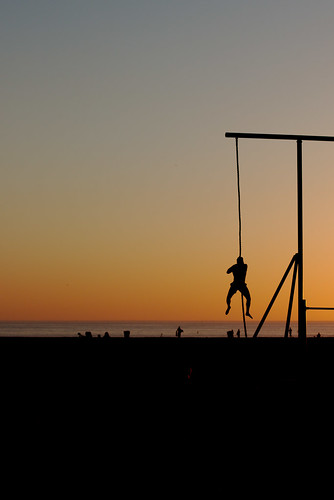
Someone climbs a rope, hands-only, as the sun sets over Santa Monica beach:

Rope climb

Three pleasures of 2016

1. I did do the intermediate run on skis I wanted. The very first one was the result of a misunderstanding; my skiing buddy thought I’d done intermediate runs in Australia and therefore after warming up could do one at Heavenly. Instead it was a first. The day went downhill (ha) after part of the resort was shut due to wind, and we missed lunch, but the cold grey morning was lovely.

2. Being taken to the ward after my thyroidectomy and having Andrew smile at me and squeeze my hand during the brief moments I was able to be awake for that afternoon.

3. The feeling of my hair swishing on my neck now that it has grown long enough.

Three news stories from 2016

Putin, I think? I’ve talked enough about the US. So: Putin, Aleppo, Brexit.

This is not fine.

You have to be a better and stronger person than I am to find something else to say.

Three sensations from 2016

1. “Koala” snuggles with my daughter, who is not as demonstrative as her older brother, except when she curls firmly into me to avoid anything or anyone she doesn’t like. Or when she’s ready for bed. Fierce sleepy marsupials are about right.

2. The taste of Haigh’s chocolates on several occasions: I bought them for myself for both cancer treatments, and when I left my job mid-year (between treatments). I remember the sweetness of the cremes, so sweet it hurts, but what I recommend is the truffles.

3. The taste of lemon sherbet boiled sweets. I went through a bag of them on medical advice during the radioactive iodine treatment; the I131 also gathers in the salivary glands and gives them mild radiation burns. Getting it excreted is the main fix, hence sour things.

Three sadnesses of 2016

1. A number of serious illnesses that aren’t mine, so aren’t mine to talk about.

2. Speaking of illnesses, but that are, or were, mine, the morning before a surgery is always a terrible time for me.

3. I actively chose to switch jobs again this year, but it was really hard and sad.

Three plans for 2017

1. I’ve started cycling in the last few months of this year. It’s a nice ride just shy of 4km with enough hills to get some exercise and a long bridge ride. In 2017 our ongoing ridiculous childcare situation will be improved, and I’m hoping riding three or four days a week will be my normal thing.

2. A peaceful week-long holiday with Andrew and the kids at Lake Macquarie. I find skiing hard work, so this will be only the second relaxing holiday we’ve all had together in the three years since my daughter was born.

3. As little travel as I can get away with. I’d love to clock up six months without a boarding pass.

Three hopes for 2017

This year, a very close cousin of “three fears”.

1. I hope my strong and wise friends are here and fighting and see something good growing from their hard work and their fear.

2. I hope it’s still possible to work for US headquartered employers in my industry without rapidly worsening complicity in human rights abuses.

3. I hope for at least one night out together with my husband that isn’t “last night before I go away for work” or “last night before I’m admitted to hospital again”.

Poem transcript

Transcript of the poem by Saladin Ahmed:

How do you talk to your kids?

Spit out the scorpions
Spit out the cyanide
Fill your mouth with thorny
flowers

Sit and hold their hands
Sit staring at their
superhero posters
Explain that villains win
sometimes

Tell them no one can tear
apart their family

Even if it’s a lie

Tell them that no one can take
away their home

Even if it’s a lie

Tell them you will keep them
safe
Even if you can’t

Teach your daughter to throw
a punch if she has to
Teach your son to cry if he
has to

Give them knives
Give them the sturdiest wax
you can find

Teach them to make candles

—Saladin Ahmed, buzzfeednews/reader

End of year prompts

I came up with my end of year prompts in 2014, feel free to use them yourself.

Previous years: 2014, 2015.

Superhumanised methyl: an infallible process for naming things

“I’m no good at names” said pretty much everyone I’ve ever founded and named a project with. Of course you aren’t because how often does one found and name a project? It’s a learned skill. You’ll get better at naming things as you name more things.

I’ve been following the same naming process since we named the Ada Initiative and it’s worked well several times; we came up with a name that we liked and the project didn’t split up over the issue of naming. I thus feel like it’s ready for public release and declaration of infallibility.

What are you trying to name?

Get down a short description of the thing you are trying to name: a two sentence summary, a mission statement, or similar. Eg: “a group blog for people who both knit and crochet”, “a future multinational oil company” or “a street festival”.

This may sound really obvious — why would you be naming something before you know what it is? — but in fact often you have to name things before almost anything else happens, because the name will need to go in your domain, in your incorporation paperwork, in your Twitter handle and so on. Often the need for a name arrives simultaneously with the need for a mission statement; get a short summary down as you currently understand your project.

Consider the obvious

I tend to lean to names that are fairly abstract, because I want to avoid asserting a particular kind of authority for a new project. For example, the Ada Initiative was not named “the Women in Open Source Initiative” for the reason that we weren’t intending to be an umbrella group or a one-stop-shop. Separately, abstract names are apparently easier to establish as a trademark (of course, if trademarkability is an important consideration for you, involve an intellectual property lawyer in your naming process).

But that said, it’s worth considering if you should be “the Winter Street Fair” or “the Crafters Blog” or “Oil, Incorporated” before you disappear into the web of name possibilities.

Assuming you’ve decided not to go with a descriptive name, it’s time to…

Come up with sources of metaphors

This is the part where I personally get stuck on “but I’m terrible at coming up with metaphors”. But again, you don’t have to do this cold. Think about:

  • your field: tools and technologies, sources of meaning and difference and status within it (quality, skill, design, distinctiveness, price, reliability, longevity, sub-cultural elements…)
  • history: early figures in the field/region, early tools and technologies, important places and their names
  • related fields and their tools and technologies, important places and so on
  • natural phenomena are very established metaphors: weather for energy/change, fire for destruction/renewal, wilderness (and space) for adventurousness, water for soothing/endurance/relentlessness

Your craft blog: historical crafters, historical technologies (eg the names of early looms), current technologies, colours, stitches, patterns, garments.

Your street festival: historical residents of the area, earlier names for the locality, street names, seasons and weather, local wares.

Your oil company: earth, power… varieties of hats? Pollution? Seriously, don’t get me to name your oil company.

Quite a lot of fields have a well-established metaphor, eg, “cloud” for computer servers hosted by other people (and earlier, for the wider Internet in general, often depicted as a cloud in diagrams). Add this and related metaphors to your sources of metaphor.

Create a list of possible names or part names.

Now you have your sources of metaphor, use them to come up with specific possible names. This is brainstorming with reference materials. I use either a thesaurus or Wikipedia to get down as many ideas as possible.

Valerie wanted to name the Ada Initiative for Ada Lovelace, but the second part of the name came from thinking about wanting to capture, essentially, activity, and then following networks of words related to activity, forward motion, and change around a thesaurus. I’ve named other things by working my way through Wikipedia categories and lists.

If I was naming a provider of cloud computing services and wanted to stick close to the cloud metaphor, this is some of what I’d end up with from this process:

  • from thesauruses, based on “cloud”: steam, vapour, nebula, dapple(d), overcast
  • from Wikipedia, poking around cloud and weather categories: hector, cloudburst, flanking line, cumulus, stratus, mushroom

If I was going to be going for high reliability, I might go with ground/grounded as a metaphor instead, and some of the following might end up on the list:

  • from thesauruses, based on “earth”: clay, loam, pottery, cave, nest, field, holding, home, soil, tillage
  • from Wikipedia, looking around soil-related categories: brown earth, mire, loam, terra, peat

This is the long-listing phase: Put down every possible name that you vaguely like. Don’t be bound by your sources of metaphor, consider adding words you’ve always liked or cool words you find randomly flipping in a dictionary, fragments of your personal motto, abandoned names from previous projects. There’s already a ton of filtering going on here (eg, it turns out there’s a whole lot of trademarked soil products ending in -sol I didn’t include) but don’t do it systematically yet. Just avoid writing down stuff you hate.

If I was looking for/open to a two word phrase, I’d both allow them here (“red soil”) and do the same process for the second half of a name (“initiative”).

You can cautiously branch out into other languages. I tend to end up at Latin pretty quickly because there’s less cultural appropriation issues than with many living languages, and English speakers can usually figure out a plausible pronunciation of the name.

Whittle down the list.

It’s time for the short-listing phase. You can do this by gut: get rid of “meh” names. This is also a good time to add a bunch of practical constraints to help cut it down. For example:

  • does it have connotations you don’t intend? (eg “girls” for a women’s group will at some point cause people to start asking questions about the age range of members)
  • how formal is the name, compared with your intentions?
  • is it striking and memorable?
  • is the origin story of the name entertaining and OK to share? (you may be asked for it)
  • is an appropriate domain name/Twitter handle/your landgrab here available?
  • is it easy to spell? (joke is on me: it took me ages to learn to type “initiative” reliably)
  • will people understand it when you say it over the phone? (trick question, this is never true, barring naming your new project “John” — or wait, was that “Jon”? — but if you keep it short at least spelling it out won’t be time consuming)
  • do you like the acronym or short form? does it have its own spelling or confusion issues? (the Ada Initiative used to receive a fair bit of correspondence concerning the Americans with Disabilities Act and the American Diabetes Association, both known as ADA)
  • is there a similar trademark?
  • is it a “style” of name widespread in your market (eg, two word names are common, or single syllables are common, or naming things in memory of is common) and do you want to nod to that or depart from it?
  • is it a word in other languages, and if so, what does it mean?
  • are you borrowing a term from a dispossessed or disadvantaged group? (eg using an Indigenous word for a non-Indigenous-centered thing in Australia)

The specific constraints will vary: I’ve rarely had to care about trademarks so far, and the fewer things I have to spell out over the phone the better. You’ll probably refine your criteria as you strike individual names.

Often at the end of this process you’ll be down to five names or less. One catch: you are pretty tired and bored by this point. Be sure you get rid of any name you in fact hate, no matter how good it seems by your criteria, because otherwise you risk choosing it out of exhaustion or inertia. In a group setting, you will need to risk a bit of conflict by trying to draw out “does anyone actually just hate any of these?”

The last one

Sometimes if you are lucky, you only have one candidate left, or else one that is just the best by far. You have a winner!

Otherwise, this is tricky. You’ve looked at the names so long you’ve started to lose any sense of their goodness. However, the whole painful preceeding process means that something that has made it this far is likely to be a perfectly fine name that you will grow attached to over time. Possibilities for making the final decision include: allowing no-reason vetos, votes, tasking one person with making the call. It can be worth taking an hour or two imagining the name in use: on your posters, your business card, your graffiti.

Postscript: what’s up with “superhumanised methyl”? Super? Human? Ised? Methyl? Well, I knew I needed to perform flawlessly in naming this entry, and so I did not do any of the above process but instead ran my random word generator a bunch of times until I got something I vaguely liked. However, in the spirit of full disclosure: I did change it to Commonwealth spelling.

Creative Commons License
Superhumanised methyl: an infallible process for naming things by Mary Gardiner is licensed under a Creative Commons Attribution-ShareAlike 4.0 International License.

Learning more about a remote working position

This entry is part 1 of 3 in the series Remote work

I’m in the process of wrapping up a long period of working remotely at least part-time from home, beginning in 2006 when I enrolled in a PhD program and continuing through my time at the Ada Initiative and at Stripe to this year.

My take on working remotely in future is really “it depends on the details” (and likely different details for different organizations). To that end, I contributed some suggested questions you could ask to Hypothesis’s Working remotely guide, which they’ve incorporated in a slightly edited form. Here’s my original questions; I’ve also added a few more at my end after some feedback from Andrew (himself a veteran of around seven years of remote work).

Introduction

Before you start working remotely at a new organization, you should explore how they structure remote working and if there are any expectations mismatches between you and the organization. A particular remote job may or may not be a match for a particular remote worker.

Important: I don’t think there is any one right answer to any of these questions. It’s a question of fit between your working style, the position itself, and the relationship of the position to the rest of the organization. But the answers are worth knowing so that you can evaluate your fit and make plans for effective remote working.

Sources of information

This entry has a lot of questions, too many for a “do you have any questions?” section of an interview. But you can use other sources of information to get most answers, especially about organization-wide questions:

  • the job description, and descriptions of similar roles
  • the organization’s website, particularly the About and Careers pages
  • the section of the employee handbook dealing with remote work
  • the LinkedIn pages or websites of your future manager and colleagues
  • longer, separate, conversations with your recruiter or hiring manager
  • your offer conversation or letter, or your contract

Some questions you also may only need to ask if you hear of concrete plans to make a change to the organization (eg, you learn that a new office is about to open near you).

Questions

How are you remote and who are you remote from? This post is using ‘remote’ to mean something like “most days, you are not in face to face contact with any colleagues.” But you should be aware of the details: will you be working without in person contact with teammates or with the wider organization almost all of the time? Do you have any colleagues in your team or your wider organization in your city or region, or who regularly visit? Will you work on any joint projects with them? Will you be able or be expected to sometimes work with them in person even if there’s not a permanent office space?

Separately, is in-person contact with vendors or customers part of the job?

Is your immediate team remote? Is your manager remote? Being a remote member of a team that is all working remotely from each other is different from a team which is mostly located in an office with each other. Likewise, being managed by someone who is in an office has some potential advantages (for example, access to information circulating through verbal grapevines, being able to access answers from colleagues for you quickly), as does being managed by someone who is themselves remote (a direct appreciation for experiences specific to remote workers, a personal interest in advocating for them).

How many remote workers are there at the rest of the organization? What percentage of teams you will work closely with are working remotely, and what percentage of employees overall are working remotely? Working as one of very few remote workers for an organization where most employees are in an office together is different from a mostly or entirely remote-working organization.

What’s the future of remote work at the organization? If the organization is mostly or entirely remote, are there any plans to change that? If the organization is mostly office-based, are there any plans to change that? If an office is likely to be founded in your city or region soon, will you be able or be expected to work from it?

You may be considering a job on the understanding that the remote work will be of very short duration (eg, an office is opening in your city in two months time). Is there any chance the time will be longer, and are you OK with that?

What is your manager’s approach to remote workers? How frequently will they speak with you and through what media? Will they expect you to travel to them? Will they sometimes travel to you? Have they managed remote workers before?

How long have there been remote workers for? Is the organization new to having remote workers or has it had remote workers for a long time and bedded down a remote working style?

What is the remote working culture like? Is most collaboration over email, text chat, phone, video conf, or some other means? Are there watercooler-equivalents like social IRC channels or video chats? How active are they? Are remote workers mainly working from home or from co-working spaces? Are there occasional team gatherings for remote workers to meet colleagues in person and are they optional or compulsory?

How flexible are the hours? Not all remote work has flexible hours; you may have mandated work hours, or core hours, or shifts, as in any other role.

Are the remote workers spread across multiple timezones? If so, are your team and closest collagues in your timezone or another one? Are you expected to adapt your working hours to overlap better with your colleagues? How are meetings and other commitments scheduled across timezones? Do they rotate through timezones or are they always held in a certain timezone? Are you ever expected to attend meetings well outside your working hours, and if so, how often is this expected and do your colleagues in other timezones face the same expectations?

What are the benefits for remote workers? Will the organization reimburse any of your remote working expenses, such as membership of a co-working space, home office furniture, or your home Internet connection costs? If you’re working in a different country from most of your colleagues, will you get equivalent benefits to your colleagues (eg, health insurance coverage)?

What are the travel expectations for remote workers? Are you expected to travel to headquarters or other offices or customers, and if so, how often and for how long? What are the travel policies and allowances for remote workers? How do these travel expectations compare to those of non-remote colleagues?

Sometimes you will be remote from an organization with an office or even headquarters in the same city as you. Will you be able or expected to visit the office? How often? Will there be resources for you (eg, hot desks, meal provisioning)?

What are the career progression possibilities for remote workers? As a remote worker in a partly non-remote organization, could you move into more senior positions over time, such as team leader, middle manager, or executive? Could you move into other teams in the organization, and if so, which ones? Are there some roles that are closed to remote workers? Match these answers to your own career goals.

What’s the training process like? Must you or can you spend a period of time in an office or visiting a colleague for training? Must you or can you do your training remotely using documentation, videos and similar? Will a trainer or colleague have some time assigned to remotely train you?

Is there support for first-time remote workers? If you haven’t worked remotely before, will the organization support you in learning how to work remotely, and if so, how?

See also

A very partial list of resources, focussing on individual remote workers and their experiences and strategies:

Creative Commons License
Learning more about a remote working position by Mary Gardiner is licensed under a Creative Commons Attribution-ShareAlike 4.0 International License.

How to tell if you are in an October Daye novel

In the style of The Toast‘s How To Tell If You’re In a Novel series, I present a How to Tell for Seanan McGuire’s ongoing October Daye novels (spoilers through to the end of book 9).

You love and grieve for your estranged teenage daughter enormously, enough to mention her in passing periodically.

Your mother is so beautiful that those looking her directly literally risk heart failure. Almost every man you know is in love with her, except for the ones who are in love with you.

One of your best friends has staked first claim on being the one who kills you. Bringing her donuts often smooths things over though.

Your loving and infinitely patient and giving substitute father figure is probably a small-minded villain. However, his identical twin brother, who arranged the years-long torture of his sister-in-law and his young niece, may be redeemable.

Most men you know are either royalty or royalty-in-hiding.

Everyone sufficiently important smells of roses.

Your cats are known spies for the monarch of a kingdom unanswerable to you or your allies. This does not significantly alter your opinion of them. Or of him for that matter.

You got your blood on the carpet again. And on your clothes. And on the walls. And on your enemies, woe betide them.

One of the major relationship issues you and your friends worry about is having a lover who needs to sleep at night-time.

You’re getting a bit tired of everyone harping on about how you have overthrown two monarchs and that you also killed a man that one time.

You like to get high so much that you sometimes alter your biology for an optimal experience.

Teenage boys look up to you and never ever rebel against you.

You drink people’s blood in order to enter their dreams and strip them of half of who they are. They are usually pretty OK about this. You’re somewhat surprised when they aren’t.

You own the knife of a teenage girl who died thinking of you as her hero, and you live with a housemate who ate her soul and later went on to assume your face and memories too. You get on great and think of each other as sisters. It’s somehow clear to everyone that you get to keep the knife.

Prejudice against people who have an animal form or characteristics is deeply disgusting to you, but you know for sure that certain lineages of magic should never ever interbreed. You’re becoming a bit ambivalent about folks with recent ancestors from the plant kingdom too.

You aren’t the species your mother always told you you were. Your friend the part-time cat would have told you this, but he didn’t think you’d believe him.

You ultimately answer to Canada.

No more rock stars: how to stop abuse in tech communities

This was co-written with Leigh Honeywell and Valerie Aurora, and was originally published on hypatia.ca. It’s also available en français sur repeindre.info.

Content note for discussion of abuse and sexual violence.

In the last couple of weeks, three respected members of the computer security and privacy tech communities have come forward under their own names to tell their harrowing stories of sexual misconduct, harassment, and abuse committed by Jacob Appelbaum. They acted in solidarity with the first anonymous reporters of Jacob’s abuse. Several organizations have taken steps to protect their members from Appelbaum, including the Tor Project, Debian, and the Noisebridge hackerspace, with other responses in progress.

But Appelbaum isn’t the last – or the only – abuser in any of these communities. Many people are calling for long-term solutions to stop and prevent similar abuse. The authors of this post have recommendations, based on our combined 40+ years of community management experience in the fields of computer security, hackerspaces, free and open source software, and non-profits. In four words, our recommendation is:

No more rock stars.

What do we mean when we say “rock stars?” We like this tweet by Molly Sauter:

Seriously, “rock stars” are arrogant narcissists. Plumbers keep us all from getting cholera. Build functional infrastructure. Be a plumber.

You can take concrete actions to stop rock stars from abusing and destroying your community. But first, here are a few signs that help you identify when you have a rock star instead of a plumber:

A rock star likes to be the center of attention. A rock star spends more time speaking at conferences than on their nominal work. A rock star appears in dozens of magazine profiles – and never, ever tells the journalist to talk to the people actually doing the practical everyday work. A rock star provokes a powerful organization over minor issues until they crack down on the rock star, giving them underdog status. A rock star never says, “I don’t deserve the credit for that, it was all the work of…” A rock star humble-brags about the starry-eyed groupies who want to fuck them. A rock star actually fucks their groupies, and brags about that too. A rock star throws temper tantrums until they get what they want. A rock star demands perfect loyalty from everyone around them, but will throw any “friend” under the bus for the slightest personal advantage. A rock star knows when to turn on the charm and vulnerability and share their deeply personal stories of trauma… and when it’s safe to threaten and intimidate. A rock star wrecks hotel rooms, social movements, and lives.

Why are rock stars so common and successful? There’s something deep inside the human psyche that loves rock stars and narcissists. We easily fall under their spell unless we carefully train ourselves to detect them. Narcissists are skilled at making good first impressions, at masking abusive behavior as merely eccentric or entertaining, at taking credit for others’ work, at fitting our (often inaccurate) stereotypes of leaders as self-centered, self-aggrandizing, and overly confident. We tend to confuse confidence with competence, and narcissists are skilled at acting confident.

Sometimes rock stars get confused with leaders, who are necessary and good. What’s the difference between a rock star and a leader? We like the term “servant-leader” as a reminder that the ultimate purpose of a good leader is to serve the mission of their organization (though this feminist critique of the language around servant-leadership is worth reading). Having personal name recognition and the trust and support of many people is part of being an effective leader. This is different from the kind of uncritical worship that a rock star seeks out and encourages. Leaders push back when the adoration gets too strong and disconnected from achieving the mission (here is a great example from Anil Dash, pushing back after being held up as an example of positive ally for women in tech). Rock stars aren’t happy unless they are surrounded by unthinking adoration.

How do we as a community prevent rock stars?

If rock stars are the problem, and humans are susceptible to rock stars, how do we prevent rock stars from taking over and hijacking our organizations and movements? It turns out that some fairly simple and basic community hygiene is poisonous to rock stars – and makes a more enjoyable, inclusive, and welcoming environment for plumbers.

Our recommendations can be summarized as: decentralizing points of failure, increasing transparency, improving accountability, supporting private and anonymous communication, reducing power differentials, and avoiding situations that make violating boundaries more likely. This is a long blog post, so here is a table of contents for the rest of this post:

Have explicit rules for conduct and enforce them for everyone

Create a strong, specific, enforceable code of conduct for your organization – and enforce it, swiftly and without regard for the status of the accused violator. Rock stars get a kick out of breaking the rules, but leaders know they are also role models, and scrupulously adhere to rules except when there’s no alternative way to achieve the right thing. Rock stars also know that when they publicly break the little rules and no one calls them out on it, they are sending a message that they can also break the big rules and get away with it.

One of the authors of this post believed every first-person allegation of abuse and assault by Jacob Appelbaum – including the anonymous ones – immediately. Why? Among many other signs, she saw him break different, smaller rules in a way that showed his complete and total disregard for other people’s time, work, and feelings – and everyone supported him doing so. For example, she once attended a series of five minute lightning talks at the Noisebridge hackerspace, where speakers sign up in advance. Jacob arrived unannounced and jumped in after the first couple of talks with a forty-five minute long boring rambling slideshow about a recent trip he took. The person running the talks – someone with considerable power and influence in the same community – rolled his eyes but let Jacob talk for nine times the length of other speakers. The message was clear: rules don’t apply to Jacob, and even powerful people were afraid to cross him.

This kind of blatant disregard for the rules and the value of people’s time was so common that people had a name for it: “story time with Jake,” as described in Phoenix’s pseudonymous allegation of sexual harassment. Besides the direct harm, dysfunction, and disrespect this kind of rule-breaking and rudeness causes, when you allow people to get away with it, you’re sending a message that they can get away with outright harassment and assault too.

To solve this, create and adopt a specific, enforceable code of conduct for your community. Select a small expert group of people to enforce it, with provisions for what to do if one of this group is accused of harassment. Set deadlines for responding to complaints. Conduct the majority of discussion about the report in private to avoid re-traumatizing victims. Don’t make exceptions for people who are “too valuable.” If people make the argument that some people are too valuable to censure for violating the code of conduct, remove them from decision-making positions. If you ever find yourself in a situation where you are asking yourself if someone’s benefits outweigh their liabilities, recognize that they’ve already cost the community more than they can ever give to it and get to work on ejecting them quickly.

Start with the assumption that harassment reports are true and investigate them thoroughly

Over more than a decade of studying reports of harassment and assault in tech communities, we’ve noticed a trend: if things have gotten to the point where you’ve heard about an incident, it’s almost always just the tip of the iceberg. People argue a lot about whether to take one person’s word (the alleged victim) over another’s (the alleged harasser), but surprisingly often, this was not the first time the harasser did something harmful and it’s more likely a “one person said, a dozen other people said” situation. Think about it: what are the chances that someone had a perfect record of behavior, right up till the instant they stuck their hand in someone else’s underwear without consent – and that person actually complained about it – AND you heard about it? It’s far more likely that this person has been gradually ramping up their bad behavior for years and you just haven’t heard about it till now.

The vast majority of cases we know about fit one of these two patterns:

  1. A clueless person makes a few innocent, low-level mistakes and actually gets called on one of them fairly quickly. Signs that this is the likely case: the actual incident is extremely easy to explain as a mistake, the accused quickly understands what they did wrong, they appear genuinely, intensely embarrassed, they apologize profusely, and they offer a bunch of ways to make up for their mistake: asking the video of their talk to be taken down, writing a public apology explaining why what they did was harmful, or proposing that they stop attending the event for some period of time.
  2. A person who enjoys trampling on the boundaries of others has been behaving badly for a long time in a variety of ways, but everyone has been too afraid to say anything about it or do anything about other reports. Signs that this is the likely case: the reporter is afraid of retaliation and may try to stay anonymous, other people are afraid to talk about the incident for the same reason, the reported incident may be fairly extreme (e.g., physical assault with no question that consent was violated), many people are not surprised when they hear about it, you quickly gather other reports of harassment or assault of varying levels, the accused has plagiarized or stolen credit or falsified expense reports or done other ethically questionable things, the accused has consolidated a lot of power and attacks anyone who seems to be a challenge to their power, the accused tries to change the subject to their own grievances or suffering, the accused admits they did it but minimizes the incident, or the accused personally attacks the reporter using respectability politics or tone-policing.

In either case, your job is to investigate the long-term behavior of the accused, looking for signs of narcissism and cruelty, big and small. Rock stars leave behind a long trail of nasty emails, stolen credit, rude behavior, and unethical acts big and small. Go look for them.

Make it easy for victims to find and coordinate with each other

Rock stars will often make it difficult for people to talk or communicate without being surveilled or tracked by the rock star or their assistants, because private or anonymous communication allows people to compare their experiences and build effective resistance movements. To fight this, encourage and support private affinity groups for marginalized groups (especially people who identify as women in a way that is significant to them), create formal systems that allow for anonymous or pseudonymous reporting such as an ombudsperson or third-party ethics hotline, support and promote people who are trusted contact points and/or advocates for marginalized groups, and reward people for raising difficult but necessary problems.

Watch for smaller signs of boundary pushing and react strongly

Sometimes rock stars don’t outright break the rules, they just push on boundaries repeatedly, trying to figure out exactly how far they can go and get away with it, or make it so exhausting to have boundaries that people stop defending them. For example, they might take a little too much credit for shared work or other people’s work, constantly bring up the most disturbing but socially acceptable topic of conversation, resist de-escalation of verbal conflict, subtly criticize people, make passive-aggressive comments on the mailing list, leave comments that are almost but not quite against the rules, stand just a little too close to people on purpose, lightly touch people and ignore non-verbal cues to stop (but obey explicit verbal requests… usually), make comments which subtly establish themselves as superior or judges of others, interrupt in meetings, make small verbal put-downs, or physically turn away from people while they are speaking. Rock stars feel entitled to other people’s time, work, and bodies – signs of entitlement to one of these are often signs of entitlement to the others.

Call people out for monopolizing attention and credit

Is there someone in your organization who jumps on every chance to talk to a reporter? Do they attend every conference they can and speak at many of them? Do they brag about their frequent flyer miles or other forms of status? Do they jump on every project that seems likely to be high visibility? Do they “cookie-lick” – claim ownership of projects but fail to do them and prevent others from doing them either? If you see this happening, speak up: say, “Hey, we need to spread out the public recognition for this work among more people. Let’s send Leslie to that conference instead.” Insist that this person credit other folks (by name or anonymously, as possible) prominently and up front in every blog post or magazine article or talk. Establish a rotation for speaking to reporters as a named source. Take away projects from people if they aren’t doing them, no matter how sad or upset it makes them. Insist on distributing high status projects more evenly.

A negative organizational pattern that superficially resembles this kind of call-out can sometimes happen, where people who are jealous of others’ accomplishments and successes may attack effective, non-rock star leaders. Signs of this situation: people who do good, concrete, specific work are being called out for accepting appropriate levels of public recognition and credit by people who themselves don’t follow through on promises, fail at tasks through haplessness or inattention, or communicate ineffectively. Complaints about effective leaders may take the form of “I deserve this award for reasons even though I’ve done relatively little work” instead of “For the good of the organization, we should encourage spreading out the credit among the people who are doing the work – let’s talk about who they are.” People complaining may occasionally make minor verbal slips that reveal their own sense of entitlement to rewards and praise based on potential rather than accomplishments – e.g., referring to “my project” instead of “our project.”

Insist on building a “deep bench” of talent at every level of your organization

Your organization should never have a single irreplaceable person – it should have a deep bench. Sometimes this happens through a misplaced sense of excessive responsibility on the part of a non-abusive leader, but often it happens through deliberate effort from a “rock star.” To prevent this, constantly develop and build up a significant number of leaders at every level of your organization, especially near the top. You can do this by looking for new, less established speakers (keynote speakers in particular) at your events, paying for leadership training, creating official deputies for key positions, encouraging leaders to take ample vacation and not check email (or chat) while they are gone, having at least two people talk to each journalist, conducting yearly succession planning meetings, choosing board members who have strong opinions about this topic and a track record of acting on them, having some level of change or turnover every few years in key leadership positions, documenting and automating key tasks as much as possible, sharing knowledge as much as possible, and creating support structures that allow people from marginalized groups to take on public roles knowing they will have support if they are harassed. And if you need one more reason to encourage vacation, it is often an effective way to uncover financial fraud (one reason why abusive leaders often resist taking vacation – they can’t keep an eye on potential exposure of their misdeeds).

Flatten the organizational hierarchy as much as possible

Total absence of hierarchy is neither possible nor desirable, since “abolishing” a hierarchy simply drives the hierarchy underground and makes it impossible to critique (but see also the anarchist critique of this concept). Keeping the hierarchy explicit and making it as flat and transparent as possible while still reflecting true power relationships is both achievable and desirable. Ways to implement this: have as small a difference as possible in “perks” between levels (e.g., base decisions on flying business class vs. economy on amount of travel and employee needs, rather than position in the organization), give people ways to blow the whistle on people who have power over them (including channels to do this anonymously if necessary), and have transparent criteria for responsibilities and compensation (if applicable) that go with particular positions.

Build in checks for “failing up”

Sometimes, someone gets into a position of power not because they are actually good at their job, but because they turned in a mediocre performance in a field where people tend to choose people with proven mediocre talent over people who haven’t had a chance to demonstrate their talent (or lack thereof). This is called “failing up” and can turn otherwise reasonable people into rock stars as they desperately try to conceal their lack of expertise by attacking any competition and hogging attention. Or sometimes no one wants to take the hit for firing someone who isn’t capable of doing a good job, and they end up getting promoted through sheer tenacity and persistence. The solution is to have concrete criteria for performance, and a process for fairly evaluating a person’s performance and getting them to leave that position if they aren’t doing a good job.

Enforce strict policies around sexual or romantic relationships within power structures

Rock stars love “dating” people they have power over because it makes it easier to abuse or assault them and get away with it. Whenever we hear about an organization that has lots of people dating people in their reporting chain, it raises an automatic red flag for increased likelihood of abuse in that organization. Overall, the approach that has the fewest downsides is to establish a policy that no one can date within their reporting chain or across major differences in power, that romantic relationships need to be disclosed, and that if anyone forms a relationship with someone in the same reporting chain, the participants need to move around the organization until they no longer share a reporting chain. Yes, this means that if the CEO or Executive Director of an organization starts a relationship with anyone else in the organization, at least one of them needs to leave the organization, or take on some form of detached duty for the duration of the CEO/ED’s tenure. When it comes to informal power relationships, such as students dating prominent professors in their fields, they also need to be forbidden or strongly discouraged. These kinds of policies are extremely unattractive to a rock star, because part of the attraction of power for them is wielding it over romantic or sexual prospects.

Avoid organizations becoming too central to people’s lives

Having a reasonable work-life balance isn’t just an ethical imperative for any organization that values social justice, it’s also a safety mechanism so that if someone is forced to leave, needs to leave, or needs to take a step back, they can do so without destroying their entire support system. Rock stars will often insist on subordinates giving 100% of their available energy and time to the “cause” because it isolates them from other support networks and makes them more dependent on the rock star.

Don’t set up your community so that if someone has a breach with your community (e.g., is targeted for sustained harassment that drives them out), they are likely to also lose more than one of: their job, their career, their romantic relationships, their circle of friends, or their political allies. Encouraging and enabling people to have social interaction and support outside your organization or cause will also make it easier to, when necessary, exclude people behaving abusively or not contributing because you won’t need to worry that you’re cutting them off from all meaningful work or human contact.

You should discourage things like: semi-compulsory after hours socialising with colleagues, long work hours, lots of travel, people spending almost all their “intimacy points” or emotional labour on fellow community members, lots of in-group romantic relationships, everyone employs each other, or everyone is on everyone else’s boards. Duplication of effort (e.g., multiple activist orgs in the same area, multiple mailing lists, or whatever) is often seen as a waste, but it can be a powerfully positive force for allowing people some choice of colleagues.

Distribute the “keys to the kingdom”

Signs of a rock star (or occasionally a covert narcissist) may include insisting on being the single point of failure for one or more of: your technical infrastructure (e.g., domain name registration or website), your communication channels, your relationship with your meeting host or landlord, your primary source of funding, your relationship with the cops, etc. This increases the rock star’s power and control over the organization.

To prevent this, identify core resources, make sure two or more people can access/administer all of them, and make sure you have a plan for friendly but sudden, unexplained, or hostile departures of those people. Where possible, spend money (or another resource that your group can collectively offer) rather than relying on a single person’s largesse, specialized skills, or complex network of favours owed. Do things legally where reasonably possible. Try to be independent of any one critical external source of funding or resources. If there’s a particularly strong relationship between one group member and an external funder, advisor, or key organization, institutionalize it: document it, and introduce others into the relationship.

One exception is that it’s normal for contact with the press to be filtered or approved by a single point of contact within the organization (who should have a deputy). However, it should be possible to talk to the press as an individual (i.e., not representing your organization) and anonymously in cases of internal organizational abuse. At the same time, your organization should have a strong whistleblower protection policy – and board members with a strong public commitment and/or a track record of supporting whistleblowers in their own organizations.

Don’t create environments that make boundary violations more likely

Some situations are attractive to rock stars looking to abuse people: sexualized situations, normalization of drinking or taking drugs to the point of being unable to consent or enforce boundaries, or other methods of breaking down or violating physical or emotional boundaries. This can look like: acceptance of sexual jokes at work, frequent sexual liaisons between organization members, mocking people for not being “cool” for objecting to talking about sex at work, framing objection to sexualized situations as being homophobic/anti-polyamorous/anti-kink, open bars with hard alcohol or no limit on drinks, making it acceptable to pressure people to drink more alcohol than they want or violate other personal boundaries (food restrictions, etc.), normalizing taking drugs in ways that make it difficult to stay conscious or defend boundaries, requiring attendance at physically isolated or remote events, having events where it is difficult to communicate with the outside world (no phone service or Internet access), having events where people wear significantly less or no clothing (e.g. pool parties, saunas, hot tubs), or activities that require physical touching (massage, trust falls, ropes courses). It’s a bad sign if anyone objecting to these kinds of activities is criticized for being too uptight, puritanical, from a particular cultural background, etc.

Your organization should completely steer away from group activities which pressure people, implicitly or explicitly, to drink alcohol, take drugs, take off more clothing than is usual for professional settings in the relevant cultures, or touch or be touched. Drunkenness to the point of marked clumsiness, slurred speech, or blacking out should be absolutely unacceptable at the level of organizational culture. Anyone who seems to be unable to care for themselves as the result of alcohol or drug use should be immediately cared for by pre-selected people whose are explicitly charged with preventing this person from being assaulted (especially since they may have been deliberately drugged by someone planning to assault them). For tips on serving alcohol in a way that greatly reduces the chance of assault or abuse, see Kara Sowles’ excellent article on inclusive events. You can also check out the article on inclusive offsites on the Geek Feminism Wiki.

Putting this to work in your community

We waited too long to do something about it.

Odds are, your community already has a “missing stair” or three – even if you’ve just kicked one out. They are harming and damaging your community right now. If you have power or influence or privilege, it’s your ethical responsibility to take personal action to limit the harm that they are causing. This may mean firing or demoting them; it may mean sanctioning or “managing them out.” But if you care about making the world a better place, you must act.

If you don’t have power or influence or privilege, think carefully before taking any action that could harm you more and seriously consider asking other folks with more protection to take action instead. Their response is a powerful litmus test of their values. If no one is willing to take this on for you, your only option may be leaving and finding a different organization or community to join. We have been in this position – of being powerless against rock stars – and it is heartbreaking and devastating to give up on a cause, community, or organization that you care about. We have all mourned the spaces that we have left when they have become unlivable because of abuse. But leaving is still often the right choice when those with power choose not to use it to keep others safe from abuse.

Responses

While we are not asking people to “cosign” this post, we want this to be part of a larger conversation on building abuse-resistant organizations and communities. We invite others to reflect on what we have written here, and to write their own reflections. If you would like us to list your reflection in this post, please leave a comment or email us a link, your name or pseudonym, and any affiliation you wish for us to include, and we will consider listing it. We particularly invite survivors of intimate partner violence in activist communities, survivors of workplace harassment and violence, and people facing intersectional oppressions to participate in the conversation.

2016-06-21: The “new girl” effect by Lex Gill, technology law researcher & activist

2016-06-21: Patching exploitable communities by Tom Lowenthal, security technologist and privacy activist

2016-06-22: Tyranny of Structurelessness? by Gabriella Coleman, anthropologist who has studied hacker communities

We would prefer that people not contact us to disclose their own stories of mistreatment. But know this: we believe you. If you need emotional support, please reach out to people close to you, a counselor in your area, or to the trained folks at RAINN or Crisis Text Line.

Credits

This post was written by Valerie Aurora (@vaurorapub), Mary Gardiner (@me_gardiner), and Leigh Honeywell (@hypatiadotca), with grateful thanks for comments and suggestions from many anonymous reviewers.